
There you are standing on the bank of some icy cold mountain stream flinging your dry fly up against a deep pool. You see it: a silver streak across the surface that dissapears back into the eddy. It’s not just an adrenaline rush. It’s a glimpse into a life that spans many years. These are years spent growing, adapting, and surviving.
When most angler think about trout they think about their size. Age, however, paints a far richer picture. Knowing a fish’s age will help you read the water better. The better you can read the water, the more you will appreciate the ecosystem you’re visiting.
Why Trout Age Matters for Anglers
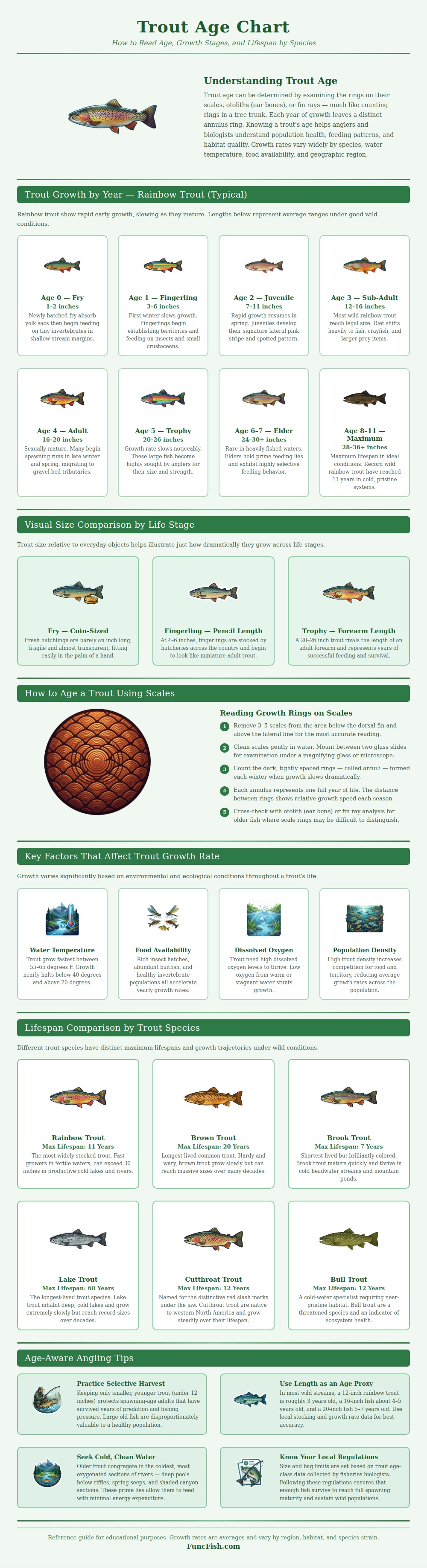
To biologists, a trout carries its past on its (body) sleeve, but you have to look closely to see it. Otoliths, the small ear bones located within the trout’s head; form annual rings, much like trees. Biologists counts those rings to work out a trout’s age; they also use scales. Both methods can reveals when fish were born and at what stage they’re currently living through. The life stages is depicted below in this breakdown of trout’s physical cues.
They begin as delicate fry, dependent on yolk sacks until hatched, and then spend their fingerling years staking out territory. At roughly age three, most fish is approaching maximum length allowed by law and make the leap from insectivore to predator, targeting smaller fish, crayfish and other bigger bits of food. This change in diet also signals a fast-growth spurt and some big body changes, including formation of that classic side stripe.
Different trout species does not grow at the same rate. Rainbow trout are known for growing rapidly during their youth, whereas other species develops at a much slower pace. Other species, such as brown trout, don’t grow as fast but live longer. They can lives decades longer then rainbow trout and even reach twenty years of age in the wild. The most extreme example of long-lived trout would of be lake trout which reach upwards of 60 years of age in colder deep lakes. Brook trout, on the other hand, reach sexual maturity fairly quickly and also enjoy a relatively short life span; preferring the harsh environment of high altitude headwater streams where survival competition is reduced. The difference in life spans shows how each species have changed over time to fit a particular role in an ecosystem.
Various environmental conditions determines if a trout reaches its genetic potential or is stunted. Metabolic rate is largely dictated by water temperature. A water temperature of 55 to 65 degrees Fahrenheit is optimal for trout growth. Outside that range, growth slows significantly; it essentially stops during extreme heat or cold. The amount of food available also greatly influence a trout’s growth. A stream rich in insect hatches allows for extra calories, leading to a rapid increase in size. How much energy a trout can absorbs for growth after meeting basic survival needs is largely determined by dissolved oxygen levels. Competition for scarce resources in densely populated streams make individual size smaller than what may have been possible otherwise.
This information will help anglers make informed choices out on the water. The old big trout live in prime real estate; those areas with good oxygen (spring seeps and deep pools) holds the large trout. Those old trout are also selective as they have lived long enough to know what’s safe and what isn’t. By practicing selective harvest we will be able to keep some of the most valuable adult trout alive to contribute to the gene pool. Measuring a trout before keeping it tells you how old it is, which gives you insight into its value within the local food web.
Understanding trout age will make you a better angler because it’s no longer just about catching numbers. Instead, it adds another level to the experience, as you’ll start viewing every trout less as a trophy and more as a survivor. When you get your next bite, think about what the fish endured to reach that moment on your line. It doesn’t take much of an adjustment, but it completely shifts your mindset and how you appreciate both the fish and the water.