
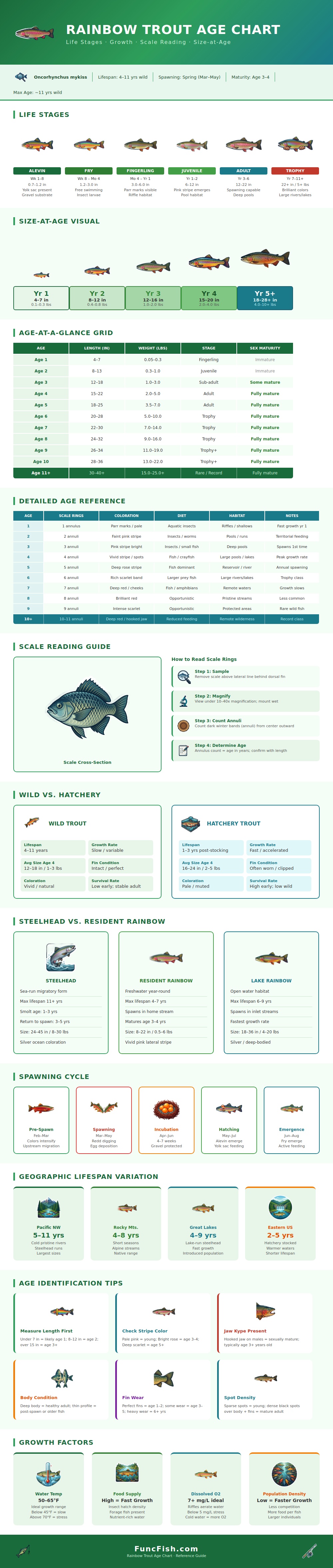
The water laps against your waders as you stand hip-deep in a chilly mountain stream. A bite turns into a hook set, and you’re on something hefty. The fish begins thrashing but not in the frenzied way of a fresh-fattened hatchery fingerling; this is an older fish, full of experience required to play the game. Moments later after a long struggle, the fish comes to hand, and you realize you’re holding a time capsule.
What’s most important isn’t the biological trivia of the rainbow trout age chart; it’s being able to read the tale the water tells. It’s understanding that each fish in your net has been through something, a journey worth pausing to consider before releasing, or perhaps trying to copy with your own casts. The graphic above does an excellent job breaking down the stages of their lives. But the true beauty is in knowing what they translate to when you’re out on the water.
Reading the Story of Rainbow Trout
It is about survival. A young trout’s early years are a blur. Right out of the egg, an alevin is all about surviving. Remember, alevins has yolk sacks still attached to their belly. It burrows into riffles and eats insect larvae from the water. It grows steady but slowly.
When it emerges as fry or fingerling, it has parr marks. Parr means vertical bands; those bands make it blend into the dappled sunlight of shallow water. Too small to show up on a scale, too well concealed in the rocks and weeds, these fish elude most anglers. In fact, most anglers don’t catch fish this young. You only catch the ones who’ve survived the first brutal year: the survivors.
The growth curve shifts dramaticly as they get older. Yearling fish is four to seven inches long. They are barely visible if you are not looking for them in the shallows. Then it’s go time. Year two and three put them into their best growth period. They begin feeding on larger insects. They pick up that distinctive pink side stripe we’ve grown fond of. That stripe gets even more pronounced as they reach sexual maturity around age three or four. This is where they first hold out on those deep runs and pools. And when they do, they become targets for lures and fly catchers alike. They are now more aggressive predators. They grow fast, as the chart shows. Weight gain picks up through their mid-years.
Age: Scale reading is what nails down age most times. It’s a bit like digging up the past for fishermen. The scientist cuts off the scale above the lateral line then magnifies it. Each dark ring is a winter where it grew slowly. How many rings? That tells you its age exactly. Looking at the color intensity and fin condition allows us to use the same reasoning but visually. The paler the color and the cleaner the fins, the more likely the fish is younger. Deep red colors and worn edges mean it’s been through several spawn cycles. Because old trout are beat up, they’ve earned their scars over the years fighting predator and current.
Age estimation is highly dependent on whether the fish is a hatchery or wild fish. Hatchery fish grow up fat off the handouts so they will be bigger, but rarely last beyond three or four years in the wild. Usually their colors are paler, and they may even have clipped fins. On the other hand, wild fish take longer to mature, but can get pretty darn old. In the clean waters of the Pacific Northwest, I’ve seen them get over ten years old. So if you catch a big rainbow with blazing colors and perfect fins, chances are good it’s not only a dandy, but also old, and probably wild. Those kinds of fish deserve respect; they show how hard it is to survive when everything else weeds you out.
Then there’s geography. Cold alpine streams with high levels of oxygen have trout that outlive those in warm tailwaters on the east side. Those fish burns more calories with faster metabolisms. Growth rate depends based off temperature. Maximum size depends on food availability. Catch a giant from a fertile lake and while it may be older, it could also be smaller but fatter than one of equal length caught from a comparable stream.
Knowing all this will enable you to set reasonable expectations. It isn’t just about size. It’s about fishing for the conditions where age groups does best. Next time you hook a rainbow, take a minute to look at its fins. Examine how strong that stripe is. Guess how old it might be by size and where it lives. Soon, your catches will not be individuals but part of larger patterns. And what was once just a day of fishing becomes a lesson in endurance and ecology. Somewhere out there, that little fish fry is hiding in the gravel and it’s fighting its way towards becoming the legend you’re after today.