
A big fish takes up your slack and the rod tip jumps heavily. You bring her up and she’s a double digit trophy fish. How old is this creature? You weigh it. And there is pride in how long it lives. It isn’t always about weight, instead it’s a chat with the clock.
You look at growth chart for how those channel, blue, and flatheads develops into giants starting as fry. Knowing their timeline alters each cast.
How Big Do Catfish Get?
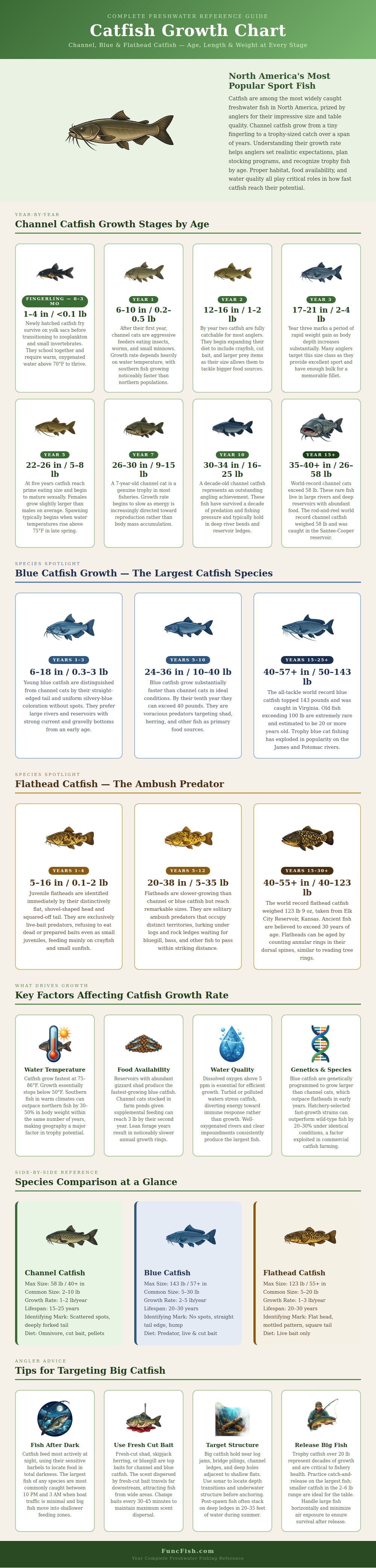
North America’s freshwaters is full of channel catfish. From fingerlings to giants, these are fish that get big fast. Most are two- to four-pounders by age three, and they are fine eating fish. This is also where the growth kicks into high gear. As infographic shows, middle-aged channel catfish is all about getting deeper. It’s a sweet time of life. This is a size when anglers commonly pursue them, since it’s a fun fish and one that can absorbs on light tackle.
Nature being what it is, a ten-year old channel cat will weigh more than twenty. They survive. They’ve eluded other fish, defied cold winters and deflected hooks. You’ll find ’em on inside turns of rivers.
Now compare that to the size of blue catfish. Blues are big rigs, those heavy-duty trucks compared to those sedans called channels. They don’t grow as fast initialy, but once they do start growing, they just keep on growing… far past stage where channels stop gaining weight. Because they eat things like shad and other baitfish, by the time a blue cat reaches age ten, he’s pushing more than forty pounds. And remember, it doesn’t level off; there’s an exponential growth rate here (check out the chart). World-record blues has reached weights of over 143 pounds.
That kind of mass requires decades of feeding and protection. Small ponds? Not likely. These fish require deep reservoirs or big river systems where there is plenty of food and good current. Catching them is going to be a patient exercise because you’re playing the long game against a fish that outgrows his competition.
In the world of catfish, flatheads are ambush predators. A square tail and wide head give them a distinctive appearance, but so does their growth rate. While reaching ultimate size is possible, flatheads begins slowly and remain slow different than other species. They will not touch dead offerings, including when young, and feed exclusively on live bait, according to the reference book. Such dietary choice reduces numbers; however, it puts fish pressure on available prey items. Thirty years old is ancient for a flathead who has probably witnessed three generation of fishermen come and go. It’s more like dragging up history than just a meal.
Genetics establish the ceiling, yet environment plays a key role in determining how closely you can come to it. Food is critical. It grows twice as fast in the south versus the north, typically due to season length. It’s not uncommon for a southern population to reach 50% of their potential size compared to a northern one. Similarly, food availability are important. If there’s a lot of gizzard shad on your reservoir, you’ll see more rapid growth in blues than you would a lean lake where finding a meal is difficult. Lastly, water quality and dissolved oxygen content is important things to think about when it comes to health and expansion.
Targeting these fish is a matter of timing. Catfish are most active for feeding after dark, as their sensitive barbels finds dinner in darkness. The biggest ones seem to move shallow between midnight and early morning when boat traffic ceases. Fresh cut bait leaves scent trails that extend great distances down stream and draw fish from large areas. Keep the signal hot by changing baits every half hour.
Truly big specimens merit consideration for release. Those trophies exceeding 20-pounds can be measured in decades of growth. If handled gentley, they lives to spawn again or simply grow bigger themselves. Honor the timeline and the river will reward you with more lasting memories then any meal could of provide.