
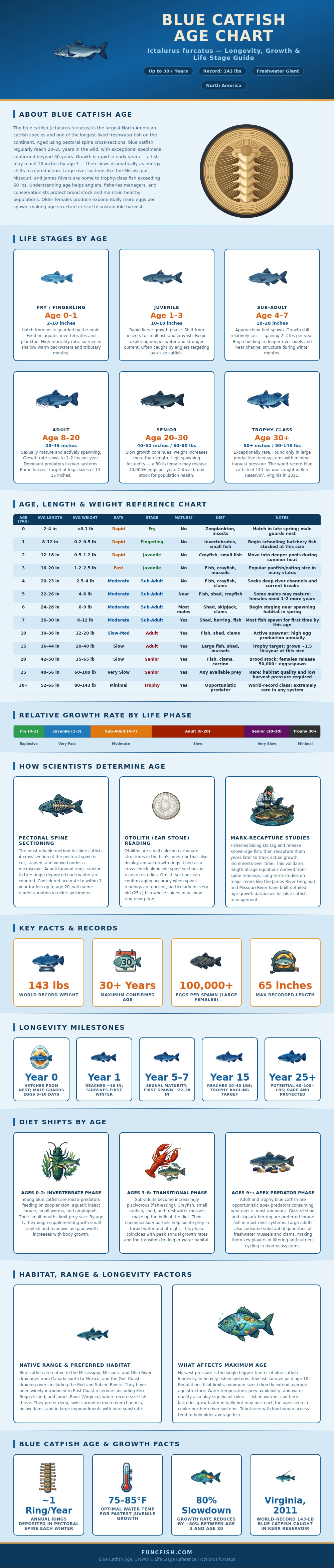
Length and weight is common measurements of success in most fishing. However, in blue catfish, size relates to age. They grows rapidly in their early years before slowing down, and they live long lives. Thirty plus years is not uncommon. Knowing that will help you become a more effectiv angler at targeting them.
It also will shift your perspective based off how much you need to respect those waters and what you should expect when catching them. The biological side of it makes it far less about luck and more dependent on catching one.
Why Blue Catfish Are Special
Life moves fast in the beginning. Blue catfish is tiny when they hatch and grow fast to escape predators. They’re more than a foot long by age one, and continue to gain mass as they consume crustaceans and insect life. That initial growth spurt are important. If they don’t reach a protectable size, their numbers diminish. Not many make it past this point.
By about three years old, the fish has reached what is called the juvenile stage. That’s when growth begins to slow a lot. Here’s where patience is key. No longer does the fish adds two feet each year. Now it begin inching along, adding just inches. Why? Big fish in the river have had plenty of time to put on weight. A blue catfish that is fifteen years old may be a mere twenty pounds heavier then its ten-year-old counterpart. But those pounds represents years of building up weight and years of surviving.
As you can see by the chart, the slowdown occur here. You aren’t searching for a sprinter anymore; instead, you’re looking for an endurance athlete.
Age is determined through analysis off their pectoral spines. Scientists slices thin sections of annual rings, similar to those in a tree, and analyze them. The results have proven these fish can survives into their 20s in well-protected environments. There are documented fish weighing over one hundred pounds and some exceeding 30 years of age. It’s not very common to see these big brutes. Before reaching that age class, they’ve been harvested under harvest pressure. Strict slot limits allows more of the population to consist of older fish. This creates trophy classes that appear mythical. Leave ’em alone and let ’em grow up big.
This is also related to diet changes. Young cats eat whatever floats their way. As adults they becomes opportunistic hunters that take bigger fish, including shad, mussels, and others. They has larger mouths capable of eating larger prey that would swallow a younger cat whole. This feeds into the fact that they live so long. And it keeps them positioned on structure where the current funnels and food concentrates.
If you like old fish, go deep. Want young fish? Hit the shallow edges. Age have as much to do with location as anything. A blue catfish hunt will open your eyes to a different reality. You can expect to catch a ten pounder within the next few minutes and yet there’s one lurking at 50 feet deep in a main channel pool that’s twice its age. This explains the fishing rules and also why certain rivers has big fish where other rivers don’t.
The more you realize about them, the more you’ll respect their life span. So the next time you hook into a big cat, think about it being many years of survival history wrapped in a slate-blue scale. It’s a deeper bond different than just a number on a scale.