
If you’ve ever grappled with a catfish as big as an anchor, it’s probably because you caught a blue cat. They’re bruisers. They weighs more, and seem to weigh more, then a bass or pike of the same size. A four foot blue cat is heavier than a four foot pike. It’s heavier than a four foot bass. That’s because blues is not built for speed, but muscle and power, thick, round beasts of a body for pure weight gain.
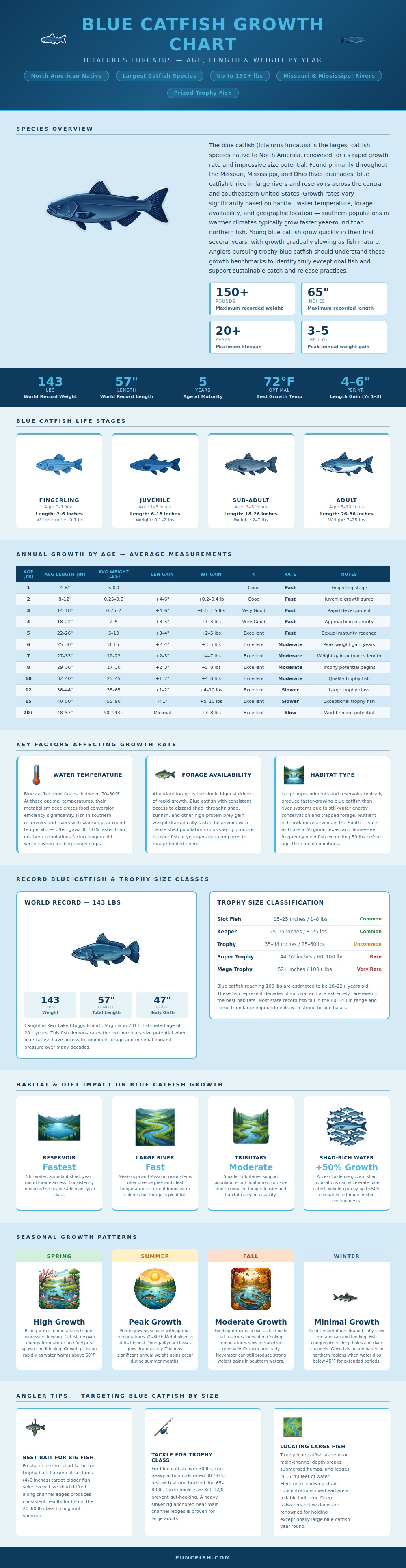
Their growth can be broken down into categories: What causes them to grow? How do they get so large? The growth chart break down these metrics year by year. In their initial years of life, blue catfish are nothing less than growth machines. From small fingerlings to respectable-keeper size, the fish quickly add several inches each year. In warming water, their metabolism kicks into high gear. Their hunger drive them to feed at a high rate, which causes them to fatten out rapidly. During those early years, nearly any suitable habitat will yield quick results as the fish convert food to body mass very effectively.
How Blue Catfish Grow
It doesn’t end there, however; it simply takes on a different feel. Sexual maturity occurs around the 5-year mark and at that time, the fish essentially stop increasing in length while continuing to gain weight. The fish ceases increasing in length and begins increasing in girth. These changes are subtle, but they is practical. This is illustrated nicely in the yearly growth chart above. A blue catfish may grow another inch or two total in length from one year to the next by year ten but still gain eight pounds. That’s what makes for a trophy fish. It doesn’t have to be any larger than the other fish. It simply has to be heavier, and it all stacks up as it gets older.
So, a thirty pound blue appears about the same overall length as a fifteen pound blue but feels like it weigh more on the end of your line. If you’re looking for big ones, prioritize age over size. As the graphic shows, growth shifts from rapid length to slower weight stacking. The key here is that this perfect curve depend heavily off the environment. The engine is the water temperature. The fuel is the forage. Southern rivers in general have warmer waters with temps hovering in the sweet spot of 70 degrees much longer, so catfish grows faster. There’s less hole time during the winter months and there’s more feeding time. Still water like reservoirs tend to outshine open rivers due to lower energy spending to maintain their position against the current. A lake fish can allocates nearly all of its metabolic energy toward growth rather than fighting the flow. That’s why some lakes get reputations for hundred pound fish and neighboring rivers can’t break fifty.
Knowing this changes how you go about fishing while on the water. Instead of seeking long fish, you seek thick ones. Your best bet at catching bigger and older fish is targeting primary ledges and channels with heavy shad groups. Big cut bait helps you weed through smaller, quicker growing younger fish who will chase down anything small. It requires less technique and more patience. You’re waiting for an old fish that has been alive for decades to screw up and do something wrong. To see what is possible in the water, refer to the chart above; now all you have to do is figure out where those conditions are present.
Understanding the growth timeline helps give perspective on catching a big one. It also helps you recognize that each hundred pound blue isn’t just a catch, but a survivor of a long and demanding existence.