
You catch flathead catfish on a moonless night, down deep, right near bottom of a deep river channel. In these spots, the current slow down just enough for ambush predator to hide and lay in wait. And instead of furious thrashes, your rod begin bending with a hard but slower pressure. The pressure is unlike the drag off a carp or bass.
But you have to know something, if you’re pursuing flatheads, you have to embrace the idea that this is one very patient creature. You’ve got time; time for nature and the angler. You need time to let things come together naturaly. That’s what fishing big fish like flatheads is all about.
The Life and Growth of Flathead Catfish
How long does it take? And what do you do once you realize that? How will it change the way you approach hooking them up when you feel that familiar bite?
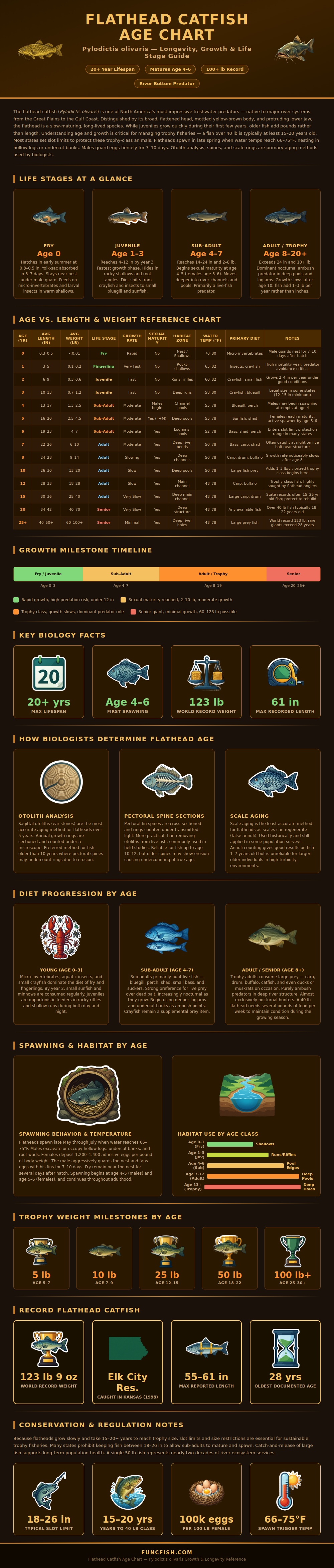
Flatheads don’t go through their formative years like most other species would expects. They don’t just get bigger every year. There are different stages that each flathead go through during its growth. Here’s a breakdown (see infographic above) of those different stage. You’ll notice how quickly fry and young-of-the-year flatheads develops versus how slowly adults progress.
The first couple of summers is spent hidden among rockier shallow areas with an insect-heavy diet as well as some small crustacean. A three-year-old flathead may be no more than ten inches in length. That doesn’t seem so impressive until you consider they’ve lived through their most vulnerable time frame. This is a key stage, the make-or-break moment where a flathead either becomes a pool-dwelling adult or dies trying.
Once they overcome this hurdle, their food source switch from tiny invertebrates to forage fish. And this is when things begin to explode for them. Fish mature sexually at 4-6 years of age. It depend on water quality and food supply. At that point, the fish relocate to logjams and deeper channel pools. They’re looking for cover protection and preparing to spawn.
Here’s where you really see it in the chart, and they start gaining pounds more than inches. Some may be a ten pounder at seven years old, but then by the time they are fifteen years old, they slows way down. Their weight gain is still there, but not much of a difference in overall length. They push well over forty pounds by now.
A lot of people gives up on them since a ten pounder and a twenty pounder look so similar. It’s all in the weight, but not a ton of length. They thicken out and round out into a barrel shape, which adds weight. Those are some heavy fish to pull when you land one.
True trophies take time, time that most fisheries in this day and age cannot offer. A flathead will weigh about 40 pounds at around twenty years old. Hitting fifty pounds often pushes that age closer to two decade. And a flathead pushing a hundred and twenty plus is one that’s been eating nonstop for almost three decades. This doesn’t happen much in fresh water systems these days, which is why conservation is important.
To see big flatheads, slot limits is in place to save the sub-adults during those critical formative years. Catching a twenty pounder and releasing her isn’t an ethical decision, it’s protecting the breeding stock. Catch everything between ten and twenty pounds and you’re killing off your next generation of giants.
Their age can tell quite a tale. Biologically speaking, age is determined by looking at otoliths, or ear stones. These has annual growth rings on them, showing that they live longer then nearly all other species in their habitat. They witness floods, droughts, and any change occurring within river systems. And they adjusts their foraging to accommodate available prey. One year a forty pound flathead could be feeding upon drum; another, carp. It shows an opportunistic kind of intelligence that defies their simplistic look.
If you’re lucky enough to land one of these old veterans, you’re tugging into something that has experienced decades of river life. At the end of the day, catching flathead catfish is about respecting time. Whether it’s waiting on the fish to bite or waiting on the fish to get bigger, there’s no hurrying the process.
Long after dark, the cool water from those deep holes flows on, providing a sanctuary where size builds slow and steady. Keeping that sanctuary intact gives the following generation of anglers an equal opportunity to experience that heavy, deliberate tug on the other end of the line. It is a silent vow made between man and river. We could of kept it only if we release the big ones.