
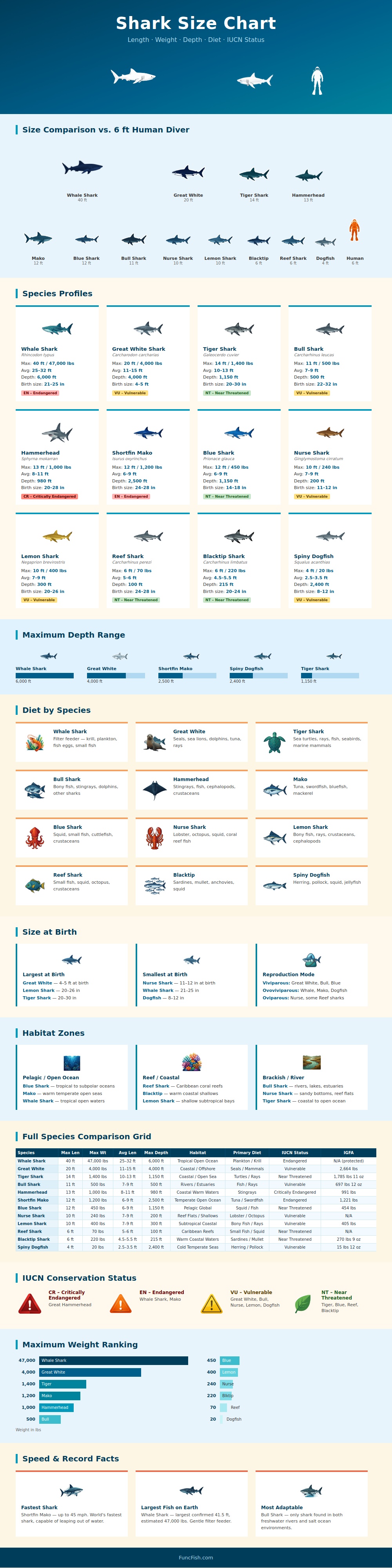
What comes to mind when you think of a shark? Teeth. And Jaws. That’s probably what most of us are stuck on.
But size does matter. See it up close and realize how big these animals get, and more importantly how small some of them stay. The fear factor turns to curiosity. Learn about evolution and biology. Realize that a forty-foot long animal could be harmless while one half its size is cause for worry. Physical differences is clear from this chart (above). Take the gloss off Hollywood and see what actualy exists under the water.
Why Size Matters for Sharks
A whale shark is the world’s biggest fish. It’s longer than a city bus. It feeds on plankton. It is a 40-foot-long creature living on microscopic drifters. Why spend calories chasing tuna when plankton is everywhere? That is efficiency in motion.
Meanwhile the great white tops out at roughly twenty feet long. It is still big, but this time notice how much heavier the great white is for its size compared to thin-bodied blue shark. Great whites develops muscle mass for powerful attacks while blues develop wire-thin bodies for swimming for miles and miles without end. Shape follows function. And understanding this can help you appreciate each as an animal it truly is.
Don’t put one predator’s reputation on another. And depth matters. Not only will they dive down low, but where do they want to hang out? While the shortfin mako dives deep, it also comes up quickly. It’s the greyhound of the sea. Other sharks can’t keep up with its speed.
The nurse shark lays around all day on the bottom of the ocean, sifting the sand for crustaceans. They aren’t looking to kill you. They are looking for lunch and don’t want to waste their energy doing so. Their lifestyle could not be more different than others. But we tend to lump them all together because they have tails and gills.
And then there’s conservation status to add some heft to the numbers. Most of the animals on this list is vulnerable or endangered. It doesn’t say “endangered” because it sounds cool. It says it because the population are declining too fast for them to reproduce enough to keep up. Habitats are being destroyed. Commercial nets causes bycatch. People fin sharks for shark fin soup. The great hammerhead has been classified as critically endangered, which is no joke.
Think about how long those fish have existed, millions of years! Now they’re battling humanity.
Size at birth does matter. People don’t realize it’s important. The great white gets born big, like four or five feet long. It’s already close to the size of a full-grown adult. And it can go hunting right away. Compare that to the spiny dogfish, which comes out tiny and gradually gets bigger over decades. That makes slow growers susceptible.
They are smaller for longer, especially in their juvenile phase, when they is even more vulnerable. And also because they have less value as a commercial fishery, since fishermen goes after bigger ones. So if you ask me how do you know when a population is in trouble? Look at its birth statistics. That tells you the balance between their reproductive strategy and their survival risk.
How reproductive. Now Diet: Each shark has a specific ecological role. The tiger shark will eat anything from old tires to sea turtles. No care for menu consistency, it has an iron stomach. While the reef shark subsists on smaller fish around coral structures. Multiple species can exist because of their different diets. They don’t all have to fight for same food source. That’s balance.
Take out the top predators or overharvest the mid-level species, and that balance fall apart.
Next time you think about sharks, think scale. Don’t think only about their teeth. Think about whether they are ambush hunters waiting at the mouth of a river. Think about them being filter feeders cruising around in sunlit waters. Look at the size chart for baseline information. Use the surrounding information to make sense of it. Stop fearing one stereotype and respect the diversity of these animals. Not all are safe. Not all are monsters. All are just trying to livig out there. And the ocean changes faster then they can adapt.
Stay focused on that perspective and the water doesn’t seem so scary.