
Chances are you’ve witnessed it, you know, those breaches. The bluish flash against the surface of the water is not some random jumping fish. It’s typicaly either a hunt strike or some dramatic displacement of air pockets as they swim at high speed.
Anglers encounter blue shark very often, and it is actualy the most widely distributed open-ocean shark on earth, yet people are still completely wrong about its size. They thinks they are going to catch some kind of monster and end up catching a slender athlete. Knowing how big this guy really is will help you understand what you’re up against once your line starts screaming from your reel.
The Size and Shape of Blue Sharks
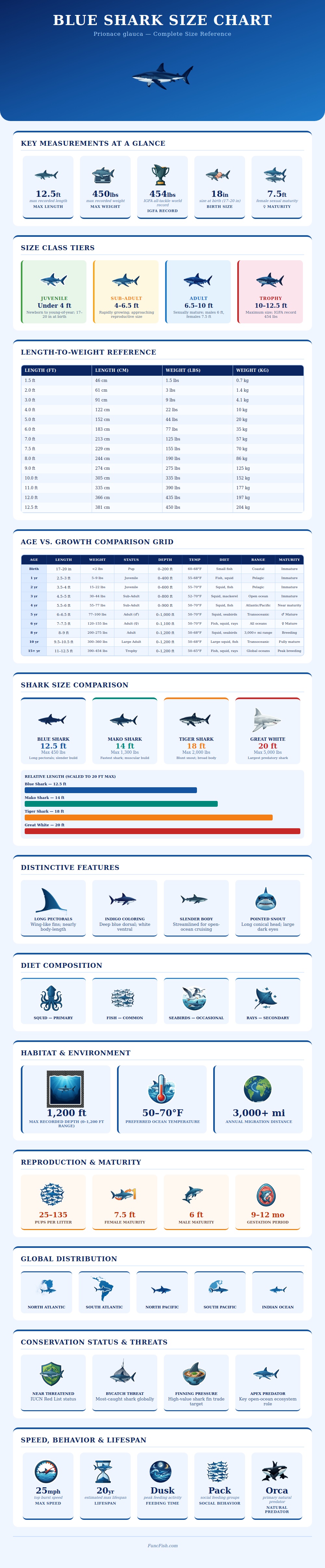
So I broke down its dimensions on the chart above, but measurements don’t tell story of their anatomy. They’re no brutes like a tiger shark; they’re an engineer’s dream of streamlining for speed and distance. Those super-long pectoral fins and that torpedo body shape helps them cross oceans day after day after day. Look at the weight to length ratios. A ten foot long blue shark is far lighter then a ten foot long mako. There’s far less dense muscle mass there, it is all about efficiency out in the open ocean.
That also clues you in as to where animal is along the growth/age range. While the chart has clear categories of juveniles (pups) through to trophy size adults, the true tale lies in how quickly these animals reaches sexual maturity. Males become sexually mature at only six feet, which is relatively quick for an apex predator that can reach well over 13 feet. It’s slower for females, who reach larger sizes before entry into breeding pool.
That is what accounts for your experience with many sub-adult animal near coastal feeding areas. They’re not yet fully grown into their adult range but are already adept hunters capable of survival in competitive waters. We know most folks thinks of these sharks inhabiting warm tropical waters. But the information about their preferred temperature is quite different than what you might think.
They love water temps from 50-70 degrees Fahrenheit and dive deeply to follow squid schools to depths exceeding one thousand feet. They are always moving up and down, using this behavior to stay active during the day and rest in shallow water at night. When their depth behaviors is figured out it makes fishing for them difficult because in addition to matching lure action with their speed, you have to also match your altitude.
Blue sharks are relatively small, even by large ocean predator standards. While they max out at about twelve feet in length, a great white can grows to as many as twenty feet and weigh upwards of five thousand pounds. Even mako packs more poundage into a similar frame. It’s a question of lifestyle. Unlike the mako, which packs more poundage into a similar frame, or the great white, which can dwarf a blue shark in mass, blue sharks is cruisers.
Each year they swim thousands of miles through all of the world’s major ocean basins. To fuel such mileage, their flexible form enable them to keep pace at one speed for extended durations while expending very little energy. One additional piece of the puzzle comes in the form of conservation status. They are listed as Near Threatened due to great pressure from commercial fisheries, including the finning trade and bycatch.
Because they get caught so often, we have very good information regarding their population numbers and how vulnerable this species is becoming. When a species is globally threatened every fish count. Catching and releasing allows those individuals to be preserved not only for future generations to enjoy sport fishing but also for further studies.
It’s one thing to hear about a fish being 500+ lbs., but it’s another thing entirely to see just how big it was when you step onto the boat deck. Once I knew this beast could of been less than 500 lbs., I realized I had to adjust my mindset to not only having brute force, but also endurance against a highly trained competitor. And the blue shark is no slouch; it can moves rapidly across huge areas of water column spanning multiple continents, covering ground efficienty with technical precision.
Size provides context for conservation needs, biology, and behavior, all wrapped up in one package. A number, reduced to a story of survival strategy perfected through millions of years of ocean travels. So now when that dorsal fin breaches the surface you can be certain just how much horsepower it’s going to take to take you down with it below the waves.