Buzzbait Surface Speed Calculator
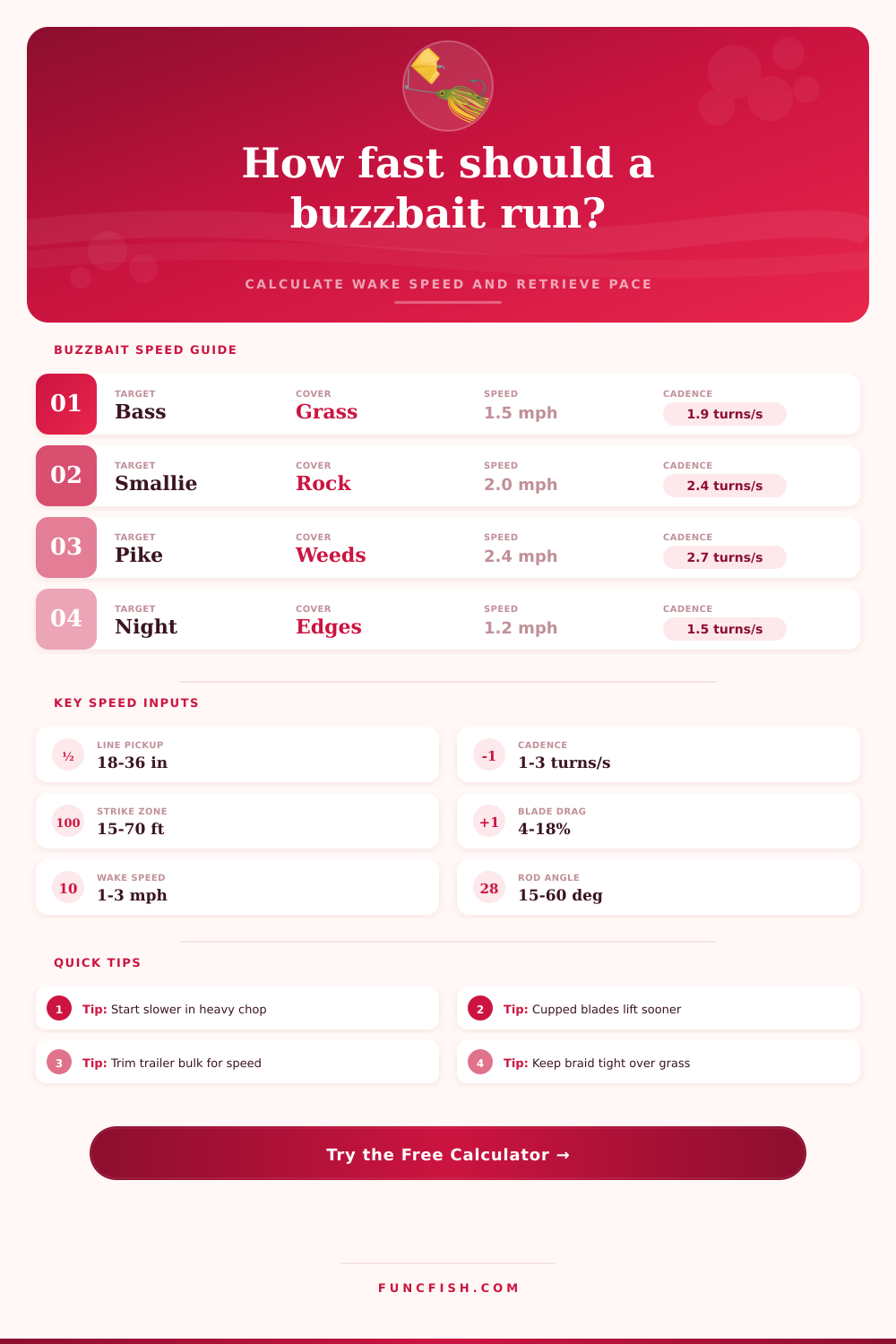
Estimate lure speed, reel cadence, wake lift, and strike-zone time for buzzbait retrieves across grass edges, laydowns, riprap, pads, and open flats.
📌Scenario presets
⚙Retrieve settings
Buzzbait speed forecast
Full breakdown
📋Blade and line reference grid
Standard single
Cupped slow rise
Double blade
Mini finesse
📊Buzzbait speed tables
| Retrieve target | Surface mph | Surface km/h | Typical cadence cue |
|---|---|---|---|
| Slow wake over pads | 1.0-1.3 | 1.6-2.1 | Just fast enough to squeak |
| Night shoreline crawl | 1.1-1.5 | 1.8-2.4 | Steady crawl, rod high |
| Grass edge search | 1.4-2.0 | 2.3-3.2 | Constant blade churn |
| Rock bank smallmouth | 1.8-2.5 | 2.9-4.0 | High, clean, and fast |
| Burn over hydrilla | 2.2-3.1 | 3.5-5.0 | Blade barely skipping |
| Pike weedline run | 2.0-2.8 | 3.2-4.5 | Fast enough to track straight |
| Line pickup | 1.5 turns/s | 2.0 turns/s | 2.5 turns/s |
|---|---|---|---|
| 22 in/turn | 1.88 mph | 2.50 mph | 3.13 mph |
| 26 in/turn | 2.22 mph | 2.95 mph | 3.69 mph |
| 30 in/turn | 2.56 mph | 3.41 mph | 4.26 mph |
| 34 in/turn | 2.90 mph | 3.86 mph | 4.83 mph |
| Scenario | Blade pick | Line match | Speed note |
|---|---|---|---|
| Grass edge bass | Standard single | 30-50 lb braid | 1.5-2.1 mph |
| Wood laydowns | Cupped blade | 15-20 lb mono | 1.2-1.8 mph |
| Rock smallmouth | Finesse mini | 12-17 lb copoly | 1.8-2.6 mph |
| Pad lanes | Toad trailer | 50-65 lb braid | 1.1-1.7 mph |
| Dirty water | Heavy thump | 17-25 lb mono | 1.3-1.9 mph |
| Pike weeds | Double blade | Braid plus wire | 2.0-2.8 mph |
💡Practical speed checks
Tip: Use line pickup per turn when you know it. Gear ratio alone misses spool fill, line diameter, and actual retrieve radius.
Tip: If the blade gurgles under the surface, raise the rod or add cadence before switching lure weight.
Sometimes bass fishing is all about glass calm water. It’s early morning after the sun come up and the surface tension is tight. Or it’s late into the night with only your headlamp slicing through the humid air.
It’s those times where speed becomes the main factor. Too fast and your buzzbait goes skipping underneath the surface, which kills both the sound and the wake. Too slow and it’s buried in the grass while being dragged along like a dead fish. That’s where you have to dial it in. The bait floats just atop the surface with the blade chugging, the skirt twitching, and the lure staying on top.
How to Find the Right Speed for Buzzbaits
Most folks miss that portion. They believe speed relates to how quickly they can turn the handle but that’s not the case. It’s about hydrodynamics, leverage and drag coming together to float the lure against it’s own weight. After you key in your desired fishing zone and reel specifications, the calculator figures the rest out for you. So instead of wondering if that higher gear ratio really pulls it faster or simply churns up more water, the calculator does all the work for you.
But here’s the caveat; line pickup per turn is more significant then gear ratio. A seven-to-one gear ratio sounds incredibly fast, but what happens when there are only a few feet of line left on the spool? That changes everything and alters the retrieve radius. Once you enter how many inches of line pickup occur for every handle rotation, the tool factors this in for you. And that’s where the half inch of difference makes a world of difference, moving your surface speed from an aggressive burn down to a slow crawl.
When you’re fishing thick areas such as heavy hydrilla, the added drag decreases your lift margin much sooner. This is especially true when using a bulky toad trailer. The drag and bulk from the cover and trailer also impact how you pull it in. The calculator accounts for that and tells you how much faster you have to reel to keep it at the same depth as a bare hook rig. It’s not like you’re cranking down any harder, but you’re accounting for the trailer and the bulkiness of your choice of cover.
What if you’re fishing a grass edge and working a traditional single-bladed buzzbait? Since there isn’t much demand for lift, the blade doesn’t have to do much work to keep the head high. So you use a slower retrieve at roughly one point five turns per second. It will allow the bait to stop long enough for a bass to strike from below.
Now change this same retrieve to a more subtle finesse mini-blade on a day when the water is clear. Since the smaller blade creates less lift, now you have to either position your rod higher or crank harder to maintain planing action. Ditch the speed down too far in clear water and the bait dives rather than skates across the surface. The blade style chart on the page illustrates the comparison.
You can see that a heavy thump blade in dirty water and a cupped blade for night fishing have different drag losses. The same cadence isn’t going to work for both and deliver equal results. How much energy does the blade transfer into forward motion? Or how much energy does it lose to the water? That’s the drag coefficient of the blade shape.
Pure numbers don’t tell the whole story. Add some wind chop to the mix. Because the wind textures the surface, you can’t tell the speed just by looking at the wake. Now it’s all feel and sound. Feel a steady pull and the bait rides up. A jerking sensation usually indicates the lure is bucking under tension or the weed guard is grabbing the weeds.
This tool also will help you know when the bait will be in the strike zone. This would of been the most important output for tournament fishermen. If you calculate five seconds of time in the target lane, then you’re burning through far too small an area to force instinctive strikes. The bigger the window, the slower you go. This means a greater number of fish gets a shot at committing. Too slow, however, and now you completely lose the surface tension. It’s a balance between stability and visibility.
Knowing how fast to crank a buzzbait isn’t so much about remembering knots per hour, as it’s about the feel of what is happening at the end of your line. The calculator gives us a physical base of understanding, and a starting point from which we can respect the limitations of our equipment. Then when you’re out there on the water, you dial in according to the conditions; the light, the warmth, and the mood of whatever creature lies beneath. You take the math, and go put your feet in the water.
Start with the calculated rhythm, and then make an adjustment if the bait starts to sink or skip. That’s where the art comes into play. The art is in the adjustment. Math gets you to the bank. Intuition keeps you there. A perfect chug is not a number on a screen.