Swimbait Glide Distance Calculator
Estimate how far a glide bait travels side-to-side per sweep, how much water a cast covers, and whether your cadence matches the lure, line, depth, and conditions.
📌Scenario presets
🎣Glide inputs
Estimated glide performance
Calculation breakdown
📊Line and lure data used by the calculator
15 lb Fluoro
20 lb Fluoro
17 lb Mono
Braid + Leader
📏Swimbait glide reference table
| Lure class | Typical length | Common weight | Useful line | Expected glide |
|---|---|---|---|---|
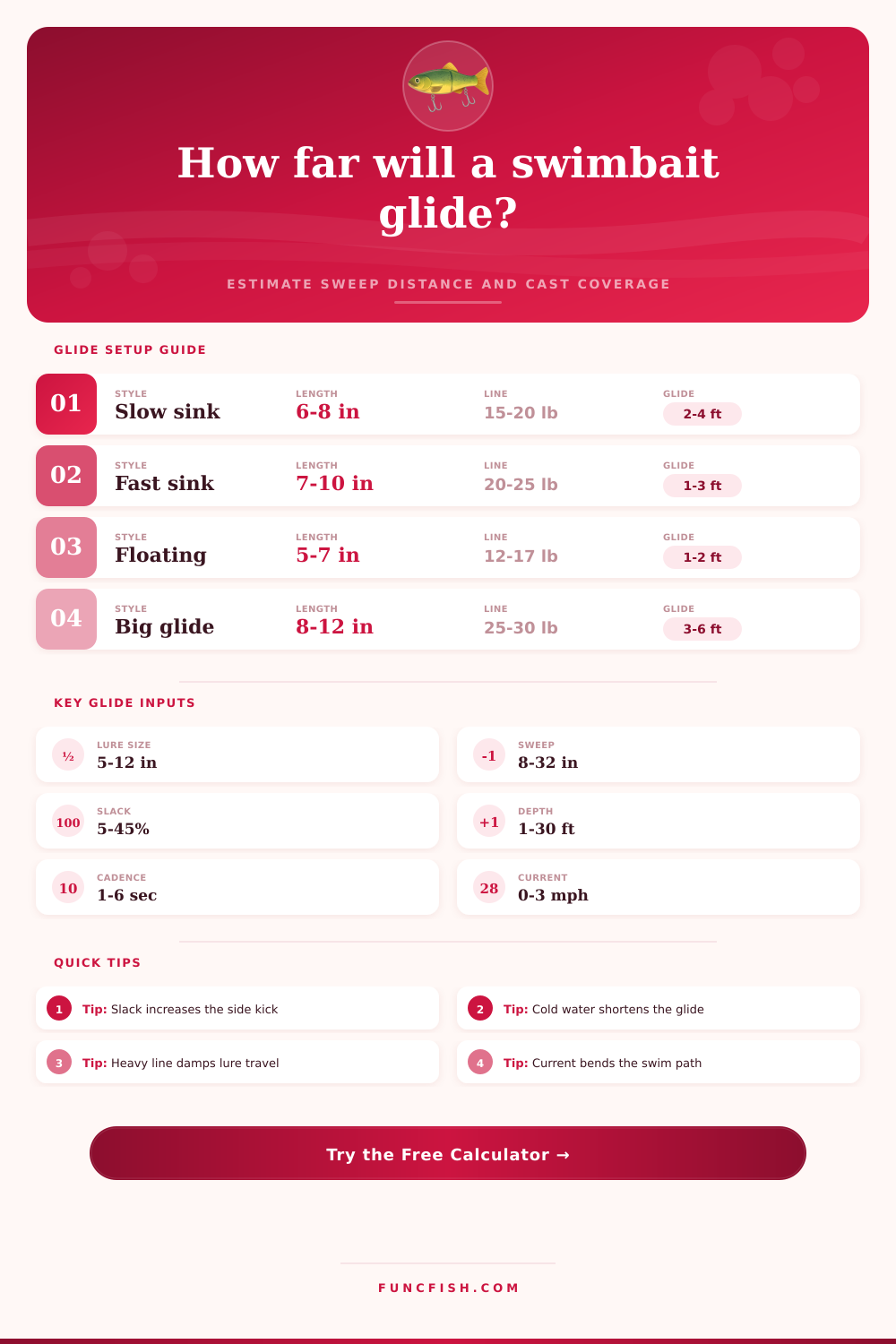
| Compact finesse glide | 4.5-6 in / 11-15 cm | 0.8-1.5 oz / 23-43 g | 12-17 lb mono or fluoro | 1.0-2.2 ft per sweep |
| Standard bass glide | 6-8 in / 15-20 cm | 1.5-3.5 oz / 43-99 g | 15-25 lb fluorocarbon | 2.0-4.0 ft per sweep |
| Oversize trophy glide | 8-12 in / 20-30 cm | 3.5-8 oz / 99-227 g | 20-30 lb fluoro or braid leader | 3.0-6.5 ft per sweep |
| Floating wake glide | 5-9 in / 13-23 cm | 1.0-4.0 oz / 28-113 g | 15-25 lb mono or copolymer | 0.8-2.5 ft per sweep |
| Fast-sink deep glide | 7-10 in / 18-25 cm | 2.5-6.0 oz / 71-170 g | 20-30 lb fluorocarbon | 1.5-3.5 ft per sweep |
🐟Species and scenario matching
| Target | Common water | Glide window | Cadence range | Setup note |
|---|---|---|---|---|
| Largemouth bass | Grass edges, docks, points | 2-5 ft per sweep | 1.5-3.0 sec | Use enough slack to var the bait kick past cover. |
| Smallmouth bass | Clear flats, rivers, rock | 1.5-4 ft per sweep | 1.0-2.5 sec | Current reduces usable width but adds downstream drift. |
| Striped bass | Open bait schools | 2.5-6 ft per sweep | 0.8-2.0 sec | Long casts favor low-stretch line and heavier rods. |
| Pike or muskie | Weed lines and breaks | 2-5 ft per sweep | 1.3-3.5 sec | Wire leaders slightly dampen wide glide travel. |
| Spotted bass | Deep clear reservoirs | 1.5-3.5 ft per sweep | 2.0-5.0 sec | Cold water and depth favor shorter, cleaner pulls. |
⚙Equipment comparison
| Equipment choice | Glide effect | When it helps | Calculator factor |
|---|---|---|---|
| Moderate-fast swimbait rod | Stores load and smooths the start of the sweep | Standard 6-8 in glides and steady cadence | 1.00 action transfer |
| Extra-heavy fast rod | Moves heavy baits quickly but can tighten the kick | Oversize baits, wind, long line, hook control | 0.96 action transfer |
| Monofilament main line | Adds stretch and lift; often shortens sharp side cuts | Wake glides, shallow water, surface followers | 0.82 transfer, high buoyancy |
| Fluorocarbon main line | Keeps the bait down and transmits a clean pull | Clear water, standard sinkers, deep points | 0.86-0.89 transfer |
| Braid to leader | Transfers input fast but can overwork a narrow bait | Long casts, current, offshore bait schools | 0.94 transfer, low stretch |
| Wire or titanium leader | Adds nose weight and reduces some free glide | Pike, muskie, toothy fish protection | 0.80 transfer, added drag |
💡Calculation notes
Slack factor: A glide bait usually needs some loose line before the rod sweep. Too little slack makes the bait track forward; too much can mute the next input.
Depth factor: Deeper retrieves add line angle and water pressure. The calculator trims glide width as depth and current increase, then adds drift to estimate the full path window.
A glide bait’s retrieve can get pretty tricky. There are moments during the retrieve where you lose sight of the lure but still feel the connection through your rod tip, this creates some blind spots in your game plan that the tool (above) will do the math for. It’s not always feet; sometimes it’s just inches. You’ll feel the bite and it’s either a blank stretch or a hook set. Your guess is as good as mine. We rely heavily on muscle memory or fuzzy memories of what that distance might feel like. That can cause us to move the lure too quickly for a lethargic fish or leave some water uncovered.
Knowing the exact amount of side to side movement for every sweep of the wrist are important. These are the mechanics of gliding. To understand how to make baits glide, let’s cover the physics behind it all: Line tension and slack.
The Secrets of Using Glide Baits
When a glide bait get to the end of an arc, yes it will kick out, but it doesn’t do that in a straight line. It want time to get down and “breathe” first. If you have your line tight up by the rod tip as you start sweeping it, then you are transferring all that energy forward and not to the side. So it cuts straight versus kicking out wide. You want some slack so it can find its neutral buoyancy point and then give the force from there. But if you have too much slack, it’s difficult to manage the pause (which is where most of the bites occurs). Your rod action and line selection help you find that sweet spot.
Line Type Depending on what you use to tie it on, the glide looks entirely different. With fluorocarbon, you have little to no stretch and very efficient energy transfer, so it kicks out clearly and crisply (even down deep). With monofilament, there’s some stretch and float. This dampens the input and gives it a wavy, softer action. It can be deadly around heavy cover or in shallow water when you need finesse. And braid has zero stretch and maximum sensitivity, so it transmits each rod tip twitch directly into the lure without delay. This helps you make super-precise retrieves, but it can also feel jerky if you don’t pay close attention to your timing.
The tool takes all those materials into account and will base its idea of the ideal glide width based off how well your setup works. The retrieval is also greatly influenced by the action of the rod. If you have a moderate-fast rod, it will store energy on the sweep and release it smoothly. That allows for longer glides while still extending the distance from the sweep. An extra-heavy fast rod move quickly with heavy baits, but if you do not use a wider casting arc, it can reduce side-to-side movement and even tighten up the kick. Matching your rod to the weight of the swimbait is very important. You don’t want the rod too stiff because then it will stop suddenly, either spooking the fish or having it not tracking correctly. You want the rod to flex just enough to cushion the start of the pull.
No two casts are alike. External variables such as current and water temperature impact every cast differently. The colder the water, the thicker the environment becomes which essentially adds drag to the lure’s progression through the water column. When targeting deeper water in the winter time versus say a warmer spring day, expect less of a glide. The current will change the direction of the lure, pulling it downstream while you try to move it sideways along a point. Understanding how these factors affect your cadence make it easier to make adjustments.
Pausing longer and retrieving at a slightly slower pace lets the bait return to its natural buoyancy so it can float freely again. To me this is a better imitation of an injured prey item than a hurried frantic presentation. You can use the reference table on the page to get an idea of what to expect for different lure classes. But the beauty is in adjusting those inputs to match your specific conditions. Do you need to make wide sweeping casts when fishing a grass edge so as not to get hung up? Do you want to target a particular dock piling that demands a tight and controlled move? You can plan that with the calculator before casting.
It will tell you roughly how many times you’ll be able to sweep the bait in seventy-five feet of space. That will help you pace yourself during your retrieve and cover the full area without rushing it. Controlling the arc instead of the throw is the key to mastering the glide bait. As the weight of the bait pulls down the line, you can adjust your movements to keep that same arc. Once you learn exactly what each sweep of your rod does with the bait, then you can put it right in front of the fish’s face wherever they’re positioned. It becomes presentation rather than guesswork.
It goes from I’m going to try this spot or that spot until I get bit, to I’m placing the bait on their head every time. That’s when you take the doubt out of the equation and let the math do its job while you focus on the art of placing and timing. And that’s how you make an otherwise good cast into a great one.