Tapered Leader Knot Count Calculator
Estimate knot count, section count, cut lengths, knot take-up, diameter step changes, and retained strength for hand-tied tapered fly leaders.
📌Tapered leader presets
⚙Leader build settings
Common fly leader butts run about 0.017-0.026 in for trout and 0.024-0.035 in for saltwater.
Smaller drops add knots but improve taper smoothness and knot seating.
Use this for a fresh tippet section, dropper tag, second fly branch, or bite tippet.
Tapered leader knot forecast
Calculation breakdown
📊Leader formula comparison grid
60-20-20 Trout
Dry-Fly Long
Streamer Bass
Euro Mono
📏Common hand-tied leader recipes
| Recipe | Finished Length | Butt Diameter | Tippet | Likely Sections | Likely Knots |
|---|---|---|---|---|---|
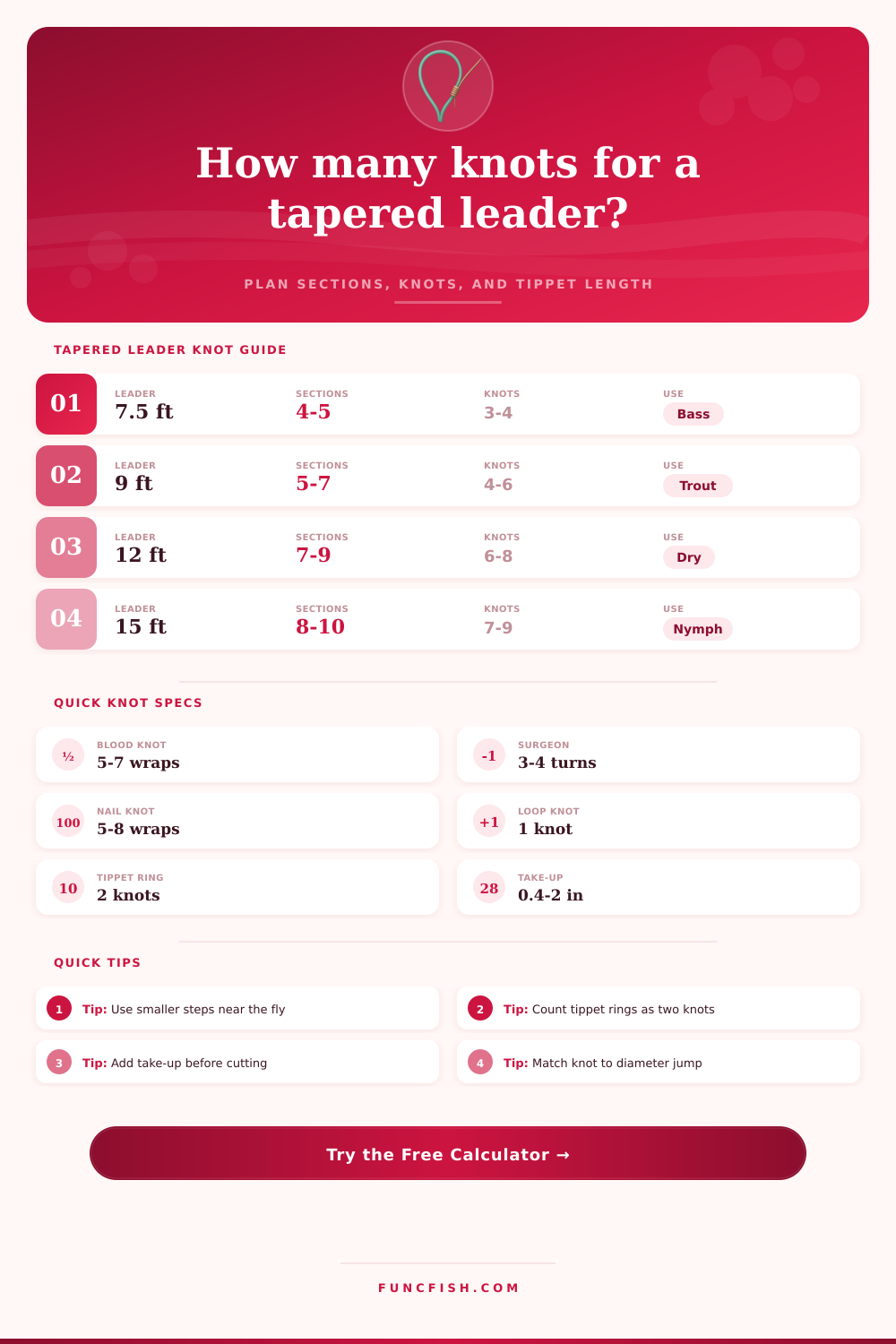
| Classic trout 60-20-20 | 9 ft / 2.74 m | 0.020 in / 0.51 mm | 4X-6X | 5-7 | 4-6 |
| Long spring creek dry | 12 ft / 3.66 m | 0.019 in / 0.48 mm | 5X-7X | 7-9 | 6-8 |
| Bass bug leader | 7.5 ft / 2.29 m | 0.024 in / 0.61 mm | 0X-2X | 4-5 | 3-4 |
| Steelhead wet fly | 10 ft / 3.05 m | 0.026 in / 0.66 mm | 0X-2X | 5-6 | 4-5 |
| Euro nymph mono rig | 15 ft / 4.57 m | 0.017 in / 0.43 mm | 4X-6X | 8-10 | 7-9 |
| Flats class tippet | 9 ft / 2.74 m | 0.030 in / 0.76 mm | 16-20 lb | 5-7 | 5-7 |
🧵Knot and material reference
| Knot | Best Diameter Match | Typical Efficiency | Take-Up Range | Common Use |
|---|---|---|---|---|
| Blood knot | Close steps, within 35% | 82-88% | 0.4-0.8 in | Clean tapered sections |
| Double blood knot | Fine tippets and slick mono | 84-90% | 0.5-0.9 in | Trout dry leaders |
| Triple surgeon | Unequal diameters | 78-86% | 0.6-1.1 in | Fast tippet changes |
| Seaguar knot | Fluoro-to-mono | 82-90% | 0.7-1.2 in | Fluorocarbon joins |
| Slim beauty | Shock to class tippet | 80-88% | 1.0-1.8 in | Saltwater leaders |
| Albright knot | Large jump to bite tippet | 75-84% | 1.2-2.0 in | Bite or shock sections |
🐟Species and fly-style comparison
| Use Case | Leader Length | Tippet Target | Step Smoothness | Recommended Knot Plan |
|---|---|---|---|---|
| Small dry-fly trout | 9-12 ft / 2.7-3.7 m | 5X-7X | Fine | Blood knots, extra mid step |
| Indicator trout | 9-10.5 ft / 2.7-3.2 m | 3X-5X | Normal | Blood knots plus tippet ring |
| Bass popper | 6-8 ft / 1.8-2.4 m | 0X-2X | Coarse | Surgeon knots, fewer sections |
| Steelhead swing | 9-12 ft / 2.7-3.7 m | 0X-2X | Normal | Blood knots with strong loop |
| Euro nymph | 12-18 ft / 3.7-5.5 m | 4X-6X | Fine | Micro ring, sighter knots |
| Saltwater flats | 8-10 ft / 2.4-3.0 m | 12-30 lb | Normal | Slim beauty or Albright shock join |
📝X-size and diameter reference
| Tippet Size | Diameter | Metric Diameter | Typical Strength | Fly Range |
|---|---|---|---|---|
| 7X | 0.004 in | 0.10 mm | 2.4 lb / 1.1 kg | 20-28 |
| 6X | 0.005 in | 0.13 mm | 3.5 lb / 1.6 kg | 18-26 |
| 5X | 0.006 in | 0.15 mm | 4.75 lb / 2.2 kg | 14-22 |
| 4X | 0.007 in | 0.18 mm | 6 lb / 2.7 kg | 12-18 |
| 3X | 0.008 in | 0.20 mm | 8.5 lb / 3.9 kg | 8-14 |
| 2X | 0.009 in | 0.23 mm | 11.5 lb / 5.2 kg | 4-10 |
| 0X | 0.011 in | 0.28 mm | 15.5 lb / 7.0 kg | 1/0-6 |
Section tip: If one diameter jump is over about 35%, add a short transition section instead of forcing a bulky knot. The calculator adds sections when the selected step plan requires a smoother taper.
Knot count tip: A tippet ring usually reduces future rebuilding, but the first build still has two knots at the ring. Count dropper tags and bite tippet joins as added knots.
If you’re a fly fisherman who ties your own leaders, then I know what it’s like to get frustrated by losing a fish and seeing half of your tippet unravel as the knot unravel in the water. The issue isn’t so much with the knot as it is thinking that less mean better in regards to a leader. We want simple, and simple is sometimes detrimental to our presentation.
A good leader has to has just enough sections to absorb energy smoothly, but too many knots will create bulks in the leader where they can be easily weakened or scare away trout. Then suddenly when a fish jumps all over the place these bulk points give way. You’re attempting to find the balance between stealth and strength which is difficult to calculate if you consider diameter change and take-up of the knot.
The Science Behind Tying Good Leaders
Now you can concentrate on creating your casting loop without worrying about the complicated math involved with tapering. It will predict number of sections to create given an end tippet size and your preferred butt diameter, taking into consideration how much physical space each knot takes up. You don’t want to forget that every time you add a surgeon’s bend or a blood knot you lose material. If you do, then your final leader won’t be as long than you planned and this messes up your cast. It tells you exactly how much line you need before you make a single cut, so you know you’ll end up with the right size once you tie everything together. That way there is no embarrassing “oops” moment when you’re done with the first section and realize you’re two inches too short of being able to achieve a full nine-foot taper.
“Knowing what the inputs are and why they’re important will shift your thinking about building.”
What’s the big deal with the diameter drop percent? Bulges in the line where one section is much bigger than another form a stiff spot where leader can’t transition smoothly through the air. Does a smooth taper transmit the energy from your heavy line to your thin tippet? Skipping sections to save some time creates an abrupt change mid-leader that introduces a sudden shock point. That shock stops the loop, that shock halts the loop. This results in tailing loops and collapsed casts. The calculator lets you see visually what a smaller diameter step does for smoothness (even though it means more knots). And it makes you consider the tradeoff: Build faster or make better casts?
There is also a hidden variable called strength retention that catches a lot of folks by surprise. Regardless of how well you tie a knot, it doesn’t retain one-hundred-percent of the breaking strength of the line. And here’s where fluorocarbon differs from nylon; it loses more strength as a result of being knotted. It will also lose more integrity due to greater diameter differences. Selecting a super-fine tippet such as 7X or 6X in your dry fly application means there isn’t much room for error. Your tool figures its estimate of your weakest link according to the knot efficiency of your line join.
If you’re fishing around hard-pulling species or in heavy cover, you may sacrifice some strength in order to have fewer sections (resulting in less bulk). But if you’re making delicate presentations, those additional mid-sections maintains the leader’s natural whip and help the fly land without a disruptive slap. Consider the behavior of the fish you are targeting. For bass fishing, power overcomes finesse a lot so heavier tippet and fewer sectioned leaders is often preferred (with shorter leaders). On the other hand, when trout fishing in clear water, you need many small steps on very long leaders to reduce visibility. These are just a few general situations where some common leader recipes can be found in the tables included with the tool, though don’t take them as rules.
The conditions change day by day and nothing in any manual will predict it better than the water clarity. What’s perfect in muddy spring runoff may spook all the fish in that crystal clear summer water. So in conclusion, there really isn’t any secret to tying a good leader as much as there is a science behind understanding how energy moves through your line. The calculator takes out all the guess work when it comes to length and count. It’s going to tell you exactly how long your leader needs to be and how many knots to expect.
Once that is covered, you can adjust for the situation. Shorten up the tippet if it’s windy or add another transition piece if they need a little more time to turn over. You’ll have a clue as to why it’s working the way it is. But the end result is always the same. A soft landing fly that stays hidden until it’s just far enough into the water to get a bite.
Every knot tied makes that sweet presentation possible and it’s worth it. You should of seen how much better it works with proper taper.