🏹 Bowfishing Draw Weight Calculator
Find the ideal bow draw weight for your target species, water depth & shooting style
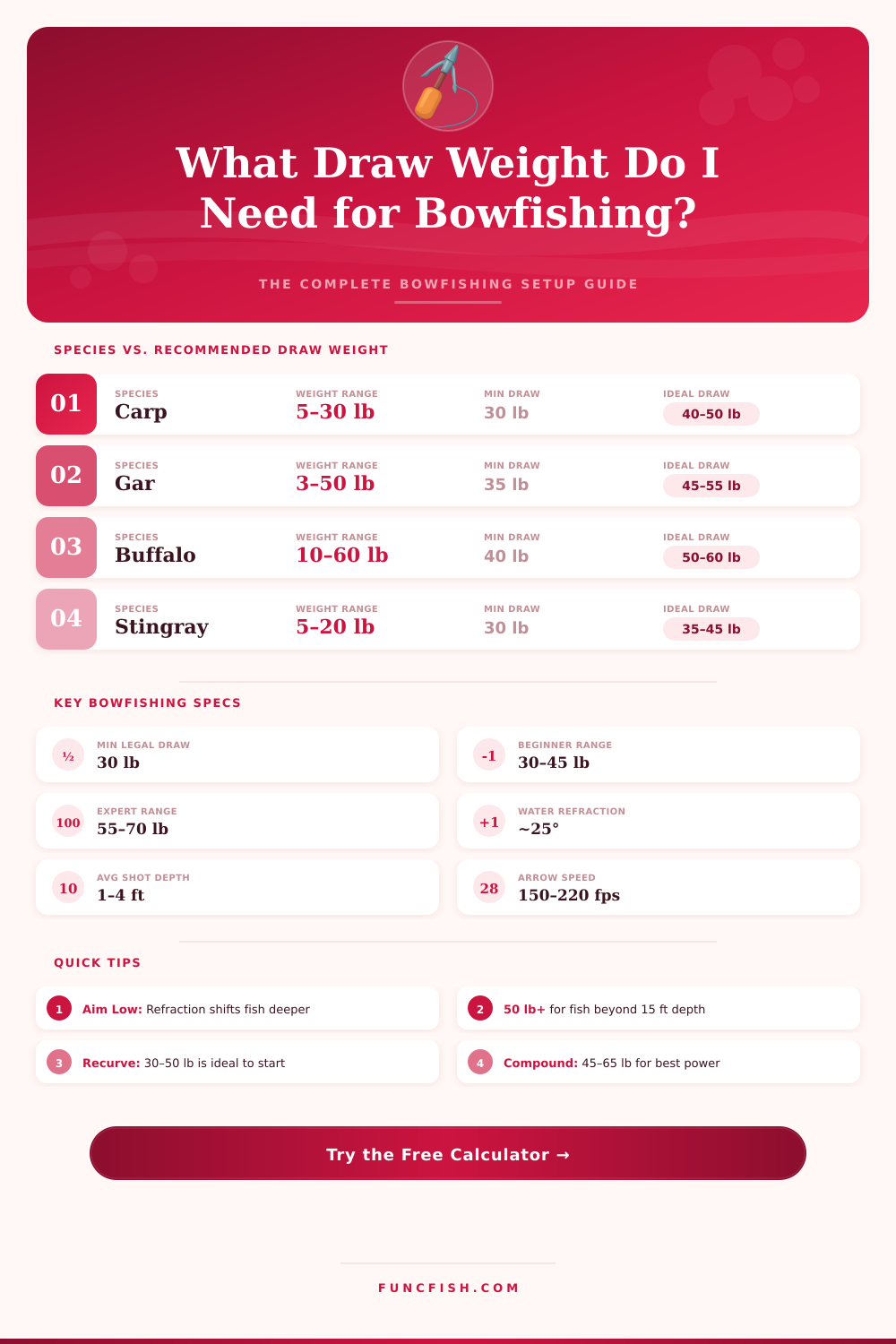
| Species | Avg. Weight (lb / kg) | Min Draw (lb) | Ideal Draw (lb) | Scale Thickness | Difficulty |
|---|---|---|---|---|---|
| Common Carp | 5–30 lb / 2–14 kg | 30 | 40–50 | Medium | Easy |
| Longnose Gar | 3–20 lb / 1–9 kg | 35 | 45–55 | Heavy / Bony | Moderate |
| Alligator Gar | 30–150+ lb / 14–68+ kg | 50 | 60–75 | Very Heavy | Hard |
| Bigmouth Buffalo | 10–60 lb / 5–27 kg | 40 | 50–60 | Medium-Heavy | Moderate |
| Grass Carp | 10–50 lb / 5–23 kg | 35 | 45–55 | Medium | Easy |
| Flathead Catfish | 5–50 lb / 2–23 kg | 35 | 40–55 | Soft / Scaleless | Easy |
| Stingray | 5–25 lb / 2–11 kg | 30 | 35–50 | Cartilage | Moderate |
| Tilapia | 1–5 lb / 0.5–2 kg | 25 | 30–40 | Light | Easy |
| Freshwater Drum | 5–25 lb / 2–11 kg | 35 | 45–55 | Medium | Moderate |
| Sheepshead | 3–15 lb / 1–7 kg | 30 | 40–50 | Medium | Moderate |
| Draw Weight (lb) | Grain Range (gr) | Material | Penetration |
|---|---|---|---|
| 25–35 | 400–500 | Fiberglass | Light |
| 36–45 | 500–600 | Fiberglass/Carbon | Medium |
| 46–55 | 600–700 | Carbon/Hybrid | High |
| 56–65 | 700–800 | Heavy Carbon | Very High |
| 66+ | 800+ | Heavy Fiberglass | Max |
| Water Depth | Apparent Depth | Aim Adjustment | Draw Add |
|---|---|---|---|
| 1 ft / 0.3 m | 0.75 ft | –3 in (7 cm) | +0 lb |
| 2 ft / 0.6 m | 1.5 ft | –6 in (15 cm) | +0 lb |
| 3 ft / 0.9 m | 2.25 ft | –9 in (23 cm) | +2 lb |
| 5 ft / 1.5 m | 3.75 ft | –15 in (38 cm) | +5 lb |
| 8+ ft / 2.4+ m | 6 ft | –24 in (61 cm) | +8 lb |
| Bow Type | Draw Weight Range | Let-off | Arrow Speed | Best Use |
|---|---|---|---|---|
| Compound | 30–70 lb (14–32 kg) | 65–80% | 180–220 fps | All species, any depth |
| Recurve | 30–60 lb (14–27 kg) | 0% | 150–190 fps | Shallow, smaller fish |
| Longbow | 30–55 lb (14–25 kg) | 0% | 140–175 fps | Shallow freshwater |
| Crossbow | 150–200 lb (68–91 kg) | 70–80% | 200–250 fps | Trophy / thick-scaled |
| Pistol Bow | 45–80 lb (20–36 kg) | 0% | 155–185 fps | Close range, compact |
| Slingbow | 25–45 lb (11–20 kg) | 0% | 120–160 fps | Ultralight / panfish |
Selecting the correct draw weight for a bowfisher is a necessary task before heading into a water. A person must consider various factor when selecting the draw weight for their bowfisher arrows. Draw weight impacts the arrow’s performance in the water.
If the draw weight are too light, the arrow will lose speed due to water resistance, and may not be able to reach the fish. However, if the draw weight is too heavy, the person will experience muscle fatigue because the arrows heavy draw weight is dificult to hold for long period of time. A person must take into consideration the size of the fish, the distance to the fish, and the stability of the platform that the person will use to bowfish to determine the best draw weight for the arrow.
How to Pick the Right Draw Weight for Bowfishing
Fish size is a primary consideration. Different draw weights will be needed to hunt different sizes of fish. For small fish, such as tilapia, the arrow has to penetrate the fishs body with less muscular density.
Thus, a lighter draw weight is all that will be needed. For larger fish, such as carp, the draw weight has to be more moderate because the carp has more muscular density. For very large fish, such as gar or buffalo fish, the draw weight will have to be high to allow the arrow to penetrate the thick body or bony plates of these fish species.
Using a draw weight that is undersized for the fish will cause the arrow to lose most of its speed in the water before it can even reach the fish. Distance is another important factor. Arrows will lose the speed that the arrow provided the further the arrow travels through the water.
For this reason, a person can use a light draw weight if the distance to the target fish is short, such as eight feet. However, for twenty-eight feet, the draw weight will have to be higher so that the arrow does not lose too much of its speed in the longer distance. Draw length for the bowfisher also play a role in the draw weight because the longer the draw length, the higher the energy that can be released from the bow.
The stability of the bowfisher’s platform is another important factor in determining the draw weight. A person can use a higher draw weight on a boat deck since it is more stable. However, if a person is on a kayak or when wading in the water, the platform is much less stable.
Thus, a lighter draw weight will make it easy for the bowfisher to maintain their stability while on an unstable platform. For compound bows, a person can use a higher draw weight since there is a let-off feature for the draw weight once the arrow is released from the bow. For recurve bows, however, the bowfisher will feel the draw weight the entire time while shooting the arrow.
Water conditions and clarity also play into the draw weight that a person should use when bowfishing. For clear water where visibility of the fish is better, a person can place the arrow into the water with more precision so a person does not have to use a higher draw weight. For muddy or dark water where it is hard to see the fish, a higher draw weight will be needed to compensate for the lack of visibility.
In addition to visibility, water currents will also play a role in the draw weight. If the water has a current, the bowfisher will have to use more draw weight to provide a shove for the arrow forward against the current. Additionally, the mass of the arrow will also have an impact on the draw weight; heavier arrows will find it easy to travel through choppy waters.
However, they will require a higher draw weight to be launched properly from the bow. Many bowfishermen make the mistake of using the maximum draw weight for their bows. A person may have a bow with a peak draw weight of fifty pounds.
However, using a draw weight of fifty pounds for many shots can cause muscle fatigue. Therefore, a person should of use a more conservative draw weight, especially if they are on an unstable platform from which they will be bowfishing. Many bowfishermen use the preset scenario for the different factors to choose the best draw weight.
A person can also test out the draw weight on non-target fish to ensure that the draw weight for the persons arrow is efficient. Above all, the best draw weight for an arrow is one that takes into consideration the size of the fish, the distance between the fish and the bowfisherman, and the stability of the platform on which the bowfisherman stands.