Perfection Loop Diameter Calculator
Estimate the finished inside diameter, leader consumed, knot throat width, and retained strength margin for perfection loops used on fly leaders, tippet rings, hooks, swivels, and loop-to-loop connections.
📌Perfection Loop Presets
⚙Leader, Loop, and Knot Inputs
The calculator reports finished inside diameter after the knot is seated, not the loose loop held between your fingers before the final pull.
Perfection Loop Diameter Results
Calculation Breakdown
🧵Material Behavior Grid
Supple Nylon
Fluorocarbon
Shock Mono
Tieable Wire
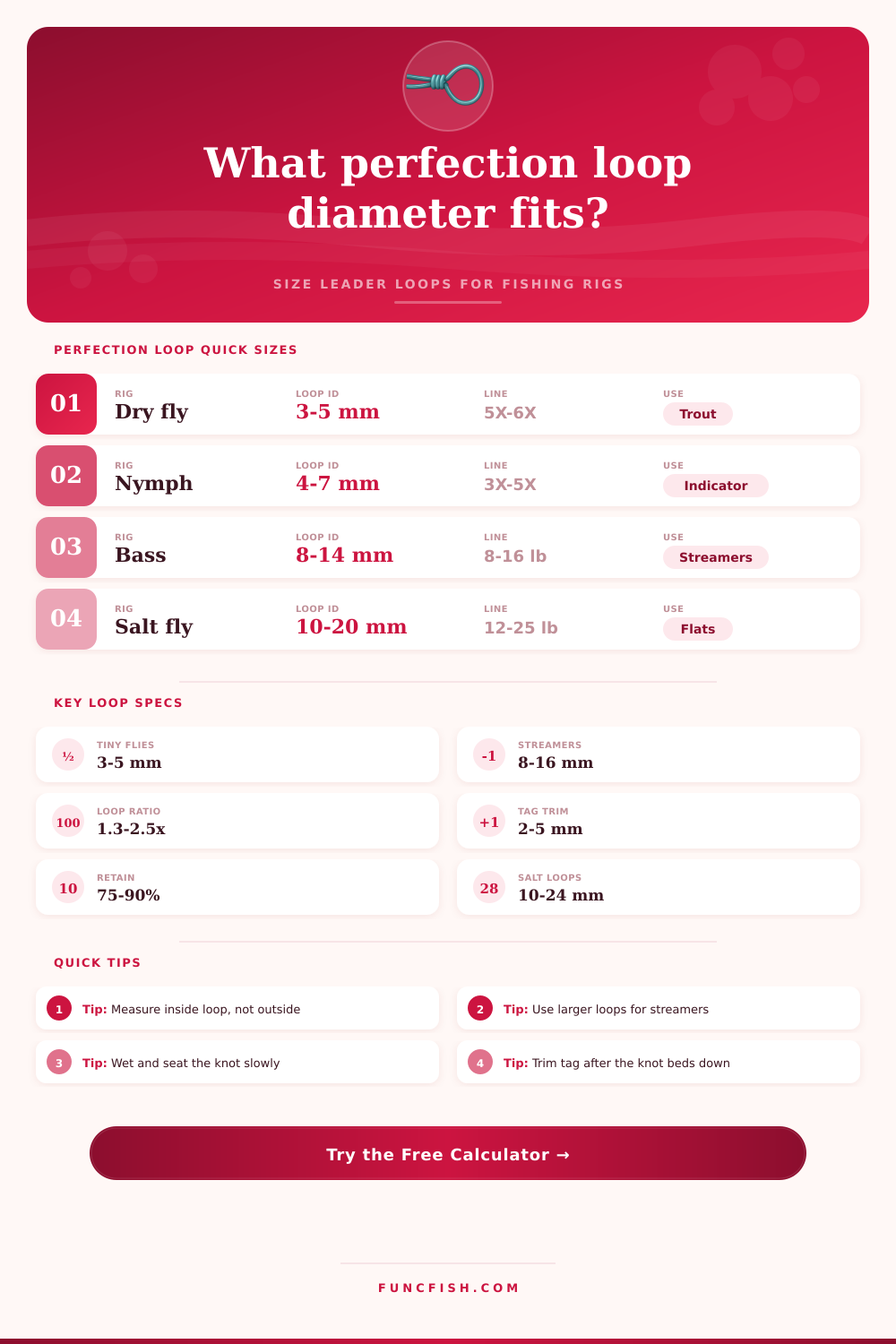
📏Perfection Loop Size Reference
| Connection Use | Common Material | Inside Diameter | Leader Used | Practical Note |
|---|---|---|---|---|
| Tiny dry fly or midge | 6X to 7X nylon, 0.10-0.13 mm | 2.8-4.5 mm / 0.11-0.18 in | 18-28 mm / 0.7-1.1 in | Small loop lands cleaner and keeps a straight tippet. |
| Standard dry fly | 4X to 5X nylon or copolymer | 4-6.5 mm / 0.16-0.26 in | 24-38 mm / 0.9-1.5 in | Enough freedom for light hackled flies without a bulky hinge. |
| Nymph or tippet ring | 3X to 5X fluorocarbon | 4.5-8 mm / 0.18-0.31 in | 28-48 mm / 1.1-1.9 in | Allow extra clearance for ring rotation and split-shot load changes. |
| Warmwater streamer | 8-16 lb mono or fluoro | 8-16 mm / 0.31-0.63 in | 50-95 mm / 2.0-3.7 in | Open loop improves kick on deer hair, bucktail, and jig flies. |
| Leader butt loop | 20-40 lb hard mono or furled butt | 12-24 mm / 0.47-0.94 in | 80-145 mm / 3.1-5.7 in | Large enough for welded fly-line loops to pass without crushing. |
| Saltwater shock tippet | 20-60 lb fluoro or mono | 12-30 mm / 0.47-1.18 in | 90-190 mm / 3.5-7.5 in | Stiffer leader needs extra diameter so the knot does not choke the eye. |
🎣Species and Gear Comparison Grid
| Species or Rig | Typical Leader | Recommended Loop ID | Peak Pull Basis | Gear Match |
|---|---|---|---|---|
| Brook trout dry fly | 5X-7X, 1.5-4 lb | 3-5 mm / 0.12-0.20 in | 20-35% of tippet | 2-4 wt rod, small fly eye, compact loop. |
| Indicator trout nymph | 3X-5X, 4-8 lb | 5-8 mm / 0.20-0.31 in | 30-45% of tippet | 4-6 wt rod, ring or swivel clearance. |
| Smallmouth streamer | 8-14 lb nylon | 8-14 mm / 0.31-0.55 in | 35-55% of leader | 6-8 wt rod, open loop for fly action. |
| Largemouth cover fly | 12-20 lb mono | 10-18 mm / 0.39-0.71 in | 45-65% of leader | 7-9 wt rod, abrasion allowance matters. |
| Steelhead wet fly | 10-15 lb Maxima-style mono | 8-15 mm / 0.31-0.59 in | 35-55% of leader | Switch or spey rod, controlled swing hinge. |
| Bonefish flats fly | 10-16 lb fluoro | 8-14 mm / 0.31-0.55 in | 40-60% of leader | 7-9 wt rod, low-profile but not jammed. |
| Pike bite tippet | 20-40 lb tieable wire | 10-22 mm / 0.39-0.87 in | 35-60% of wire | 8-10 wt rod, larger bend radius protects wire. |
| Tarpon shock tippet | 40-80 lb shock mono | 18-35 mm / 0.71-1.38 in | 45-70% of leader | 10-12 wt rod, knot test strongly recommended. |
🔗Loop Knot Comparison
Perfection Loop
CompactBest when a straight, tidy loop is needed on tippet, leader butts, or loop-to-loop fly-line connections.
Non-Slip Loop
OpenGood fly action on streamers and saltwater flies, but uses more tag length and creates a larger knot barrel.
Surgeon Loop
FastSimple field loop for heavier leaders, though it can sit slightly off-center compared with a perfection loop.
Welded Loop
LargeCommon on fly lines; leader butt perfection loops need enough diameter to pass over the welded loop cleanly.
| Loop Type | Best Diameter Range | Typical Retained Strength | Bulk at Knot | Best Use |
|---|---|---|---|---|
| Perfection loop | 3-30 mm / 0.12-1.18 in | 75-90% when dressed well | Low to medium | Leader loops, tippet rings, small fly loops. |
| Non-slip mono loop | 8-40 mm / 0.31-1.57 in | 80-95% with correct turns | Medium | Maximum lure or streamer swing. |
| Surgeon loop | 8-50 mm / 0.31-1.97 in | 70-90% depending on material | Medium to high | Quick heavy leader loops in rough conditions. |
| Bimini loop | 25-100 mm / 0.98-3.94 in | 90-100% if tied correctly | Long and flexible | Big-game doubled line before a leader connection. |
📚Diameter Formula Reference
| Formula Piece | What It Measures | Typical Multiplier | Why It Matters |
|---|---|---|---|
| Eye clearance diameter | Eye diameter multiplied by desired clearance and loop role | 1.3x to 3.0x | Prevents the loop from binding against the fly eye, swivel, or welded loop. |
| Material bend diameter | Leader diameter multiplied by stiffness bend requirement | 14x to 38x | Stiffer fluoro, shock mono, and wire need a larger bend radius to avoid choking. |
| Style opening factor | Compact, balanced, open, or oversize user preference | 0.9x to 1.35x | Controls how much action and hinge effect the finished loop adds. |
| Leader consumed | Inside circumference plus knot barrel and tag allowance | ID x 3.14 | Shows how much tippet disappears when the knot is dressed and trimmed. |
| Strength margin | Retained knot strength divided by expected peak pull | 1.2x to 3.5x | Highlights when a small loop or rough seating is too close to the planned load. |
💡Loop Sizing Tips
Measure after seating: A perfection loop often shrinks as the knot barrel rolls tight. Pull the standing line and tag evenly, then measure the inside opening with small calipers or a millimeter rule.
Match loop to fly action: Tiny dries and straight nymph rigs usually prefer compact loops, while streamers, bass bugs, and saltwater patterns need more inside diameter for a cleaner kick.
Are you frustrated that a perfection loop is not holding up on a cast? Took the time to dress the knot, trim the tag end, tie it on, pull it nice and snug and it seems like it’s tied on well. The loop is center cut and trimmed out nicely. The knot even feels good on your fingertips. But as soon as you feel that fish take the line, the loop collapse back onto the shank or slips off the hook eye. Grrr… it ruined the whole presentation of the fly.
The solution is usually the size of the loop. Most guys just guess how much slack to put in based off eyeballing it… Knowing what finished inside diameter will be before dipping the line in the water is key. The calculator also take the guess work out of matching the eye size of your hook to the correct stiffness of your leader. It does all the geometry for you. You pick a situation, like heavy saltwater streamers or dry fly trout, and it set up to match the physical properties of the materials.
Why Your Loops Fail and How to Fix Them
Nylon flows easily and is flexible, while fluorocarbon is stiff and do not bend easily. So if you don’t account for that when you make the loop you can end up with a loop so small that the knot chokes down when it seats and doesn’t have any strength at all. The calculator factors that in to recommend a larger or smaller diameter, based off the breaking strain and outside diameter of the leader. This help you get a nice tight profile without being so tight that it kills the knot strength.
For example, a small dry fly require a tight loop. Anything larger near the eye change how the fly lands on the water’s surface. Too big a loop forms a hinge which will prevent the fly from lying down flat. This appears unnatural to the wary eyes of trout. On the other hand, when you apply that same small loop to an oversized bulky bass streamer, you are limiting its action. A bigger loop give those lures more space to work, which results in a wider clearance ratio. You’re not just trying to fit the hook but allowing the lure to have physical space to perform correctly in the water column. For instance, as we see on the page, diameter ranges shifts from millimeters for midge patterns to twenty millimeters or more for heavy tackle.
Another variable that tends to be forgotten until a big fish runs off with your tippet is strength retention. While a perfect loop is efficient, it’s only efficient if there is enough lead consumed and the loop are seated properly. The calculator also estimate the amount of tag allowance and leader length lost within the knot barrel. This help you build your leader more accuratly for the best performance. You don’t want to be running short on tippet due to underestimating the material cost of a few loops up the line.
Also, knowing how much stronger or weaker the knot is compared to the expected peak pull give you the confidence to fish it. It lets you know that the knot will handle the battle but not be so bulky that it spooks those nervous species. To put it simply, it’s a matter of measuring and being patient.
Friction burns will greatly reduce both the strength of fluorocarbon and nylon. So be sure to soak the knot well before pulling it tight. When pulling it tight, pull equally on the tag end and standing line until the knot is completely seated, and finally cut off the remaining line. Take your time here. What diameter you measure is what your knot will be after you bed it down. It won’t quite reach its full seated size until you let go of the free loop between your fingers during the last tug. Being accurate at the start avoids the need for any tweaks near the end, which most commonly result in errors.
Learning to tie a loop is not so much remembering the steps but learning ratios. Knowing exactly what size loop you need for your line and your fly will cause you to stop thinking about tying the knot and focus instead on catching the fish. You begin to see the ideal loop melt away in the presentation leaving nothing but movement of the fly and the response of the water. That’s what we’re after.
It’s a good sized loop doing its quiet job allowing your tackle to perform as intended when the tug arrives. You should of seen how much better it worked.