Double Surgeon Knot Turns Calculator
Estimate whether a true double surgeon, triple surgeon, or extra-turn surgeon knot best matches your line pair, diameter mismatch, tag length, drag load, and finish quality.
📌Double surgeon knot presets
⚙Knot and line settings
Use the measured or package diameter. Surgeon knots tolerate modest mismatch, but bulk rises quickly.
The smaller diameter controls slip risk; the larger diameter controls guide clearance.
Double surgeon turn forecast
Calculation breakdown
🧵Line material data used by the calculator
Nylon Mono
Fluorocarbon
Copolymer
Soft Tippet
Fluoro Tippet
Hard Mono
Gel-Spun Braid
Coated Hybrid
📏Surgeon knot turn reference tables
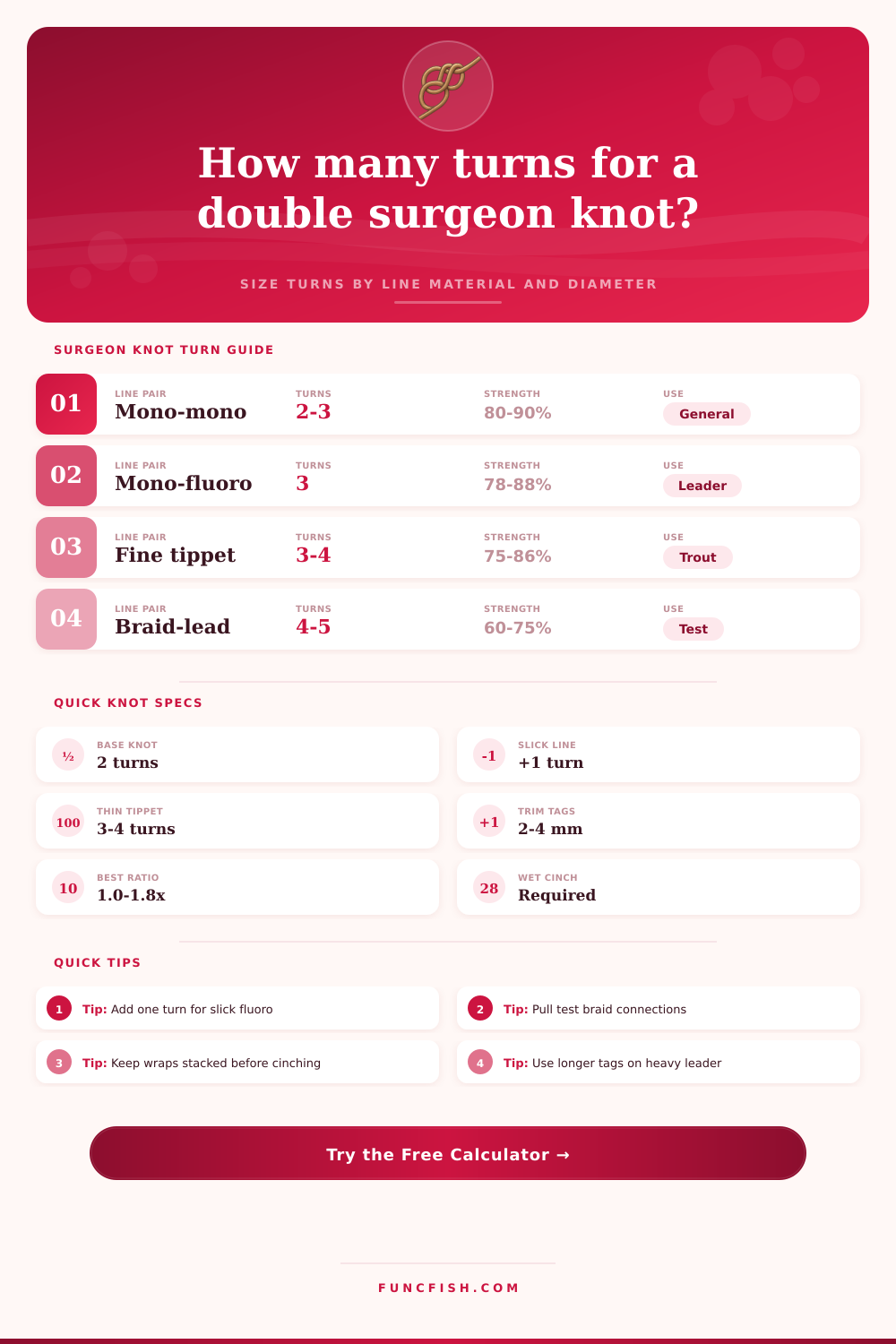
| Line pairing | Typical turns | Expected efficiency | Best diameter ratio | Field note |
|---|---|---|---|---|
| Nylon mono to nylon mono | 2-3 loop passes | 80-90% of weaker line | 1.0-1.5x | True double often works when dressed cleanly |
| Nylon mono to fluorocarbon | 3 loop passes | 78-88% of weaker line | 1.0-1.7x | Triple surgeon reduces fluoro slip |
| Fine nylon tippet to fine tippet | 3 loop passes | 78-88% of weaker line | 1.0-1.4x | Small line benefits from the added wrap |
| Fluoro tippet to fluoro tippet | 3-4 loop passes | 74-84% of weaker line | 1.0-1.4x | Slick, hard surface needs slow seating |
| Heavy mono to lighter mono | 2-3 loop passes | 75-84% of weaker line | 1.5-2.2x | Bulk and tag angle become limiting |
| Braid to leader | 4-5 loop passes | 60-75% of weaker line | 1.0-2.0x | Use only after hard pull testing |
| Diameter class | Metric range | Imperial range | Double surgeon outlook | Tag start length |
|---|---|---|---|---|
| Extra fine tippet | 0.08-0.12 mm | .003-.005 in | 3-4 turns, avoid jerky cinch | 75-100 mm / 3.0-3.9 in |
| Light freshwater | 0.13-0.22 mm | .005-.009 in | 2-3 turns for mono, 3 for fluoro | 65-90 mm / 2.6-3.5 in |
| Medium freshwater | 0.23-0.40 mm | .009-.016 in | 2-3 turns with low bulk | 55-85 mm / 2.2-3.3 in |
| Heavy leader | 0.41-0.65 mm | .016-.026 in | 2 turns often seats cleaner | 80-125 mm / 3.1-4.9 in |
| Shock leader | 0.66-0.90 mm | .026-.035 in | 2 turns, bulk warning likely | 115-170 mm / 4.5-6.7 in |
| Diameter ratio | Turn effect | Bulk effect | Strength outlook | Decision cue |
|---|---|---|---|---|
| 1.0-1.3x | Use material recommendation | Low | Best range | Double or triple by material |
| 1.4-1.8x | Add one turn if slick | Moderate | Good with careful cinch | Check tag angle after seating |
| 1.9-2.4x | Extra turns may help thin side | High | Marginal for hard leaders | Pull test before fishing |
| 2.5-3.0x | Turns cannot solve all mismatch | Very high | Low unless soft mono | Consider a different connection |
| Over 3.0x | Not recommended | Bulky | Unreliable | Change knot or line pair |
🎣Gear and species comparison grid
Trout Tippet
Lines: 4-6 lb nylon or fluoro tippet
Turns: 3 for most repairs
Watch: fine tags slipping during cinch
Bass Spinning
Lines: 8-12 lb mono to 8-12 lb fluoro
Turns: 3 when fluoro is involved
Watch: guide clearance on longer leaders
Panfish UL
Lines: 2-4 lb fine mono
Turns: 3-4 with soft line
Watch: over-tightening tiny knots
Walleye Rig
Lines: 6-10 lb mono to fluoro
Turns: 3 with leader changes
Watch: nicked fluoro near jigs
Steelhead Float
Lines: 8-12 lb main to 6-10 lb leader
Turns: 3, sometimes 4 in cold
Watch: cold hands and stiff mono
Inshore Leader
Lines: 10-15 lb mono to 15-25 lb fluoro
Turns: 3 with a long tag
Watch: abrasion-dulled leader ends
Surf Shock
Lines: 15-20 lb main to 30-40 lb leader
Turns: 2-3, bulk limited
Watch: tip-top clearance before casting
Braid Caution
Lines: thin braid to mono or fluoro
Turns: 4-5 only after testing
Watch: braid cutting into leader
📊Species and load reference tables
| Species group | Common line range | Typical drag load | Surgeon turn start | Practical check |
|---|---|---|---|---|
| Brook, rainbow, brown trout | 2-6 lb / 0.9-2.7 kg | 0.5-2 lb / 0.2-0.9 kg | 3 turns | Inspect fine tippet for heat curl |
| Crappie, bluegill, perch | 2-6 lb / 0.9-2.7 kg | 0.5-1.5 lb / 0.2-0.7 kg | 3 turns | Keep the finished knot compact |
| Bass, walleye, pickerel | 6-15 lb / 2.7-6.8 kg | 2-5 lb / 0.9-2.3 kg | 2-3 turns | Use three when fluoro is the leader |
| Steelhead, salmon, lake trout | 8-20 lb / 3.6-9.1 kg | 3-8 lb / 1.4-3.6 kg | 3 turns | Retie after hard abrasion or snags |
| Redfish, snook, sea trout | 10-25 lb / 4.5-11.3 kg | 3-8 lb / 1.4-3.6 kg | 3 turns | Check bulk through small guides |
| Surf species and rays | 15-40 lb / 6.8-18.1 kg | 5-12 lb / 2.3-5.4 kg | 2-3 turns | Shock loads demand pull testing |
💡Turn selection notes
Turn count tip: A double surgeon knot means both line ends pass through the same loop twice. Adding a third or fourth pass can improve grip on slick or fine line, but it also makes a larger knot that must be dressed slowly.
Tag length tip: Extra turns need extra tag length because both parallel strands travel around the loop together. Start longer on heavy leader, then trim only after the knot has been wetted, seated, and pull-tested.
So you carefully strip the fish for 45 minutes but then your leader snaps exactly where you tied it off. It’s not bad luck. It’s physics meeting some bad knot mechanics. It’s not bad luck. It’s physics meeting some bad knot mechanics.
In today’s world of fishing, the old standby double surgeon loop is just that (the old standby). For most application it handles size differences between the heavier leader and smaller tippet better then most other knots. You can splice a heavy fluorocarbon leader to thin nylon tippet without the whole thing collapsing into a friction burn, provided you adjust your turns for the material’s slickness.
Why Your Fishing Knots Break
But here’s the kicker, when you tie this knot you think you’re supposed to use a certain number of turns no matter how thick or smooth the material is. The default setting for most anglers are three turns all around for everything from heavy bass leader to panfish tippet. But not all line textures grip equally. For instance, fluorocarbon is slick and dense while braid has very low friction. Adding more wraps help the knot hold better under pressure.
The drag system and how much the materials grips are factored in the calculator. It’ll tell you whether just two wraps is good enough or if you should of stick with three to avoid slippage. Good knots is made better with less. Each extra turn add another layer of line to the inside of the loop. That translates into more outside diameter in the finished knot. Get enough layers and it won’t fit between your rod guides. You make a perfect knot on the bank, but when you try to cast it snags on the first guide. The line break under tension before you even set the hook into a fish.
Based off both turn count and line diameters, the tool guesses how much bulk your knot will have in the end. And it tells you if you’re making a knot that’s mechanically strong but physically obstructive. Many angler don’t pay attention to that balance between strength and clearance until it’s too late.
More than folks realize, tag length is important. Stiff, cold lines don’t bend well so having some excess line for several loops without going dry in the middle of tying becomes necessary. With short tags, your hand has to work fast. You end up placing one loop atop the other instead of nesting them well. That lack of alignment causes stress points to put too much load onto a single strand of fiber.
Line must be wet before cinch. The tightening of dry nylon produces heat which softens the plastic until melting occurs; this weaken the nylon by 10% or more. Safe turn range is matched up with common situations in the reference table. Note that braids are dangerous. They’re slick against themselves, have very little stretch and tying a surgeon’s knot straight to braid is dicey. Even doubled over multiple times, slick fibers will slip. You’ll end up cutting into the softer leader material on the opposite side of the knot. That’s what the calculator warns you about.
It may recommend four or five times through, but sometimes it’s not that you need more turns, but rather a different knot altogether. Fluorocarbon gets brittle and monofilament get stiff in cold temperatures. A knot tied with numb fingers won’t dress like one tied in your heated garage. Tying it to tight because the line is stiff often coils it out of shape. Add an extra turn if you’re fishing in cold water streams in the ice out or early spring.
Dress your knots slowly. Not like crumpled up paper in your pocket but rather like stacks of plate on a shelf. Ultimately, a strong connection relies on consistency more than complexity. A properly dressed, wet two-pass surgeon knot ties as strongly as anything else and takes up less room than four loops of half-baked knots done wrong. If you make one loop too long and cinch it too tight while dry you’ll ruin even a five-passer.
Your hands ultimately do all the heavy lifting. The tool gives you a baseline. The rest is between you and your hands. Respect the friction. Manage the bulk. And make sure that leader stays tied to your main line when it’s time for business.