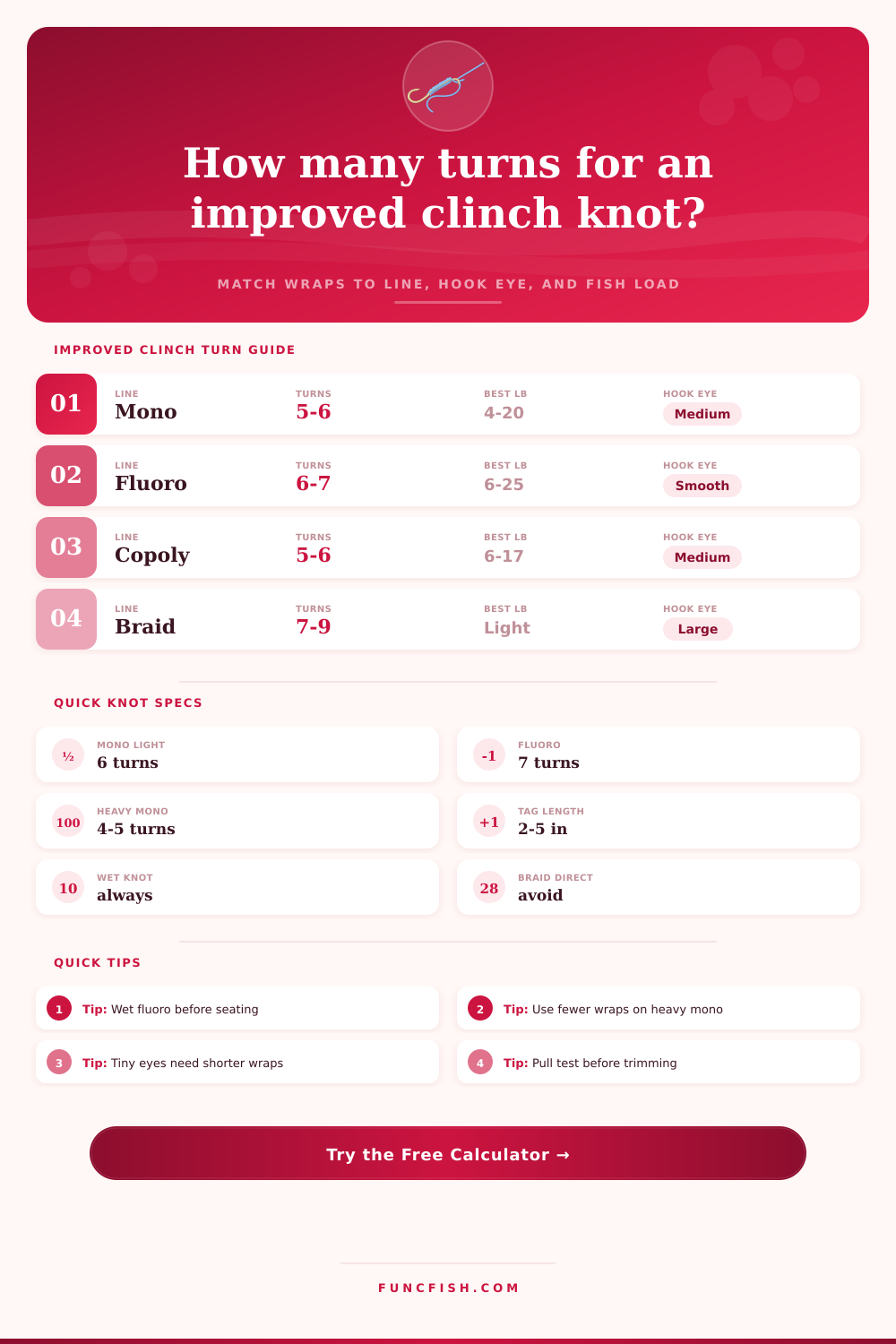
Improved Clinch Knot Turns Calculator
Estimate improved clinch wraps, tag allowance, coil length, and working knot strength from line material, diameter, hook eye clearance, lure load, seating quality, and target fish pressure.
Finesse rigs reward extra wraps if the hook eye still has room.
Package diameter is best; wraps are adjusted by how much coil length fits before the eye.
| Line class | Typical diameter | Mono or copoly turns | Fluoro turns | Notes |
|---|---|---|---|---|
| Ultralight 2-4 lb | 0.005-0.008 in / 0.13-0.20 mm | 6-7 | 7 | Small coils bite well but need enough tag to seat. |
| Light 6-8 lb | 0.009-0.011 in / 0.23-0.28 mm | 6 | 6-7 | Common trout, panfish, and walleye range. |
| Medium 10-14 lb | 0.012-0.015 in / 0.30-0.38 mm | 5-6 | 6 | Balanced for bass crankbaits, jigs, and inshore plugs. |
| Heavy 17-25 lb | 0.016-0.021 in / 0.41-0.53 mm | 5 | 5-6 | Use slow seating; check eye room before adding turns. |
| Extra heavy 30-50 lb | 0.022-0.032 in / 0.56-0.81 mm | 4-5 | 4-5 | Improved clinch becomes bulky; large eyes help. |
| Eye type | Usable opening | Best line range | Turn adjustment | Practical limit |
|---|---|---|---|---|
| Micro jig or small fly | 0.030-0.055 in / 0.8-1.4 mm | 2-6 lb | Keep 5-7 turns compact | Heavy fluoro may not pass twice cleanly. |
| Standard hook eye | 0.060-0.110 in / 1.5-2.8 mm | 4-20 lb | Use normal chart turns | Most improved clinch ties fit cleanly. |
| Split ring or lure ring | 0.100-0.180 in / 2.5-4.6 mm | 8-30 lb | Add one turn for shock | Watch for sharp ring edges or gaps. |
| Heavy forged hook | 0.120-0.240 in / 3.0-6.1 mm | 15-50 lb | Reduce if coils stack | Large wire can bend the first wrap sharply. |
| Tippet ring or tiny swivel | 0.035-0.070 in / 0.9-1.8 mm | 3X-7X tippet | Extra tag, gentle seating | Use fine tippet and inspect the pass-back. |
| Target setup | Typical line | Terminal tackle | Suggested turns | Load note |
|---|---|---|---|---|
| Stream trout spoon | 4-6 lb mono | Small snap or ring | 6-7 | Light drag, thin line, compact coils. |
| Bass crankbait | 10-14 lb mono/copoly | Split ring | 5-6 | Hard casts make clean seating important. |
| Panfish tungsten jig | 2-4 lb mono | Micro eye | 6 | Do not crowd the eye with stacked coils. |
| Walleye jigging | 8-12 lb fluoro | Jig eye | 6-7 | Fluoro needs moisture and steady draw-down. |
| Redfish plug | 15-20 lb fluoro | Salt plug ring | 5-6 | Surges favor a longer tag and pull test. |
| Catfish circle hook | 20-30 lb mono | Large hook eye | 4-5 | Thick line grips with fewer full coils. |
| Salmon spinner | 12-17 lb mono | Spinner wire eye | 5-6 | Twist and pulses reduce the safety margin. |
| Fly streamer tippet | 0X-3X nylon | Streamer hook eye | 5-6 | Seat slowly so coils do not cross. |
| Material | Typical clinch efficiency | Friction behavior | Default wraps | Calculator adjustment |
|---|---|---|---|---|
| Nylon monofilament | 80-90% | Forgiving stretch and good bite | 5-6 | Baseline for most terminal connections. |
| Fluorocarbon | 75-85% | Stiffer and heat sensitive | 6-7 | Adds wraps and penalizes dry seating. |
| Copolymer mono | 78-88% | Moderate stretch and surface grip | 5-6 | Close to mono with slight stiffness adjustment. |
| Hard mono leader | 70-82% | Thick, springy coils | 4-5 | Limits turns when eye crowding rises. |
| Fly nylon tippet | 82-90% | Fine diameter and supple seating | 6-7 | Allows extra wraps when eye space is adequate. |
| Braided PE direct | 45-65% | Very slick under load | 7-9 | Flags slip risk even with extra wraps. |
Terminal knots The clinch knot, which has been improved upon, are one of the most popular end connecting knots due to its solid feel of security and ability to hold up to pressure. With practice, it’s possible to get it tied without your eyes. It is used on everything from bass crankbaits to trout streamers.
But most people tie this knot around hook eye seven times each turn whether the leader is thick or thin and whether the eye is large or small. That’s a high risk for slippage with lines like braid. But with heavy mono or stiff flurocarbon as leaders, that typically won’t work out. For those who need the exact coefficient, there they are above. But knowing why they differ give you an idea of how to secure your fish.
How to Tie the Improved Clinch Knot Correctly
One thing that’s important in cinching down a knot is amount of friction it can provide. As you pull both the tag end and the standing line toward one another, the coils will stack up on hook eye. With thick line, there are too many turns to let the coils lie flat. They’ll actualy cross over themselves or bunch up before the knot gets completely cinched tight. This causes weak spots where the knot might slip completeley or, more often, simply come undone. A thinner line, like 4-pound test monofilament, has enough room to fit inside a normal hook eye. A few turns around the eye (6 or 7) make enough surface area for friction to grab and grip.
Seven turns of 20-pound fluorocarbon are far too thick to fit snuggly inside a hook eye. It’s a solid wad of rigid plastic that won’t seat correctly. Most people don’t realize how important material properties is. The nylon monofilament stretches and remembers its shape to conform to the wire eye and lock down in position. It is forgiving as you tighten knot. Because of its density and stiffness, fluorocarbon are more resistant to bending into a tight loop around slender hook wires. An additional turn may be required for sufficient grip on fluorocarbon. Then care should of been taken when tightening to seat the knot. To avoid heat damage from friction while pulling, fluorocarbon must be wetted before tying. Heat generated by dry ties on rigid line will weaken plastic structure at the stress point.
What you can do depends off the shape of your terminal tackle too. Eyes on micro jigs are really small. They are sometimes only just big enough to fit a strand of line through twice. There’s no way you’re getting a half dozen clean wraps around an area that measures.04 inches! You want enough wraps to generate friction, but not so many that they interferes with each other. Knots look neater and do not get messy in small eyelets, odd spots become places where things catch.
Lures with split rings and other eyelet give you more space, but they often have gaps or rough spots that will catch your line. An additional wrap gives you more contact points and balances out any bumpy spots. Same goes with braid, although braid can also create other problems. Because of that slick microfiber material, it will slip along the line easily. This is great for casting, but not so much than knot friction. This means you may need to add extra wraps to make up for the lack of grip. However, in a traditional improved clinch style, braid doesn’t has enough grip on the knot to hold tight. Your best bet here is either to switch your knot altogether or live with the increased chance of slipping if you’re forced into this situation.
The tool takes all that into account and helps adjust the recommended number of wraps and the overall strength estimates based off materials. A good knot is one where the coil stack balance and lays flat on the eye of the hook. Too few wraps won’t create any friction. Too many will get in each other’s way. Give the knot a gentle tug to pull test it before trimming your tag end, does it slip? Is there an unevenness to the knot? Something was amiss during wrapping. The way to know is by feel.
Once the motion is understood, this knot is bulletproof. It sticks tight from day one until the line is severed at the breaking point or snapped clean elsewhere.