Tippet Breaking Strain by Diameter Calculator
Estimate straight-pull tippet strength from diameter, convert it to an X-size, apply material and knot efficiency, then compare the usable load against target fish and drag pressure.
📌Tippet diameter presets
⚙Diameter and fishing settings
Use calipers or the published diameter. The X-size field can fill this automatically.
This is not the whole fight load; the calculator applies a scenario surge factor.
Tippet breaking strain forecast
Calculation breakdown
🧵Tippet material data grid
Nylon Mono
Fluorocarbon
Soft Nylon
Hard Mono
📏X-size diameter and strain reference
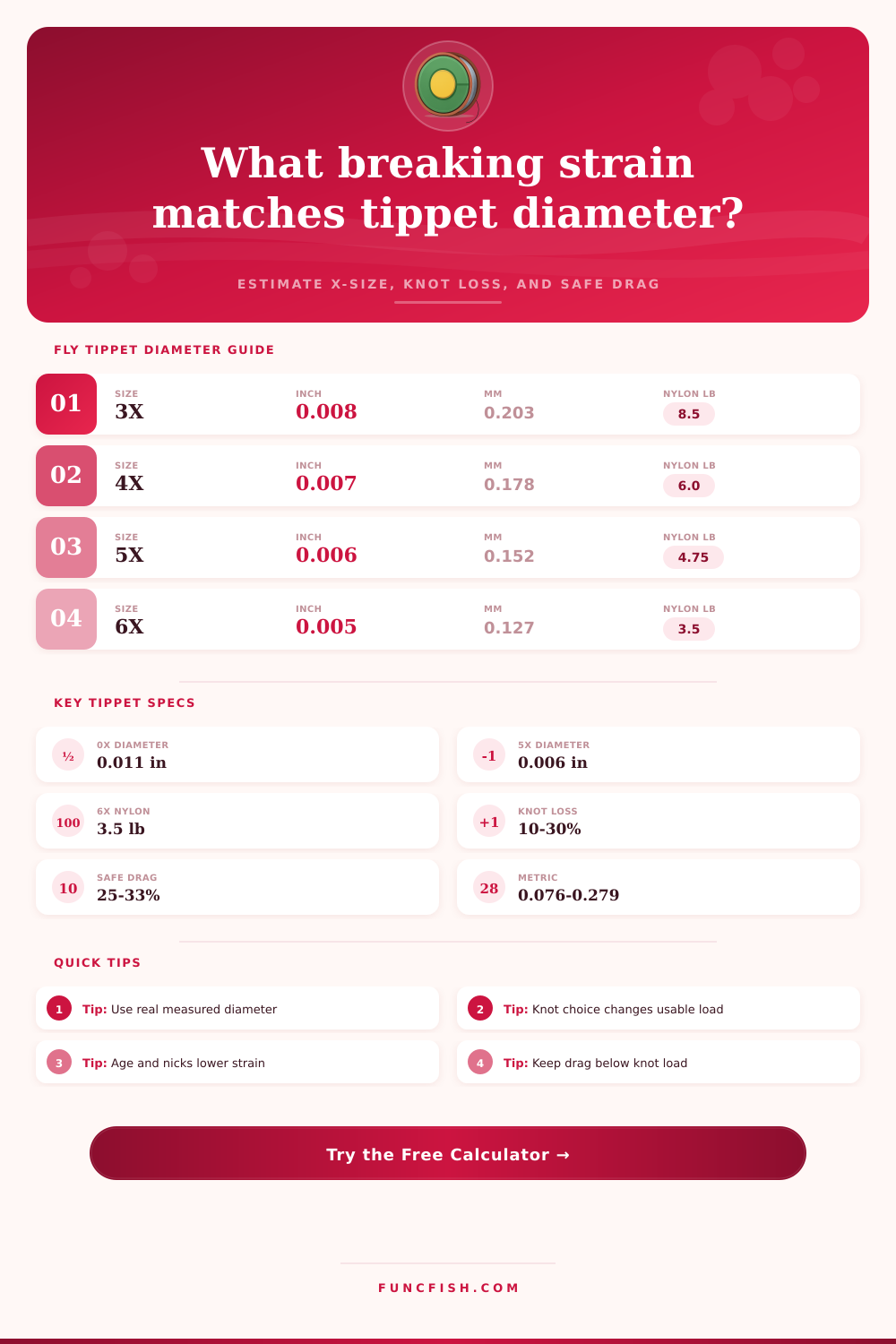
| X-size | Diameter (in) | Diameter (mm) | Typical nylon (lb) | Typical fluoro (lb) | Common fly range |
|---|---|---|---|---|---|
| 0X | 0.011 | 0.279 | 15.0 | 16.0 | 2-6 streamers, bass bugs |
| 1X | 0.010 | 0.254 | 13.0 | 14.0 | 4-8 hoppers, carp flies |
| 2X | 0.009 | 0.229 | 10.5 | 12.0 | 6-10 streamers, nymphs |
| 3X | 0.008 | 0.203 | 8.5 | 9.5 | 8-12 hoppers, big dries |
| 4X | 0.007 | 0.178 | 6.0 | 7.0 | 10-16 nymphs, dries |
| 5X | 0.006 | 0.152 | 4.75 | 5.5 | 14-20 dries, emergers |
| 6X | 0.005 | 0.127 | 3.5 | 4.0 | 18-24 dry flies |
| 7X | 0.004 | 0.102 | 2.5 | 3.0 | 20-26 tiny dries |
| 8X | 0.003 | 0.076 | 1.5 | 2.0 | 24-30 midges |
🔗Knot efficiency reference
| Connection | Typical efficiency | Best tippet sizes | Strength note |
|---|---|---|---|
| Tippet ring or micro swivel | 90% | 0X-7X | Strong when the terminal knot is seated cleanly |
| Improved clinch | 86% | 0X-6X | Reliable for most trout flies and small streamers |
| Uni or grinner | 84% | 0X-5X | Good with slick fluoro and heavier tippet |
| Davy or double Davy | 83% | 4X-8X | Small knot with good fine-tippet performance |
| Blood knot tippet join | 82% | 0X-6X | Best when diameters are close |
| Triple surgeon tippet join | 80% | 2X-8X | Fast join with moderate bulk |
| Non-slip loop knot | 78% | 0X-5X | Better fly action, lower peak strength |
| Perfection loop | 72% | 0X-4X | Convenient loop, less ideal for fine tippet |
🎣Species and gear comparison grid
| Target | Usual tippet | Diameter span | Typical strain | Rod class | Drag approach |
|---|---|---|---|---|---|
| Small stream trout | 5X-7X | 0.004-0.006 in | 2.5-4.75 lb | 2-4 wt | Rod bend and hand pressure |
| Technical tailwater trout | 5X-6X | 0.005-0.006 in | 3.5-5.5 lb | 4-5 wt | Light reel drag, long leader |
| Hopper or nymph trout | 3X-5X | 0.006-0.008 in | 4.75-8.5 lb | 4-6 wt | Moderate drag, mend often |
| Streamer trout | 0X-3X | 0.008-0.011 in | 8.5-16 lb | 5-7 wt | Strip-set, then controlled reel load |
| Carp and bass | 0X-2X | 0.009-0.011 in | 10.5-16 lb | 6-8 wt | Clear line, protect knots from abrasion |
| Steelhead and salmon | 0X-2X | 0.009-0.011 in | 10.5-16 lb | 7-9 wt | Smooth reel drag and low rod angle |
| Light saltwater flats | 0X or larger | 0.011 in plus | 16-20 lb class | 7-9 wt | Set drag below bite-section knot |
📊Condition and material adjustment table
| Factor | Multiplier | When to use it | Effect on calculator |
|---|---|---|---|
| New smooth tippet | 1.00 | Fresh spool, no visible damage | Uses the full estimated straight strain |
| Fished but smooth | 0.94 | Normal session wear without nicks | Small reduction before knot load |
| Light abrasion | 0.86 | Weed, moss, guide rub, or net contact | Meaningful reduction in usable strength |
| Older spool | 0.78 | Heat, UV, or long storage exposure | Conservative derating for age |
| Wind knot or kink | 0.68 | Visible curl, overhand knot, sharp bend | Strong warning to re-tie |
| Tooth or rock roughness | 0.62 | Bite marks, shell, rock, or pike contact | Lowest usable-load estimate |
💡Tippet strength notes
Measured diameter beats the label. Two tippets marked the same X-size can vary in actual diameter and straight-pull rating, so use the custom field when you have caliper or micrometer data.
Use knot strength for drag decisions. The straight-pull number is useful for comparing materials, but your practical limit is the knot-adjusted value after wear, temperature, and shock margin.
There will be times you hook a fish and the next thing that happens is you feel the tippet break off at the knot. It has happened to most angler at some point or another. Even with all the preparation in the world for your cast, it can still happen. So what do you do? Don’t go out and buy stronger line. Instead, understand real strength of what you have. Because what’s printed on the spool is almost never right.
In reality, any kind of knot significantly decrease the breaking strain of your tippet. While it may only decrease it by ten percent with a basic knot, complex loops can takes up to thirty percent or more off the strength. The calculator takes all of this into account after choosing your material type and knot so there is no math needed on your part.
Why You Should Measure Your Fishing Line
Why does this matter? Because you need some sort of safety margin when you’re fighting a fish. If your strength equals the fish exactly, you have no wiggle room. If something unexpected happens, like a sudden jump or a current, you’ll lose the fish.
The most objective measurement is diameter. Nylon, like fluorocarbon, is fairly consistent about tensile strength, so you can rely on thickness more then what brands say about their product. A fiveX from one company might be different than another, yet matching diameters will result in roughly equal performance. Calipers are the best way to eliminate the guesswork and measure the actual diameter of your own line. Simply put in that specific measurement and let the tool work out numbers according to standard industry tables without regard for hype, it eliminates the mistake of trusting the package too much.
But then there is the feel of that strength on the line. Because fluorocarbon has almost no stretch, it runs a little stronger than weight for weight. On the other hand, nylon do have some stretch and that stretch really comes into play when a fish makes that last second hard turn. You don’t rip a fly out of their mouth because the nylon stretches, acting as its own kind of shock absorber. So the tool will apply a certain strength factor to each type of material.
When you are nymphing with all that current, that extra nylon stretch saves flies from being ripped out of mouths. But when you are fishing dry flies in calm water, that same stretch can cause missed hook sets. Understanding that tradeoff allow you to decide whether you want more or less sensitivity vs. Forgiveness before you even make your cast.
The environmental factors is dicey too. Heat and exposure to light degrade old line, especially when left on the spool in direct sunlight. Even colder water will make even stiffer line snap harder at the first shock load. You can input variables into the calculator such as a rough pike’s mouth or other abrasions from weedlines. A good safety factor keeps the estimated break off far above reality. Slip is preferable to break each and every time.
You should of used a better knot for that. At the end of the day, fly fishing is a game of redundancy and precision. There’s no telling where a fish is going to go to get hung up. There’s nothing you can do about what they’re going to do. What you CAN do is ensure you’ve got plenty of reserve strength to manage whatever surge comes your way.
Building leaders based off actual knot efficiency and diameter instead of spool ratings means that when it counts, you’ll be able to count on them performing as they should. It’s all about maintaining the connection long enough to allow the rod to do its part. Trust the math, not the label, and let it save your catch.