Outrigger Spread Angle Calculator
Estimate outrigger pole spread, tip separation, halyard drop angle, and effective lure lane width from boat beam, pole length, elevation, setback, lure drag, and trolling speed.
📌Spread presets
⚙Outrigger geometry
Use the distance between port and starboard outrigger bases when mounts are outside the beam.
Measure plan-view angle: 0 degrees points aft, 45 degrees reaches wide off the beam.
This is the vertical drop from tip block to release clip while trolling.
Positive trim opens the lure lane target; negative trim plans for tighter, easier turns.
Outrigger spread geometry
Calculation breakdown
📊Outrigger class data
15 ft mini
22-24 ft center-console
28-32 ft sportfish
38 ft long rigger
📐Spread angle reference
| Plan-view spread angle | Typical use | Geometry effect | Handling note |
|---|---|---|---|
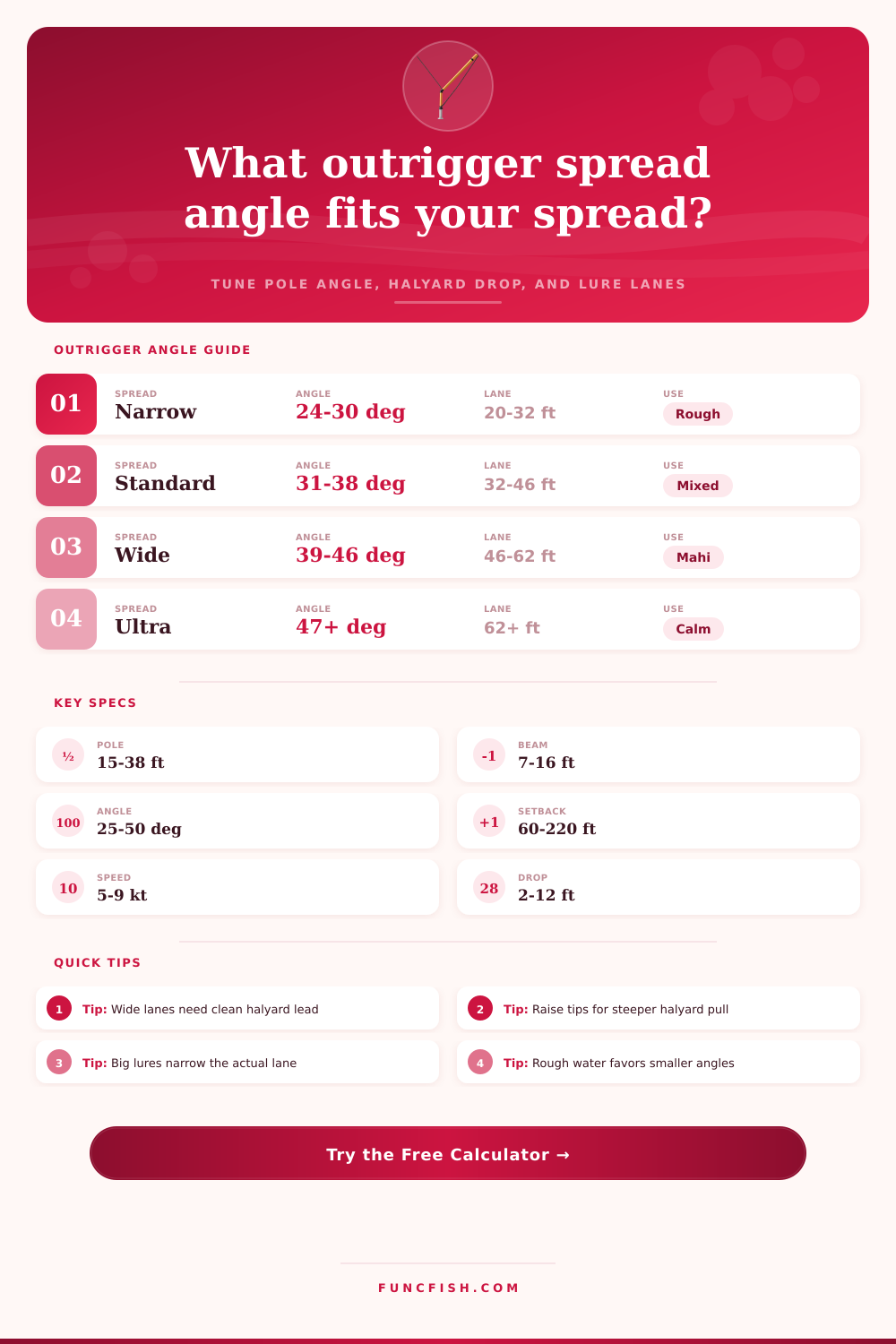
| 24-30° | Rough water, high-speed wahoo, crowded lanes | Narrower tip spread, stronger aft pull | Easier turns and less tip bounce |
| 31-36° | Standard mixed offshore trolling | Balanced lane width and clean halyard lead | Good starting zone for 18-28 ft poles |
| 37-42° | Mahi, sailfish, white marlin baits | Wide bait lanes with moderate aft reach | Watch inside rigger during tight turns |
| 43-48° | Calm-water tournament spread | Maximum width with less aft projection | Best with tall, stiff poles and clean seas |
| 49°+ | Specialty ultra-wide layouts | Very wide lanes, high side load | Use only when mounts and halyards stay fair |
📏Halyard and lure lane guide
| Halyard drop angle | Release behavior | Best lure class | Adjustment |
|---|---|---|---|
| 4-7° | Flat, low downward pull | Small ballyhoo, small feathers | Raise clip tension before going wider |
| 8-12° | Clean normal lead | Naked or skirted ballyhoo | Most reliable everyday release zone |
| 13-17° | Positive downward control | Medium plastics and splash birds | Useful when baits skip in chop |
| 18-22° | Steep pull on the clip | Heavy lures or teaser support | Check for premature release and line rub |
| 23°+ | Very steep, high load | Specialty heavy setups | Reduce drop or open the tip reach |
🐟Gear and species comparison
| Target spread | Common pole length | Angle range | Lane width target |
|---|---|---|---|
| Mahi and school dolphin | 18-24 ft / 5.5-7.3 m | 38-46° | 34-56 ft / 10-17 m |
| Sailfish ballyhoo spread | 24-32 ft / 7.3-9.8 m | 36-44° | 42-66 ft / 13-20 m |
| White marlin pitch-bait spread | 28-38 ft / 8.5-11.6 m | 35-43° | 48-76 ft / 15-23 m |
| Blue marlin lure spread | 28-38 ft / 8.5-11.6 m | 32-40° | 44-70 ft / 13-21 m |
| Yellowfin tuna bars | 22-32 ft / 6.7-9.8 m | 28-37° | 34-58 ft / 10-18 m |
| Wahoo high-speed lures | 15-24 ft / 4.6-7.3 m | 24-32° | 22-42 ft / 7-13 m |
⚓Mounting width reference
| Boat type | Mount spacing | Base height | Practical note |
|---|---|---|---|
| Trailer center-console 23-26 ft | 7.5-9.5 ft / 2.3-2.9 m | 7-9 ft / 2.1-2.7 m | Use shorter drop and moderate width |
| Offshore center-console 28-36 ft | 9.5-12 ft / 2.9-3.7 m | 8-11 ft / 2.4-3.4 m | Good fit for 22-28 ft poles |
| Express or walkaround | 10-13 ft / 3.0-4.0 m | 10-14 ft / 3.0-4.3 m | Higher tips improve halyard lead |
| Convertible sportfish | 13-17 ft / 4.0-5.2 m | 15-24 ft / 4.6-7.3 m | Long poles support wide billfish lanes |
| Tower tournament boat | 15-19 ft / 4.6-5.8 m | 20-32 ft / 6.1-9.8 m | Check clearance and halyard fairness |
Tip: A wider pole angle does not always create a wider lure track. Large lures, tuna bars, and higher speeds pull the bait toward the centerline, so compare tip width against effective lane width before changing the mount angle.
Tip: If the halyard drop angle climbs above about 18°, try raising the clip, reducing drop, or easing the pole angle before adding more release tension. Cleaner geometry usually beats a tighter clip.
In offshore trolling, when you set out a bait that’s too wide, you know it. Your pole tip quiver with weight on it; the halyard hums as if strummed on a guitar. Too often, the bait glide past your transom. Veteran skippers understand this paradox: you need width so you won’t foul your lines, yet you still needs to be able to control the bait and position it near where the fish are holding.
Unfortunatly, outrigger geometry can involve three dimension interacting at the same time. It’s not always intuitive math. The majority of anglers only consider the horizontal spread angle and they think increasing the width of their spread will also increase the width of their lure lane. Wrong.
The Science of Outrigger Angles
The magic occur within vertical plane. Raising the pole tip up increases your halyard leverage significently. Increasing the angle of the halyard as it drops to the water result in a much more aggressive pulling down action by the clip. If you don’t handle this properly, it can cinch the effective bait track tighter to the centerline.
Once you enter length of your pole and the beam of your boat into calculator above, it does the trigonometry for you. So you don’t have to guess what that will be given the elevation change. Know your boat beam‘s significance here. It act as the baseline anchor point from which all other measurements come.
If you are running a narrow center console with mounts close together, you will need a steeper spread angle to get the same tip separation as wide-beam sportfishing yacht operating at a modest angle. The other factor that changes how your spread work is trolling speed, which cause a bigger lure and teaser to develop more lift. That creates unpredictable movement away from the tip and up toward the surface.
To account for that lateral movement, it look at drag class and calculates how far it moves off center. In doing so, it provide an accurate effective lane width instead of a straight theoretical line from the tip. This is important if you are fishing for fish like sailfish or mahi, which feed at very specific depths, and need baits to be placed accordingly.
Another thing we tend to overlook is how rough water add a new variable. Wide angles are no longer assets but liabilities in heavy chop. An open pole have a longer lever arm that picks up wind and wave action. This result in violent bouncing of the tip. This bounces shock loads right back into the halyard clip. It also increases potential for gear failure or premature release.
A tighter spread angle in rough seas brings the load direction nearer to the centerline of boat. It protects your rigging while stabilizing the setup. Before playing with horizontal spread, try varying the elevation angle. The higher you have the pole tip, the greater height of the drop for the halyard. That has a big effect on the lead angle. Having a cleaner route for the halyard means less friction on the block and no line rub on the structure of boat.
In some cases, you can go up a little in elevation, use a smaller spread angle and still get same lane width as before. Overall that makes it a more stable set-up. Included in tool are some good starting points via reference tables that come with it. You will make last-minute adjustments based off conditions.
Naked ballyhoo is different than tuna bars. Wahoo lures demand a different geometric approach then billfish teasers. Adjusting your spread throughout the day help you understand how all of this ties together. Trolling becomes more about reading the water and finding fish versus struggling with the gear.
That’s what makes getting the geometry correct so important. It take trolling out of being a guess-and-check process and turns it into a science. It’s about finding the sweet spot; making the bait run wide enough to be safely away but under control so it presents perfectly in the strike zone. Dial it in and rest of the day goes smoothly.