Rod Wrap Thread Length Calculator
Estimate thread yardage for guide wraps, trim bands, ferrule marks, underwraps, and overwraps from blank diameter, wrap length, thread size, packing, tension, and allowance.
📌Rod wrap presets
⚙Thread and wrap settings
Count each guide, ferrule mark, or decorative station that receives a wrap.
Use the average diameter over the guide foot, not just the smallest end of the wrap.
Measure the full covered length, including the ramp at each guide foot.
Higher values cover thread flattening, crossed starts, and imperfect packing.
Rod wrap thread estimate
Calculation breakdown
🧵Thread size comparison grid
Size A Nylon
Size B Nylon
Size D Nylon
Metallic A
📏Thread pitch and coverage table
| Thread | Model diameter | Packed pitch | Turns per inch | Common use |
|---|---|---|---|---|
| Silk 00 | 0.0045 in / 0.114 mm | 0.0043-0.0048 in | 208-233 | fine fly rod restoration |
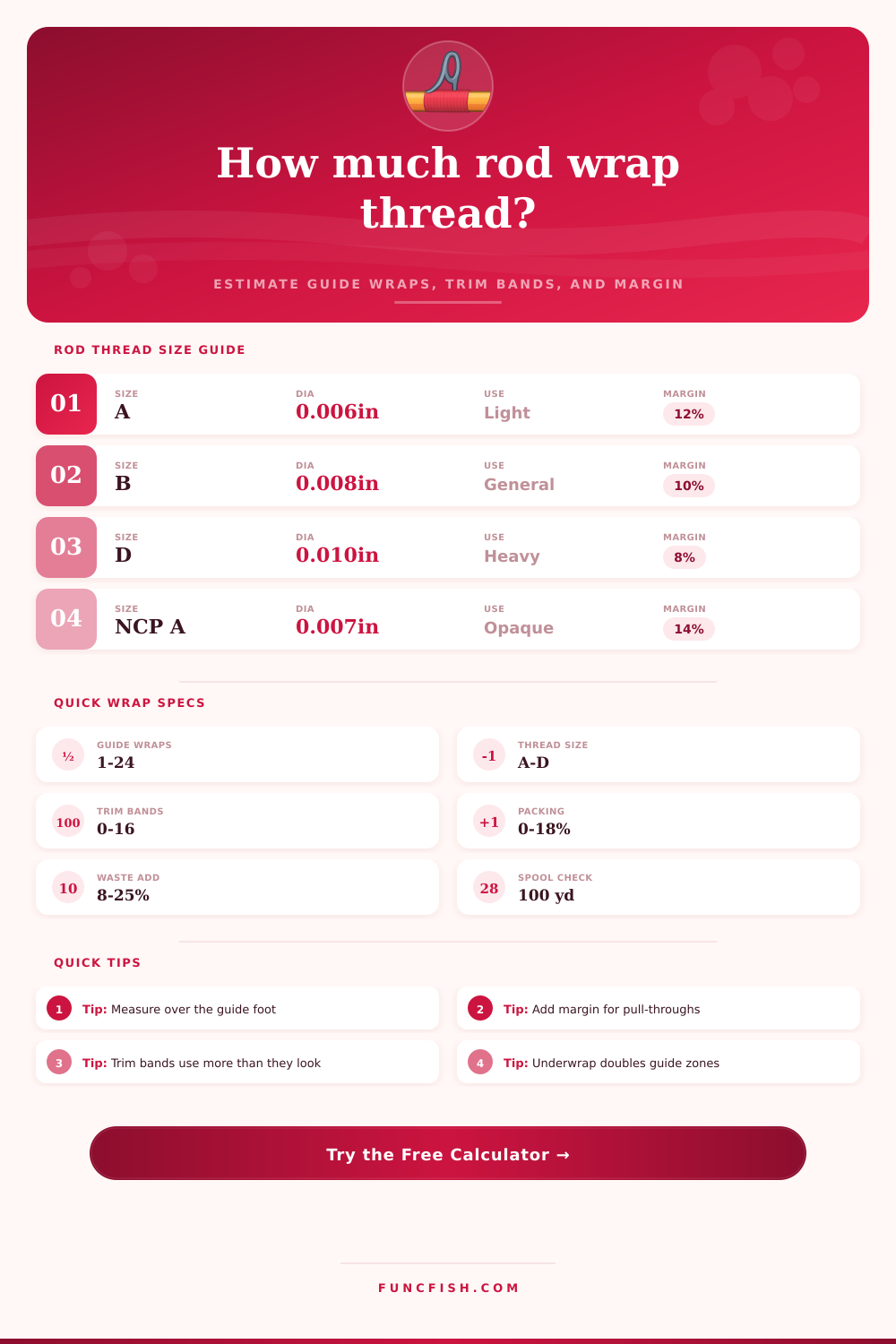
| Nylon size A | 0.0060 in / 0.152 mm | 0.0056-0.0064 in | 156-179 | most freshwater guide wraps |
| NCP size A | 0.0070 in / 0.178 mm | 0.0066-0.0076 in | 132-152 | opaque color without preserver |
| Nylon size B | 0.0080 in / 0.203 mm | 0.0075-0.0087 in | 115-133 | general guide repairs and trim |
| Nylon size D | 0.0100 in / 0.254 mm | 0.0092-0.0110 in | 91-109 | heavy saltwater guide feet |
| Kevlar D | 0.0110 in / 0.279 mm | 0.0102-0.0123 in | 81-98 | abrasion-prone heavy repairs |
🎣Rod class reference table
| Rod class | Guide count | Average diameter | Wrap length per foot | Thread choice |
|---|---|---|---|---|
| Ultralight spinning | 6-8 | 0.12-0.22 in / 3-6 mm | 0.35-0.55 in | silk 00, nylon A |
| Bass casting | 8-11 | 0.18-0.34 in / 5-9 mm | 0.45-0.70 in | nylon A or B |
| Fly trout | 9-12 | 0.10-0.26 in / 3-7 mm | 0.30-0.52 in | silk 00, nylon A |
| Inshore spinning | 8-10 | 0.24-0.44 in / 6-11 mm | 0.55-0.85 in | nylon A, B, NCP A |
| Surf casting | 7-10 | 0.36-0.68 in / 9-17 mm | 0.70-1.10 in | nylon B or D |
| Offshore trolling | 5-8 | 0.55-0.95 in / 14-24 mm | 0.90-1.45 in | nylon D, kevlar D |
🔄Wrap type comparison table
| Wrap type | Thread demand | Extra allowance | Why it changes | Typical result |
|---|---|---|---|---|
| Single-foot guide | lowest | 12-16% | one foot and one pull-through | compact guide wraps |
| Double-foot guide | medium | 14-18% | two separate feet per guide | twice the wrap zones |
| Underwrap plus overwrap | high | 16-22% | base layer adds diameter | saltwater protection wraps |
| Trim band set | low per band | 18-25% | short tags dominate the length | accent rings and ferrule marks |
| Decorative butt wrap | variable | 20-35% | long sections and color changes | large spool drawdown |
| Repair over old edge | medium | 18-28% | rough epoxy edges waste thread | more pull-through margin |
📊Thread length quick lookup
| Example setup | Thread size | Wrap zones | Base length | Plan length |
|---|---|---|---|---|
| Bass 9-guide casting rod | Size A | 18 | 8-12 yd | 10-15 yd |
| Trout ultralight spinning | Silk 00 | 7 | 2-4 yd | 3-5 yd |
| Surf double-foot build | Size B | 16 | 14-22 yd | 18-28 yd |
| Offshore underwrap set | Size D | 14 | 30-48 yd | 38-60 yd |
| Fly snake guide set | Size A | 22 | 6-10 yd | 8-13 yd |
| Decorative butt section | Size A | 1 | 10-35 yd | 14-45 yd |
💡Builder notes
Measurement tip: For guide feet, measure the wrapped length on the blank after the guide is taped in place. Long ramps and heavy feet can add more thread than diameter alone suggests.
Allowance tip: Short trim bands waste a surprising amount because each band still needs a start tag, pull-through loop, and trim tail. Raise allowance when bands outnumber guides.
Any rod builder will tell you that there’s a certain type of panic that sets in three guides before handle and you just know your thread spool is almost out. You’ve mixed the epoxy. You’ve sanded the transition. And you’ve got that last perfectly wrapped knot tied off too. Now you gotta go find two more yards of same nylon to complete your project.
That calculator does the math for you (above), but knowing how it gets those numbers will keep you from ever getting to the panic point in the first place. It makes you consider the invisible length that gets lost in tags and knots, it considers the geometry of tight packing. A lot of people first learn about calculating thread length by multiplying blank diameter by number of wraps, then calling it good. But they fail to account for tension and friction.
How to Use a Thread Calculator for Rod Building
Your thread is not simply resting on surface. It’s pushing against the resistance of a glass-like or carbon-based material that wants to slide back down. You can avoid this problem because the calculator allows you to enter a packing gap allowance in percent. This extra amount compensates for the naturaly give caused by pulling thread snugly onto a fiberglass or graphite foot. It also gives you some slack as you begin each wrap, which inevitably pulls out when you’re burning off the thread and trying to make it all lay flat. Without this variable, your guesswork could of get you into trouble.
The diameter is number of turns covering the blank surface. Thread size makes all the difference here. Nylon thread is typically about six thousandths of an inch thick (size A). While seemingly thin, it’s also tightly packed. It provides more turns per inch than bulkier threads like Size D, which are used for beefy saltwater rods. Smaller turns require additional turns to achieve the same distance along a guide foot.
That’s where the turns-per-inch reference on the page comes in. It illustrates that while individual strands take up less physical space, they requires more turns to cover the same distance. It’s a geometric give-and-take that catches folks when they think thinner = fewer yards.
Another thread-consuming beast is the underwrap. That little layer of black nylon under your guide foot not only dresses up your rod but it also protects blank from rod wear. But again, that layer increases the diameter of that circle you’re trying to wrap. And the bigger the circle, the more thread for every single turn. That’s why if you’re building a surf casting rod with eight guides and heavy underwraps, that added circumference will multiply in a hurry.
With the tool you can toggle layers on/off so you can view the true cost before cutting your spool. Until you’re looking at the bill, those little accent rings, or bands, don’t seem like much. Each has to start somewhere, get turned around a couple times realy tightly, and then there’s the whole tail tying thing. If you build a custom rod with fancy rings on each guide station, all that waste adds up quick. You might think it doesn’t matter for a single band, but that “doesn’t matter” stuff adds up to an entire yard of wasted thread across 10 bands. The calculator breaks out main guide wraps from trim bands so you can understand exact what your little decorative touches add up to in material cost.
Thickness is one consideration, but it’s not the only factor. For example, metallics have much less stretch compared to silk or nylon. Pull too hard when you’re cinching them in place for the last time and they snap! This means you will need a little more extra material to account for the trouble of having to retie an accent thread that broke off. Conversely, silk compresses and stretches wonderfully well, but if you don’t get tension absolutely perfect, it won’t look good at all.
In contrast, a poorly done metallic wrap will show imperfections. If you’ve got a lot of epoxy on top of it, that poorly done silk wrap may be hidden beneath, but a poorly done metallic wrap will show imperfections. Not so much. Don’t guess. The good rod builders don’t. They know exactly how many stations they’re going to have.
They measure the average diameter of their blanks per guide foot and calculate from there. Then they tack on a safety margin based off their own proficiency level. Novices should err on the side of caution since tying and tagging errors are inevitable. Vets can afford to be a little more sparing once they learn where their own tension tendencies fall in regards to packing density. Remember, while thread expense is part of getting your yardage correct, it’s also about honoring the process by doing it right.
At the end of the day, a successful build depends more on preparation then raw talent. That’s when I no longer have to worry if I’ve got enough left to get me through; I’m no longer scrambling for another spool in my junk drawer. I can now concentrate on clean epoxy lines and smooth transitions without having to do math in my head. All the calculations take away the stress and let me concentrate on the creative side of things, which is realy what the fun stuff is all about.