Slip Bobber Depth Stop Calculator
Set the bobber stop distance for slip float rigs from measured water depth, desired bait height above bottom, float style, wind angle, current drift, leader length, and rod casting clearance.
📌Slip bobber presets
⚙Depth stop inputs
Use a small margin when sonar depth is moving, the bottom is soft, or a clip-on depth finder hangs below the hook.
Slip bobber depth stop results
Full calculation breakdown
🧵Stop, float, and line comparison grid
Thread Stop
Dacron Knot
Rubber Stop
Double Stop
📏Bobber stop depth reference table
| Measured depth | Bait height above bottom | Base bait depth | Typical stop from hook | Use case |
|---|---|---|---|---|
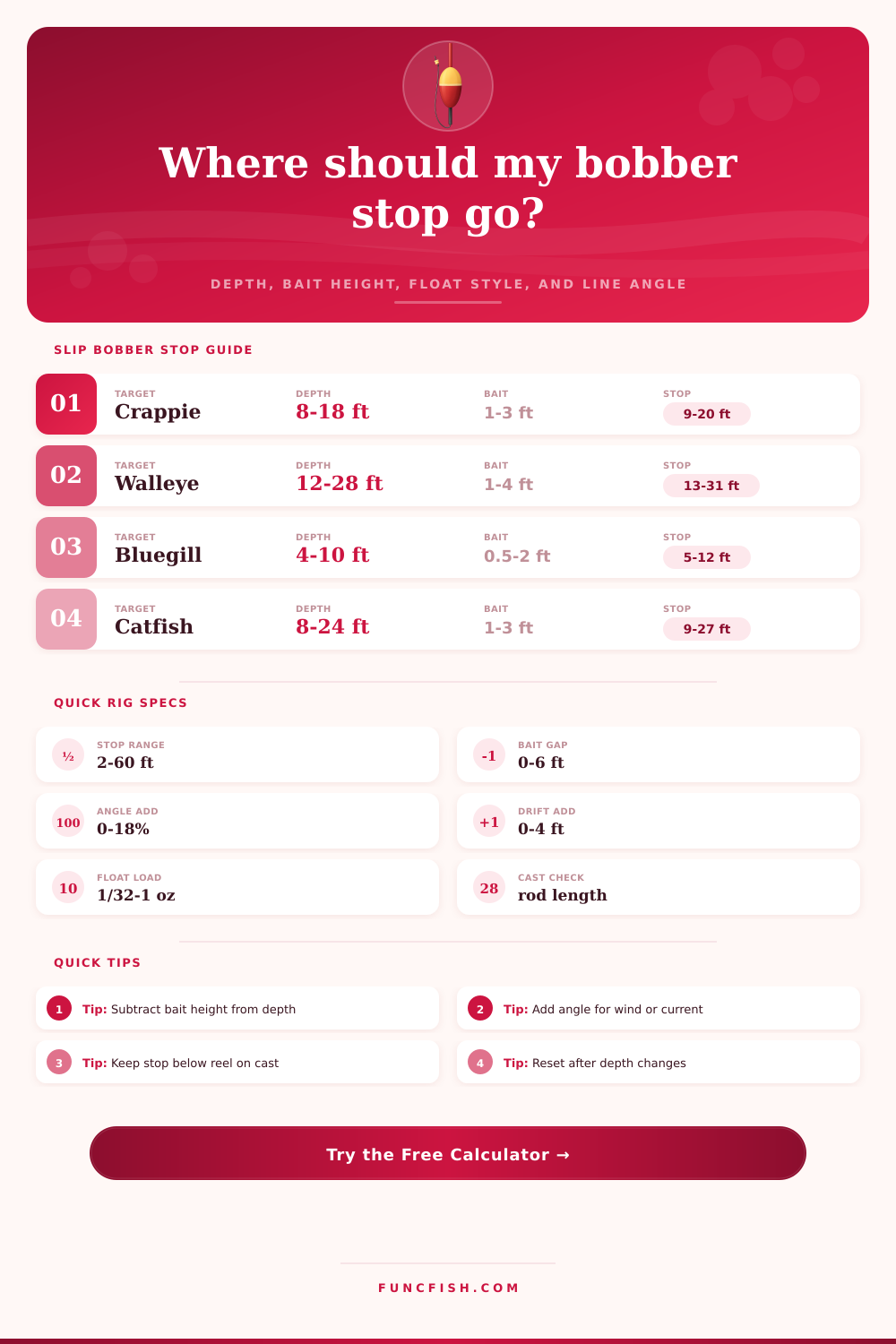
| 4 ft / 1.2 m | 0.5 ft / 15 cm | 3.5 ft / 1.1 m | 3.8 to 4.2 ft | Bluegill beds, shallow trout, docks |
| 8 ft / 2.4 m | 1 ft / 30 cm | 7 ft / 2.1 m | 7.3 to 8.1 ft | Weedline panfish, shallow crappie |
| 12 ft / 3.7 m | 2 ft / 61 cm | 10 ft / 3.0 m | 10.4 to 11.8 ft | Dock lights, timber edges, trout |
| 18 ft / 5.5 m | 2 ft / 61 cm | 16 ft / 4.9 m | 16.8 to 19.0 ft | Crappie brush, perch flats, catfish |
| 25 ft / 7.6 m | 3 ft / 91 cm | 22 ft / 6.7 m | 23.2 to 26.5 ft | Walleye reefs, deeper basin edges |
| 35 ft / 10.7 m | 4 ft / 1.2 m | 31 ft / 9.4 m | 32.8 to 37.8 ft | Deep crappie, suspended live bait |
💧Current and line-angle adjustment table
| Condition | Line angle | Stop multiplier | Extra drift allowance | Rig read |
|---|---|---|---|---|
| Still water or ice hole | 0 to 5 deg | 1.00 | 0 ft / 0 cm | Set stop close to calculated bait depth |
| Light breeze or slow slip drift | 6 to 10 deg | 1.02 | 0.2 ft / 6 cm | Small correction keeps bait above cover |
| Moderate wind bow or current seam | 11 to 18 deg | 1.05 | 0.6 ft / 18 cm | Deeper stop offsets angled main line |
| Strong current or long cast swing | 19 to 26 deg | 1.10 | 1.0 ft / 30 cm | Use heavier shot or shorten drift lane |
| Boat controlled drift | 8 to 16 deg | 1.04 | 0.4 ft / 12 cm | Correction depends on boat speed |
| Wind against current | Variable | 1.08 | 0.8 ft / 24 cm | Watch float lean and reset often |
🐟Species and gear matching table
| Species target | Common depth window | Float and stop match | Leader or hook spacing | Calculator focus |
|---|---|---|---|---|
| Crappie over brush | 8 to 22 ft / 2.4 to 6.7 m | Pencil or weighted slip float with thread stop | 12 to 24 in / 30 to 61 cm | Keep bait just above limb tops |
| Walleye on rock reef | 12 to 30 ft / 3.7 to 9.1 m | Weighted float and Dacron stop | 18 to 36 in / 46 to 91 cm | Add line-angle correction for drift |
| Bluegill and perch | 4 to 16 ft / 1.2 to 4.9 m | Small round or pencil float with micro stop | 6 to 18 in / 15 to 46 cm | Prevent dragging tiny jigs in weeds |
| Channel catfish | 8 to 28 ft / 2.4 to 8.5 m | Big bait float with double stop | 18 to 30 in / 46 to 76 cm | Hold bait off mud and debris |
| Stillwater trout | 5 to 18 ft / 1.5 to 5.5 m | Long waggler or pencil float | 10 to 24 in / 25 to 61 cm | Fine tune suspended bait depth |
| Pike or bass live bait | 5 to 14 ft / 1.5 to 4.3 m | Weighted float and heavy stop | 12 to 30 in / 30 to 76 cm | Place bait above weed tops |
🛠Float load and stop behavior table
| Float setup | Useful load range | Best stop style | Cast clearance concern | Adjustment note |
|---|---|---|---|---|
| Pencil float | 1/32 to 1/8 oz / 0.9 to 3.5 g | Thread or micro stop | Low, slides cleanly | Best for subtle bites and light jigs |
| Round foam float | 1/16 to 1/4 oz / 1.8 to 7 g | Rubber or thread stop | Medium, bead size matters | Good all-around panfish rig |
| Weighted slip float | 1/8 to 1/2 oz / 3.5 to 14 g | Dacron or thread stop | Medium, checks long casts | Useful when casting into wind |
| River balsa float | 1/8 to 3/4 oz / 3.5 to 21 g | Dacron stop | High, stop can creep | Add correction for current belly |
| Big bait float | 1/2 to 1 oz / 14 to 28 g | Double stop | High, heavy bait pulls hard | Use a larger bead and recheck depth |
| Ice slip float | 1/64 to 1/16 oz / 0.4 to 1.8 g | Tiny thread stop | Low, no cast load | Depth mark can be very precise |
💡Slip bobber calculation tips
Stop-setting tip: The basic stop setting starts with bottom depth minus the bait height you want. Add the hook-to-stop hardware distance, then apply the line-angle correction when the float drifts away from vertical.
Clearance tip: If the calculated stop sits far beyond the rod tip during casting, choose a smaller float bead, retie a slimmer stop knot, or reel the float closer before the next cast.
The line goes out over the water, then passes through guide to your spool. Then you tie a knot and hope it stops where you need it to stop. Physics is often ignored when we think about depth. When you cast into wind or against a current you throw the bait out and the line bows. It’s not hanging verticaly straight down. That angle forms a triangle between hook, float, and rod tip. If you only use fish finder reading to set the stop knot you’re ignoring that angle. Your bait is positioned higher then you meant for it to be. You believe you’re throwing to twelve-foot crappie but the fish is actualy in the weeds four feet below.
Trigonometry: The calculator does all of this math for you. If you want your bait 4 inches off the bottom, it will subtract that number from your water depth. Next, it includes current or wind-driven line angles. Many homebrew rigs falls down here. A gentle wind can adds just two percent to your stopping distance. A powerful river flow can boost that correction by double digits. That’s how much longer your hook stay in the strike zone.
Why Physics Matters for Your Stop Knot
Hardware reality also factors into the inputs. It’s not like measuring from top of the water to the eye of the hook. There’s something in between. The calculator includes the length of your float, your leader, and any split shot weight below the float. Four inch pencil float plus a six-inch leader sounds small. But those inches count in shallow water when targeting trout or bluegill. Does this represent the difference between missing a bite and snagging the bottom? That sum total the overall distance from the hook up to the stop knot. Then the tool verifies if that’s longer than clearance of your rod’s casting. Stop too near the reel seat and it will hit your guides on the cast. And that wrecks both presentation and potentially the line itself.
Notice how much deeper you need your bait when fishing for walleyes versus panfish over a reef edge. Drift allowance is also recommended if you expect moderate current. Why? This keeps the rig off bottom and pulls the line slightly out from vertical. That creates a triangle where the hypotenuse exceeds your depth. If you don’t take it into account you’ll miss fish that are literaly in front of your face.
There’s a lot more to stop knot material than people realize. Some stops like rubber slip/slide/stretch on long casts but set quickly. Dacron holds better on braids, but it is bulky and difficult to cinch down. Thread slips easily, but will creep with heavy loads. You choose those variables with the tool. It also adjusts for bulk & friction of each.
The setup doesn’t keep up with field conditions as fast as they do. Wind? Calm water? Change the angle correction and recalibrate. Big live bait? Tiny jig? The float load will be different and that impacts depth it’s sitting on in the water. That impact is on the depth the hook is effective at catching fish. The environment or presentation changes. Reset the stop.
A good catcher can make precise casts. A hopeful caster cannot. There is no need to be accurate down to the millimeter. What you want to know is where your bait realy lives in the water. That’s what your gut feeling says, but it’s somewhere else. A step-by-step approach takes out guesswork. You measure. Then, you take into account environmental factors, such as wind or current. Next, you factor in hardware. Finally, you put that hook right at the spot where the fish will wait. It transforms fishing from a casual outing into a target hunt. Instead of estimating, the stop knot becomes a promise.