Gaff Length By Rail Height Calculator
Estimate a practical gaff length from rail height, crew reach, fish position below the rail, shaft angle, hook size, fish class, cockpit setback, and lift clearance.
📌Gaff setup presets
⚙Rail height and reach inputs
Measure from waterline to the top edge where the gaff hand must clear the rail.
Use the expected depth of the gaff point when the fish is beside the boat.
A steeper angle reaches deeper but gives less sideways sweep and less pull control.
Add clearance for the hook bend, fish roll, and not scraping the rail on the lift.
Gaff length and rail clearance results
Full calculation breakdown
🔧Gaff head and shaft data grid
2-3 in Hook
4 in Hook
5-6 in Hook
Flying Head
📊Rail height comparison grid
Low rail
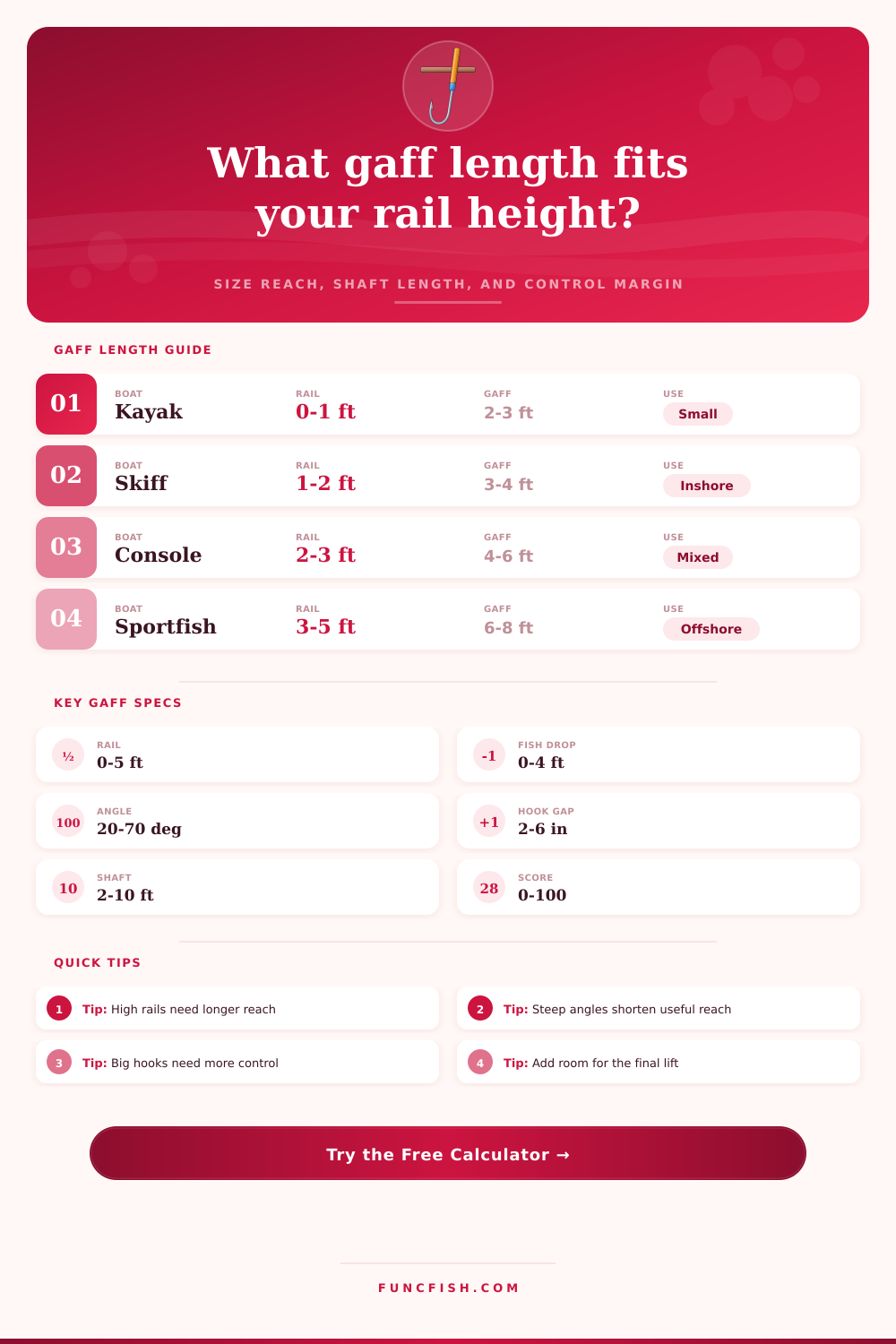
Rails under 18 in usually favor short, stiff gaffs because the fish is close and the lift happens fast.
Normal cockpit
Rails from 24 to 36 in often land in the 4 to 6 ft shaft range for mixed inshore and offshore fish.
High rail
Rails above 42 in need more vertical reach and a cleaner lift path, especially when the fish rolls away.
Pier or dock
High platforms can exceed normal hand-gaff geometry; the score warns when a different landing tool is better.
📏Rail height and shaft length table
| Rail or platform | Common height | Starting gaff length | Best fish class | Geometry note |
|---|---|---|---|---|
| Kayak or low skiff | 0-14 in / 0-36 cm | 2-3 ft / 0.6-0.9 m | Small inshore fish | Short reach keeps control close |
| Bass boat or flats boat | 14-24 in / 36-61 cm | 3-4 ft / 0.9-1.2 m | Pike, snapper, redfish | Low rail but some horizontal setback |
| Bay boat or dual console | 24-32 in / 61-81 cm | 4-5 ft / 1.2-1.5 m | Cobia, kingfish, mahi | Normal mixed-boat starting point |
| Center console offshore | 30-40 in / 76-102 cm | 5-6 ft / 1.5-1.8 m | Mahi, tuna school fish | Needs reach below rail and clear lift |
| Sportfish cockpit | 36-48 in / 91-122 cm | 6-8 ft / 1.8-2.4 m | Tuna, wahoo, grouper | Longer shaft gives reach but adds leverage |
| Pier or fixed dock | 5-15 ft / 1.5-4.6 m | 8-20 ft / 2.4-6.1 m | Special landing setups | Often exceeds normal hand-gaff handling |
🐟Fish class and hook gap table
| Fish class | Typical weight | Hook gap | Preferred shaft feel | Calculator adjustment |
|---|---|---|---|---|
| Small inshore fish | 5-12 lb / 2-5 kg | 2-3 in / 5-8 cm | Short and quick | Less reach allowance, high control |
| Medium game fish | 12-30 lb / 5-14 kg | 3-4 in / 8-10 cm | Moderately stiff | Balanced reach and lift margin |
| Long fast fish | 15-60 lb / 7-27 kg | 3-5 in / 8-13 cm | Fast sweep with control | Adds horizontal setback allowance |
| Deep-bodied fish | 20-70 lb / 9-32 kg | 4-5 in / 10-13 cm | Strong lift path | Adds hook gap and roll clearance |
| Flat fish | 15-100 lb / 7-45 kg | 3-6 in / 8-15 cm | Longer downward reach | Adds fish-drop allowance |
| Heavy tuna class | 60+ lb / 27+ kg | 5-8 in / 13-20 cm | Heavy or flying setup | Penalizes overload and long leverage |
⚓Shaft material comparison table
| Shaft material | Stiffness | Weight feel | Best length zone | Handling note |
|---|---|---|---|---|
| Tubular aluminum | Good | Light to medium | 3-7 ft / 0.9-2.1 m | Common all-around hand gaff material |
| Solid fiberglass | Very good | Medium to heavy | 4-8 ft / 1.2-2.4 m | Forgiving and strong under lift load |
| Carbon composite | Excellent | Light | 5-10 ft / 1.5-3.0 m | High reach with less swing fatigue |
| Wood handle | Moderate | Medium | 3-6 ft / 0.9-1.8 m | Good grip but can flex when long |
| Telescopic shaft | Lower | Variable | 3-6 ft / 0.9-1.8 m | Storage-friendly but less rigid extended |
| Rope flying gaff | Special | Head only | 6-10 ft / 1.8-3.0 m | Shaft places head; rope takes the load |
💡Gaff length calculation tips
Reach tip: Rail height alone is not enough. Add the fish drop below the waterline and the horizontal setback from the hull, then correct for the angle you can actually hold while the fish is moving.
Control tip: The shortest gaff that clears the rail is often better than the longest one that reaches. Extra length increases leverage on the wrist, hook, and shaft during the final lift.
Many guys buy a gaff based off its rail height, but few think about how your shoulder connects to the shaft as you lift or how fish hangs in the water. That’s when all the geometry kicks in. Because if you think about it. We’re trying to apply a triangle of leverage from our shoulder to the fish. Most folks rely on guesswork instead of trigonometry to get this right, and that explains why rail height becomes such an important part when considering both vertical reach and balance.
Plug those numbers into the calculator above and it do all the math for you. That way you don’t have to be fiddling with sine and cosine coefficients at 6AM when the sun’s high in the sky and fish is chewing. Just input your dimensions. Tell us how much higher the gunwale is than the water, how far below the water the fish’s center of gravity is, and how far your hand is from target horizontally. That last one is what most folks forget about. They assume it’s all vertical reach, but in fact you’re hardly ever right on top of the fish. It might be because you’re standing behind the helm or because you’re sitting on a cooler. Either way there’s always some horizontal gap and it will eat away at your available shaft length quicker then you think.
How to Choose the Right Gaff Size
The decision of which size hook to use comes down to compromise between control and penetration. For example, you can use a three inch hook on redfish. However, you cannot use one for tuna and mahi because that tiny head is likely to slip out in the heat of battle. On the other hand, larger hooks requires greater clearance to clear the rail on the lift. In other words, you must have ample space between the gunwale and the hook to ensure the fish does not scrape along the fiberglass tearing up your line. To achieve this protective arc a longer shaft is necessary if your rail is high and your hook is big.
However, longer means leverage becomes an issue. The further the handle is positioned from the pivot point the harder it will be on your wrist when the fish rolls. It’s all about finding balance between being long enough to reach and having the strength to stay there. That leverage feels different depending upon materials. Tubular aluminum shafts are popular because they’re lightweight yet will bend if forced past their moddern designed strength. Solid fiberglass will be stiffer and able to hold more weight before bending out of shape. This is important when hooked into a five-foot wahoo at the rail. Carbon composites are pricey but take a little of the swing fatigue out of a day’s work. Wood handles has the traditional feel but provide good grip and are also easy to find.
The tool generates a handing score based on the angle, length and weight. If it’s low then you’ll likely experience wrist strain or miss strike with this combo. It is better to choose something shorter and stiffer rather than having a noodle-like feeling when under pressure.
They say the sea state is a bigger factor than many give it credit for. When it’s calm, you’ve got time to line up the perfect shot. With the roll of the chop, fish stays mostly in one place but the boat moves up and down on each swell, changing where you need to aim. Offshore what’s spot-on in the slip won’t work at all. As the boat pitches up and down the window of opportunity get smaller. To compensate you’re going to add margin to your reach calculation based off how it will move around. That’s what the tool does with those variables. It provides you a starting point, then you tweak from there.
Catching the fish is not really the mission; it is catching them without damage or breaking any furnitures. Usually the ideal gaff is the shortest one that gets the job done while staying clear of the rail. Skill does not increase with added length. Added length increases both distance and the risk factor. Be near the middle of the boat with your hands, trust the geometry and be respectful of the leverage. You’ll get a cleaner fish on board and your wrists should of appreciated it later.