Fish Weight by Length and Girth Calculator
Estimate live fish weight from length and girth using field formula divisors for bass, trout, pike, catfish, panfish, offshore pelagics, and general gamefish body shapes.
📌Length and girth presets
⚙Fish measurement settings
Use total length for most freshwater fish; use fork length when that is the standard for tuna and some pelagics.
Girth is squared in the formula, so a small tape error changes weight quickly.
Leave at the loaded profile value unless you have a local length-girth chart for the species.
Length-girth weight estimate
Full calculation breakdown
📊Species and gear comparison grid
Bass Profile
Trout Profile
Pike Profile
Catfish Profile
📏Length-girth formula divisors
| Fish profile | Default divisor | Typical girth ratio | Best length input | Calculator note |
|---|---|---|---|---|
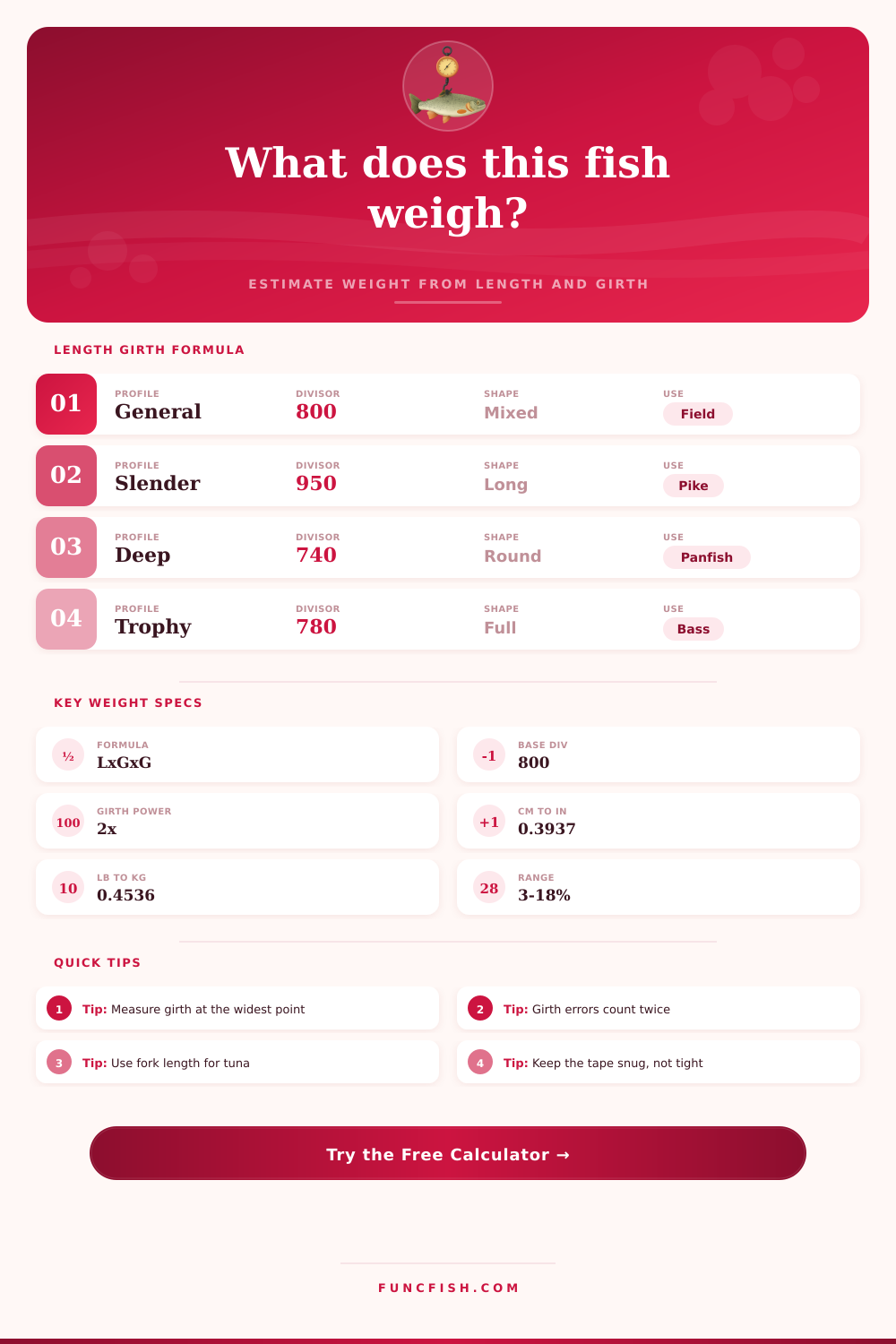
| General gamefish | 800 | 50-70% of length | Total length | Standard field estimate for mixed body shapes. |
| Full-bodied bass | 780 | 62-78% of length | Total length | Handles broad shoulders and pre-spawn bellies. |
| Lean bass or walleye | 880-900 | 48-63% of length | Total length | Higher divisor reduces over-estimation on tapered fish. |
| Trout and salmon | 860 | 50-65% of length | Total or fork length | Works for normal stream and lake condition fish. |
| Pike, muskie, barracuda | 980 | 35-52% of length | Total length | Long slender fish usually need a higher divisor. |
| Catfish, carp, drum | 735 | 60-85% of length | Total length | Round-bodied fish need a lower divisor. |
| Deep panfish | 740 | 58-78% of length | Total length | Useful for crappie, bluegill, and deep perch. |
| Tuna and pelagics | 900 | 48-66% of fork length | Fork length | Fork length avoids tail-tip inflation. |
🎯Measurement sensitivity reference
| Measurement issue | Weight effect | Why it matters | Best calculator setting | Field check |
|---|---|---|---|---|
| Length off by 1% | About 1% | Length is used once in the formula. | Length uncertainty | Measure nose to tail on a flat board. |
| Girth off by 1% | About 2% | Girth is squared before dividing. | Girth uncertainty | Repeat widest-point wrap twice. |
| Loose tape | High estimate | Slack inflates the squared girth term. | Loose tape method | Remove visible bow from the tape. |
| Tight tape | Low estimate | Compression reduces the body circumference. | Compressed tape | Use contact without squeezing. |
| Fork vs total length | Species-specific | Fork length is shorter than total length. | Fork length type | Use the same standard as the chart. |
| Wrong body profile | Medium to high | The divisor represents cross-section shape. | Species profile | Compare girth ratio to table values. |
⚖Scale and handling match table
| Scale class | Useful range | Best species match | Resolution target | Calculator use |
|---|---|---|---|---|
| Ultralight pocket scale | 0-10 lb / 0-4.5 kg | Trout, panfish, finesse bass | 0.01-0.05 lb | Compare when estimated weight is small. |
| Bass digital scale | 0-30 lb / 0-13.6 kg | Bass, walleye, redfish slots | 0.02-0.10 lb | Good match for most freshwater trophy estimates. |
| Tournament digital scale | 0-55 lb / 0-24.9 kg | Striper, salmon, pike, carp | 0.05-0.10 lb | Useful when the estimate nears bass-scale limits. |
| Catfish sling scale | 0-110 lb / 0-49.9 kg | Catfish, carp, drum, muskie | 0.1-0.5 lb | Pair with round-body profiles and wide girths. |
| Offshore spring scale | 0-250 lb / 0-113 kg | Tuna, amberjack, grouper | 0.5-1 lb | Use fork length and a pelagic divisor. |
| Boat sling scale | 0-500 lb / 0-227 kg | Large tuna, shark, giant catfish | 1-2 lb | Best when handling gear supports the fish fully. |
🐟Common species length-girth examples
| Species example | Length | Girth | Profile divisor | Approximate weight |
|---|---|---|---|---|
| Largemouth bass | 22 in / 55.9 cm | 16 in / 40.6 cm | 780 | 7.2 lb / 3.3 kg |
| Brown trout | 24 in / 61.0 cm | 13 in / 33.0 cm | 860 | 4.7 lb / 2.1 kg |
| Northern pike | 40 in / 101.6 cm | 17 in / 43.2 cm | 980 | 11.8 lb / 5.3 kg |
| Channel catfish | 32 in / 81.3 cm | 22 in / 55.9 cm | 735 | 21.1 lb / 9.6 kg |
| Crappie | 16 in / 40.6 cm | 11 in / 27.9 cm | 740 | 2.6 lb / 1.2 kg |
| Redfish | 28 in / 71.1 cm | 17 in / 43.2 cm | 820 | 9.9 lb / 4.5 kg |
| Walleye | 30 in / 76.2 cm | 16 in / 40.6 cm | 900 | 8.5 lb / 3.9 kg |
| Yellowfin tuna | 50 in / 127.0 cm | 34 in / 86.4 cm | 900 | 64.2 lb / 29.1 kg |
💡Measurement tips
Girth placement: wrap the tape around the widest part of the fish, usually just ahead of the dorsal fin or across the deepest belly point. For round-bodied fish, rotate the tape until it sits square to the body, not angled toward the tail.
Formula check: if the result feels high, recheck girth before changing length. Because the calculator squares girth, a half-inch error on a heavy fish can move the estimate more than a full inch of length.
The moment you pull a fish from the water, the excitement shifts to curiosity. How much did I just catch? All anglers ask that question, whether they is catching trophy bass in a lake or smallmouth in a creek to meet slot limits. And ideally you’d weigh it right there, but scales can be cumbersome and you forget them. But knowing some basic geometry, we found measuring girth and length to estimate weight work remarkably well. Plug those numbers into the calculator up top and it does the math for you so you’re not trying to remember coefficient and conversion factors. It also keeps fish wetter longer, improving their survival rate.
The basic idea is that it treats the fish as a cylinder, not a blob. So, when you measure girth, that is circumference of the cylinder, and when you measure length, that is height of the cylinder. Because volume increases as the square of diameter, the girth are squared before being divided by a constant for each species. And this is why girth is so important and length isn’t. An error in length measurement of one inch have only half the impact of a one-inch error in girth measurement. Why? This happens because you square the girth number before dividing by the species specific constant. Get that?
How to Measure Fish Weight Without Scales
This is where folks screw up. They’ll go crazy trying to get their length down to the closest sixteenth of an inch, but then they throw the girth tape around them and let it sag loose, which greatly inflates the number. The other part is matching correct body profile. Not all fish are cylinder shaped. For example, a fat catfish with its round belly and deep body are less heavy for its width than a slender pike. To compensate for this, the tool applies different divisor depending on the body shape. Think of the divisor as a correction factor based off how thick the fish’s body is compared to its length.
Using a generic setting on an exceptionally lean smallmouth bass is going to result in an overestimate of size. Using a slender-profile setting on a full-bodied largemouth is going to make a monster appear average. But it does matter if bragging rights are at stake. Beyond just raw numbers, do field conditions matter? Of course they do. A wintering prespawn fish will appear much more different than a freshly spawned one and even more different than a fish full of baitfish. This is where you use the condition adjustment in the settings. It will adjust the starting point higher or lower based on the fish’s physical condition.
Your tape technique matter too. You want snug but not tight. Too tight and you are compressing the body and underestimating the weight. Too loose and you allow the squared girth term to swell the equation. It’s there for a purpose, but only when the entered data reflect what is really happening. Forked finned fish like tuna and others that swim in the open ocean in particular pose a problem due to extreme variability in tail fin spread. Total length is a poor choice when estimating these fish as it results in overestimates frequently. Fork length is a set measure that ignores the variable tail rays to make the measured length consistent. The chart on the page explain it well: Which length type works best with what body shape? The math matches how bodies are built to maintain biological norms. Matching the profile with the measurement type will keep everything consistant.
The way a fish is handled will not only affect its well being but also how accurately it can be estimated. Evenly supporting the fish allow for correct measurements. This prevents damage to the spine and maintains the proper body form throughout. A twisted spine alters the girth which throws the estimate off. Measure at the widest part (most often at the widest part of the belly, or just behind the dorsal fin) and make sure the tape runs parallel with the axis of the tail. If possible don’t take a measurement when the fish is flailing about. That adds extra stress that distorts the body shape. A calm estimate is an accurate estimate.
Ultimately, it is about respect for the craft. It creates a meaningful record from a quick snapshot without dragging out the heavy tools. It gives you an accurate estimate based on size, shape and condition. You should of used this more often. In the end, you haven’t just taken home a story; you have proof of their size that honors both the fish and the sport. The numbers are there to tell the tale, but the tape has the truth.