Smoker Brine Ratio Calculator
Scale fish smoker brine from batch weight, water coverage, target salinity, sugar balance, cure level, salt density, and container headroom.
📌Smoker brine presets
⚙Brine ratio inputs
Example: 1.25 means water weighs 1.25 times the fish batch.
Equilibrium mode uses fish plus water; water-only mode uses water mass only.
Set 0 when cure is not part of the brine specification.
Smoker brine batch math
Full calculation breakdown
📊Batch ratio data cards
Mild Fish Brine
Standard Smoker Brine
Firm Brine
Cure Math Check
📋Reference tables
| Brine target | Salt percent basis | Sugar ratio | Water coverage | Math note |
|---|---|---|---|---|
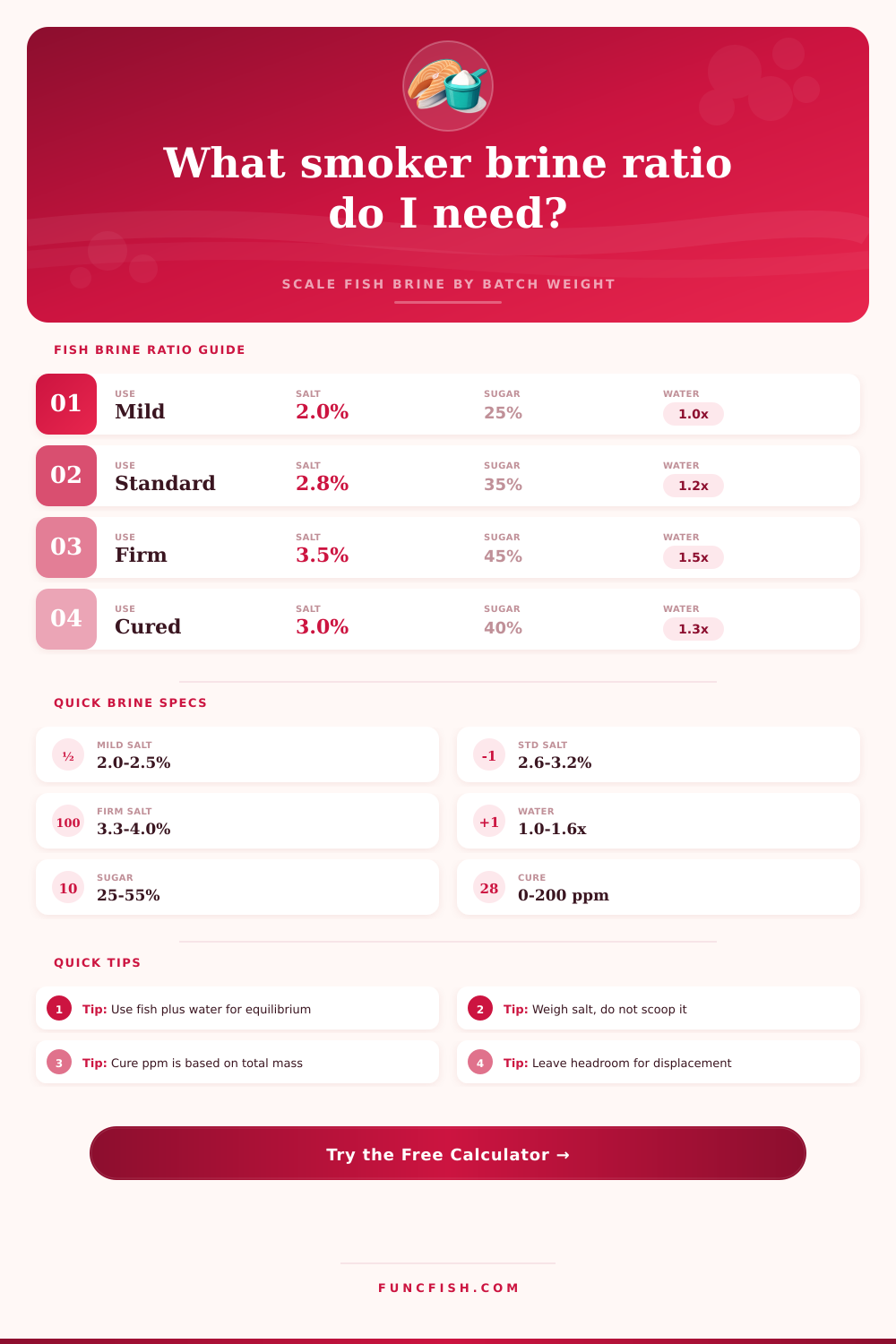
| Mild smoker fish | 2.0% to 2.5% | 20% to 35% of salt | 1.0x to 1.2x fish weight | Low salt balance for lean fillets |
| Standard salmon | 2.6% to 3.2% | 30% to 45% of salt | 1.2x to 1.4x fish weight | Balanced equilibrium batch scaling |
| Firm oily fish | 3.3% to 4.0% | 40% to 60% of salt | 1.3x to 1.6x fish weight | Higher solute load for rich fish |
| Cure ppm check | Selected salt percent | Any selected ratio | Any selected ratio | Cure #1 grams use total mass |
| Salt type | Approx grams per tablespoon | Approx grams per cup | Volume reliability | Calculator use |
|---|---|---|---|---|
| Table salt, fine | 18 g | 288 g | High | Dense volume conversion |
| Morton coarse kosher | 15 g | 240 g | Medium | Coarse kosher estimate |
| Diamond Crystal kosher | 9 g | 144 g | Medium | Light flake estimate |
| Fine sea salt | 17 g | 272 g | High | Fine crystal estimate |
| Coarse sea salt | 13 g | 208 g | Low | Coarse crystal estimate |
| Pickling salt | 18 g | 288 g | High | Fine dissolving salt |
| Fish group | Typical smoker brine target | Water ratio | Density behavior | Scaling factor |
|---|---|---|---|---|
| Salmon or steelhead | 2.7% to 3.2% | 1.2x to 1.4x | Moderate displacement | Standard baseline |
| Trout or char | 2.0% to 2.8% | 1.0x to 1.3x | Lower mass pieces | Reduce salt target slightly |
| Whitefish or cod | 2.2% to 3.0% | 1.1x to 1.4x | Lean and flaky | Moderate sugar ratio |
| Mackerel or herring | 3.0% to 4.0% | 1.3x to 1.6x | Oily, dense batches | Raise solute load |
| Catfish or tilapia | 2.2% to 2.8% | 1.1x to 1.3x | Moist lean fillet | Use mild to standard |
| Batch fish weight | Water at 1.2x | Salt at 2.8% equilibrium | Sugar at 35% of salt | Container with 15% headroom |
|---|---|---|---|---|
| 2 lb / 0.91 kg | 2.4 lb / 1.09 L | 2.51 oz / 71 g | 0.88 oz / 25 g | 4.6 qt / 4.4 L |
| 5 lb / 2.27 kg | 6.0 lb / 2.72 L | 6.16 oz / 175 g | 2.16 oz / 61 g | 11.5 qt / 10.9 L |
| 10 lb / 4.54 kg | 12.0 lb / 5.44 L | 12.32 oz / 349 g | 4.31 oz / 122 g | 23.0 qt / 21.8 L |
| 20 lb / 9.07 kg | 24.0 lb / 10.89 L | 24.64 oz / 699 g | 8.62 oz / 244 g | 46.0 qt / 43.5 L |
🧰Gear and species comparison grid
Flat Pan Batch
Best for: Fillets and strips.
Coverage math: 0.9x to 1.2x water.
Headroom: 10% to 15% is usually enough for shallow layouts.
Food Tub Batch
Best for: Mixed fillet sizes.
Coverage math: 1.2x to 1.5x water.
Headroom: 15% to 20% for displacement.
Cooler Batch
Best for: Large salmon or whitefish sets.
Coverage math: 1.4x to 1.7x water.
Headroom: 20% if pieces are irregular.
Whole Fish Batch
Best for: Small trout, herring, or mackerel.
Coverage math: 1.4x to 1.8x water.
Headroom: Higher because shape traps volume.
Ratio tip: Equilibrium math is batch-stable because salt is calculated against fish plus water mass, so doubling fish and water doubles salt without changing the final percentage.
Scale tip: Salt volume is a backup estimate only. The gram result is the controlling number because coarse and flaked salts can vary widely by scoop.
It’s a nice looking piece of salmon that you pulled off ice, so you take it into house to start making your brine. Then what? How much salt and how much sugar do you put in there? No idea; you’re winging it. Will it fit in the bucket? Is that going to be enough liquid to contain the fish as they floats? Are you going to tip the thing stirring it?
Good smoked fish is all about exact math, not some mysterious skill. This take the guesswork out of it. Enter your batch size below and tool will spit out a full recipe. It gives you the exact amount of salt, sugar, and cure required for your fish. It also factors in both volume of water and how much space the brine fills in your vessel.
Why Exact Math Is Important For Brining
Why? Because brining is not art; it’s chemistry. Osmosis is working for you or against you. Choosing between Equilibrium and Traditional Percentage Methods are by far most critical selection. You’ve seen many recipes instructing you to use X-amount of salt per gallon of water. That won’t work. Fish aren’t all the same thickness. They’re not all the same density. And they’re certainly not the same fat content.
Equilibrium brining take into account the weight (mass) of the fish + water. The result is always that a thin trout fillet will have the same internal salt concentration as a thick halibut steak, after a certain period of time. It stabilizes the outcome regardless of which cut style you choose. For those who smoke whole small fish, the density shifts somewhat and the calculator corrects for that displacement to maintain your salinity target.
Another common problem is that there is not enough water to cover all of the fish. Uneven curing can lead to air pockets (dry spots) and air pockets = no bueno. You have an option for setting a coverage ratio here in the calculator, it’s basically how much does weight of your water compare to the weight of your fish? For example, a 1.2 coverage ratio implies that your water weighs twenty percent more then your fish. That sounds like a lot of water but keep in mind that fish displace their own volume. If you don’t account for this, you’ll end up with a brine that’s either too weak in places or too strong elsewhere.
It also uses weight instead of volume measurements (the other reason why measuring with cups might be inaccurate) since different brands of salt will have vastly different flake sizes (and kosher vs. Table salt has a bigger impact than most people realize because kosher salt is much less dense and uniform. A cup of one brand won’t be equal to a cup of another, which may throw your measurement off by half or even double, and that’s bad news bear when it comes to things like over salting meat and ruining bacon.
Invest in cheap digital scale if you don’t have one yet; weighing out ingredients removes this variable, and the thing will pay for itself after just one failed batch of over-salted something-or-other. You should of used a scale earlier.
The sugar does double duty. It rounds out the saltiness of the brine while also feeding the good bugs that do all the work during curing. You’ll see a place on the calculator where you enter sugar in percentage of your total salt amount; that way you adjust the overall salt content (up/down depending on type of fish) but maintain the ratio. For instance, oily fish such as mackerel tend to take more salt and sugar than leaner whitefish which can get mushy quickly if over-brined.
Things gets even more precise when preserving color and extending shelf-life with Cure #1. The tool tells you exactly how many milligrams of cure will achieve your desired parts per million across the entire batch mass. That’s why getting it right is not negotiable, under-curing exposes the fish to spoilage, while over curing results in a chemical aftertaste that overpowers the smoked flavor.
Control is king when it comes down to it, as having a firm grasp on your water and salt content allows you to take the anxiety out of the equation. No more praying for the perfect fish, it’s all about following the formula, trusting in the science and letting the heat handle the heavy lifting. This leads to delicious, repeatable smoke each and every time. You’ll recieve better results with this method. The modern way is much easier than older methods. It feels naturaly right. Actually, it works well based off these numbers. Making sure you use correct furnitures for your smoker is also key. Do not let the brine dissapears from the fish. Use a luxurius amount of smoke if you want!