
A little bit earlier in the spring you get hooked up using some light tackle and a tiny piece of worm, thinking it’s going to be something big. Well it’s just about as big as a handful long when it comes back, but it fight like it weighs twice as much than that does. When it finally splashes through top of the water, it looks so much bigger than it was. That’s the way it goes with bluegills.
That is the classic bluegill; the fish that will teach children how to use a fishing pole and keep old men coming back to small ponds because they simply won’t stop fighting. Before you realy learn to appreciate the fish, you better know what you’ve got in your net. There are quite a few cousins in the sunfish family that all looks a lot alike, and it gets confusing.
How to Tell a Bluegill From Other Fish
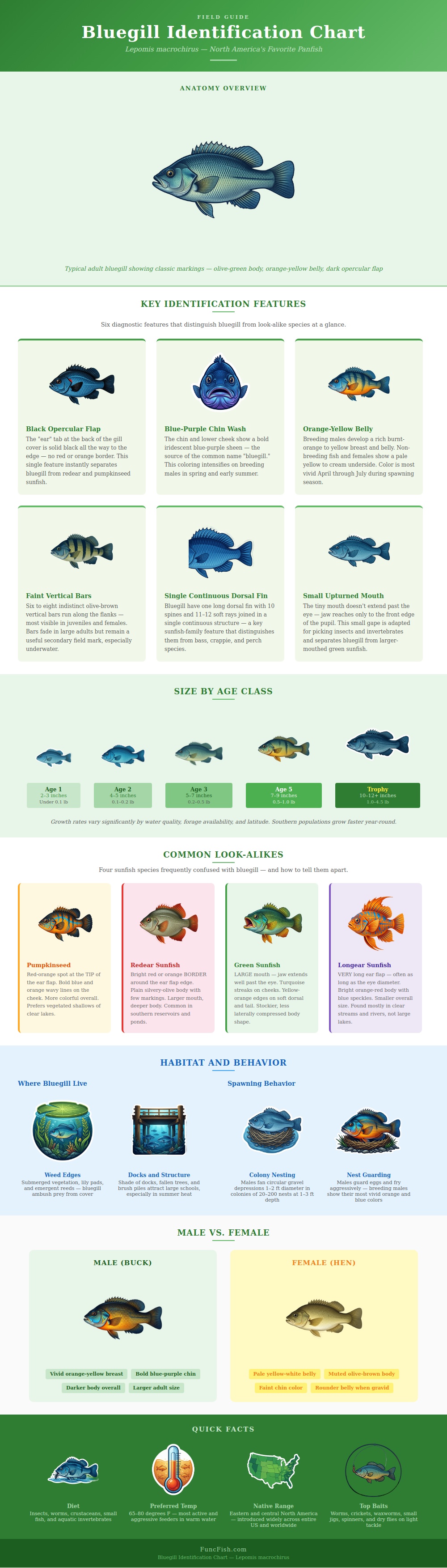
Behind the gills is probably the best place to tell the true bluegill apart from its cousins. Find that distinctive ear flap located off to the side of its head. This one characteristic do more work than all of the other markings on the fish combined. It’s a solid black tab without any kind of bright border around the edge.
A redear sunfish will have an orange or red rim around this flap so it’s usually easy to identify. The pumpkinseed goes a bit further with its colors by having wavy blue lines running down its cheeks and sometimes a red-orange spot on the very end of its ear. When light is low, the water is dirty or you’re not paying close attention to these details, they can be pretty easy to mix-up.
Finally, there’s the face. Those vivid colors that wash across the throat and lower jaw in an adult male give him his common name: bluegill. As spring temperatures warms, this blue-purple glow increases. It washes across entire gill flap and floods the throat of a spawning male with an electric blue and sometimes even an orange belly. This makes a breeding male look almost like a livig stained glass window.
Females don’t get these bright colors, remaining a duller olive-brown color with a pale yellow belly to help hide in the cover and guard the bed. It helps to know who you’re looking at, since not only do males become much more aggressive during the courtship ritual but they’ll also readily bite on lures that females totally ignore.
How do they grow? The answer lies in the chart above, which illustrates why patience pays in panfish fishing: A yearling weighs less than an ounce (and it isn’t much longer than your thumb). It will take several years before that same fish reach trophy status. And even when that happens, its maximum size is small compared to pike or bass. Most don’t get any bigger than about ten inches and most of their weight are in their heads.
To get one big enough to feel on your drag, you’ll need to find relatively clean water with high predation pressure and plentiful food. You will also need good growth rates, which depend heavily based off habitat quality and latitude. A Florida trophy may be considered average in Maine.
Where do you find them? Before they want to show themselves, look for habitat clues. Weed edges, lily pads, and submerged docks provide the perfect ambush points. Bluegill like any type of structure that gives them cover from predators but allows them access to open water where prey congregates. Submerged docks, weed edges, lily pads… All are perfect spots for bluegill to hide when ambushing unsuspecting insects. Because they swim in schools, if you find one there is probably dozens more nearby.
It is spawning time. Males form circular nests in shallow areas with gravel bottoms and frequently group up in clusters spanning long stretches of a lakeshore. They’ll chase everything that gets too near their territory, which makes them an easier target because of their aggressive territorial nature.
When anglers think they are catching bluegills and it turns out to be green sunfish, they make mistakes based off body similarity at distance. The tell is the mouth shape. Bluegill’s mouth is a small upward turned affair for picking off of surfaces. The green sunfish has a wider mouth that extends way beyond the eye. It is a subtle difference, but you will see it once they are next to each other.
Aha! Learning to see those slight bars on their flanks also helps us identify them when we can’t clearly see the ear flap. Younger ones will have more distinct bars than older, “grumpy” fish lurking beneath brush piles.
In the end, being able to correctly identify your bluegills turns carefree angling into observing nature. You find yourself paying attention to what types of water grow bigger fish. You also learn more about structure, as some structures hold better fish than others. The next time a tiny flash of color jumps out of the water and pulls back on your line, you’ll instantly recognize who bit. Sure, it’s still a little sunfish thrashing at the end of your line, but now it has a familiar face, a known name and a distinct personality. Knowing this makes each hookset not just a blind date, but an introduction worthy of meeting.