
You’ve been there before: You see a big bluegill in the water, but it comes to the scale weighing not much at all. You see another fish swimming alongside the reeds and think it’s huge, but it thuds softly on end of hook and doesn’t even budge the needle. Then you set the hook and feel a ton of weight on the other end of the line but wind up with a skinny little ten-inch fish that weighs less then a fat eight inch one.
This is the riddle to the puzzle of sunfish fishing. They has this odd ability to make a fish appear bigger than they really are. The light makes our eyes play tricks and water distorts perspective. So visual guesswork just isn’t accurate. That is why knowing how length relates to weight is such an important thing. It turns you from a guesser to an educated angler who understand what he has on the hook when the bite occurs.
How to Guess the Weight of a Bluegill
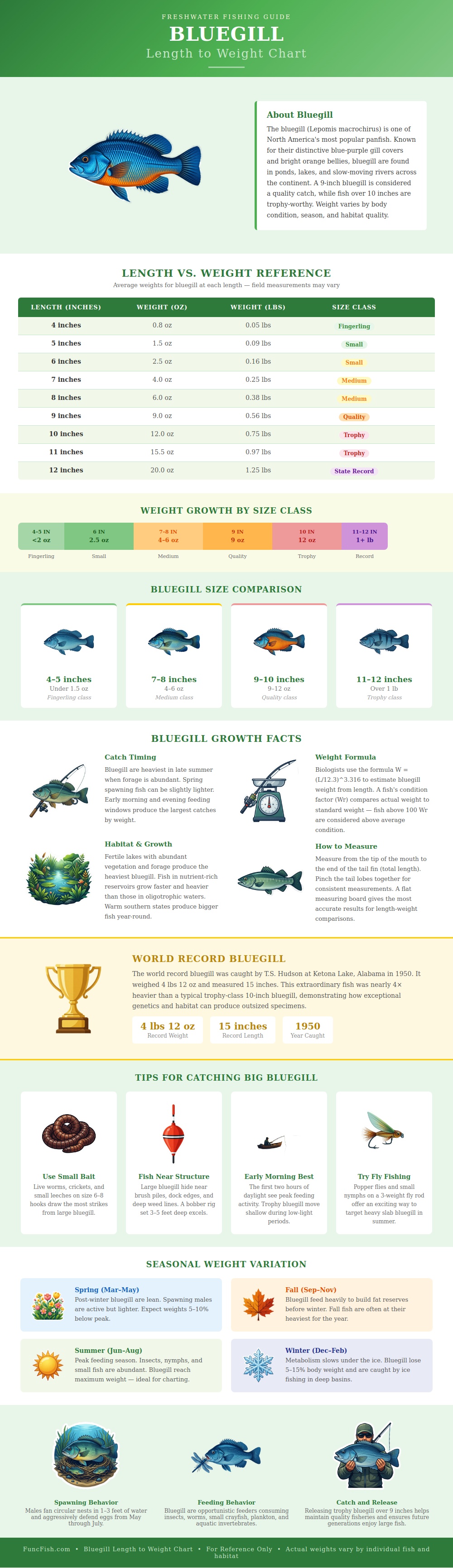
That’s where the weight comes into play. Weight increases as the fish grows in length, in fact it skyrockets. A four-inch fingerling, which many of us think will make a decent meal, probably weighs less than an ounce. Nine inches on the other hand can easily approach half a pound. This increased density is what sets the avid panfish guy apart from those who merely catch them casualy.
You’ll notice in graph above that weight doesn’t steadily rise in proportion to the length of the fish. It EXPLODES. Once past eight inches, it increase at an exponential rate. This means a 10-inch bluegill isn’t slightly bigger than an eight-inch one. It’s a whole new ballgame. And that’s why folks misunderstand it. They think growth is linear; it’s not. Growth is exponential in well fed water.
This data is based off fish in average condition; unless you’re extracting starving specimens from overpopulated ponds. Bluegill living in fertile lakes teeming with insects and vegetation develop fatter bodies to sustain their skeleton. So if you catch a nine inch fish in the heat of summer when forage is plentiful, expect much more bulk than one you catch in cold spring water moments after they spawns. The infographic suggests as much with its mention of warm months being their peak weight.
How do biologists estimate these figures? They establish condition factors, which compare an actual weight to standard length. Healthy, plump fish are above average condition. Underfed or stressed fish is below average. Understanding this explains why you shouldn’t get too excited about a skinny ten-inch’er; it could still be a good catch in a bad lake, but it won’t weigh like those trophy illustrations in the reference table.
To weigh them right, you must gets the measurements right. For some reason a lot of guys don’t line their heads up straight on the scale or stretch their tails out too far when they go to get a weight. The normal way to measure it is to pinch the tail lobes together. Then, compress the caudal rays where they meet at end of the tail. Finally, take a measurement from tip of the nose down to the end of the caudal rays. Do it every time and soon you’ll see what scientific surveyors see.
Studies show that size trends for most bluegill population peak somewhere around nine or ten inches. Predators keep the population in check along with lack of food resources. When you catch one that’s an eleven-incher it’s something special. When you land a slab at twelve inches it becomes legend.
How do you actualy catch them? Your best friend is structure. Big bluegill aren’t the most cautious of feeders but they love to hang out around cover such as docks, brush piles and deep weed lines. Unless they’re desperate for food, they won’t risk exposing themselves in open water. Offering up something small like a nightcrawler or cricket on a tiny hook enables you to put your offering in front of them naturaly and not set off their instinct to protect themselves.
The other key is early morning light. These fish will venture shallow to feed during low-light hours. When the sun rises, they slide back to the safety of deeper cover. Getting bites becomes odd and hard to detect.
In conclusion, fishing for large bluegill comes down more to having patience than ability. They are an exception to a normally smaller population. So when you eventually hook into one of those 13-plus-inch slabs that doesn’t fit on the average weight graph, think back to that shocked expression when it bursts onto the surface. It’s all worth the silent hours staring at that bobber.
So release the big fish for the sake of the habitat and hopefully your guess will match the scale next time around. You should of seen how big it was.