
Schooling number panfish with great flavor, yellow perch are always a sure bet. Unfortunatley, their population are sometimes consistently small or non-existent on many lakes. If you want to learn how these things play out instead of leaving them to chance, you need to look at the biology. Specifically, growth pattern of yellow perch reveals much about a lake’s population density, food webs, and overall health. Since conditions from when they were fry determine how big a fish becomes, we need to examine their early life stages and learn why certain lakes support a bigger catch different than other lakes do.
Why They Grow Big But growth begins early. A yearling perch will spend its days cruising around shallow weed bed, filtering tiny insect larvae and zooplankton out of the water. Those fry that gets into a warm summer with a rich plankton bloom will grow fast, and the more they grows in their first year, the better off they are permanently.
How Yellow Perch Grow Big
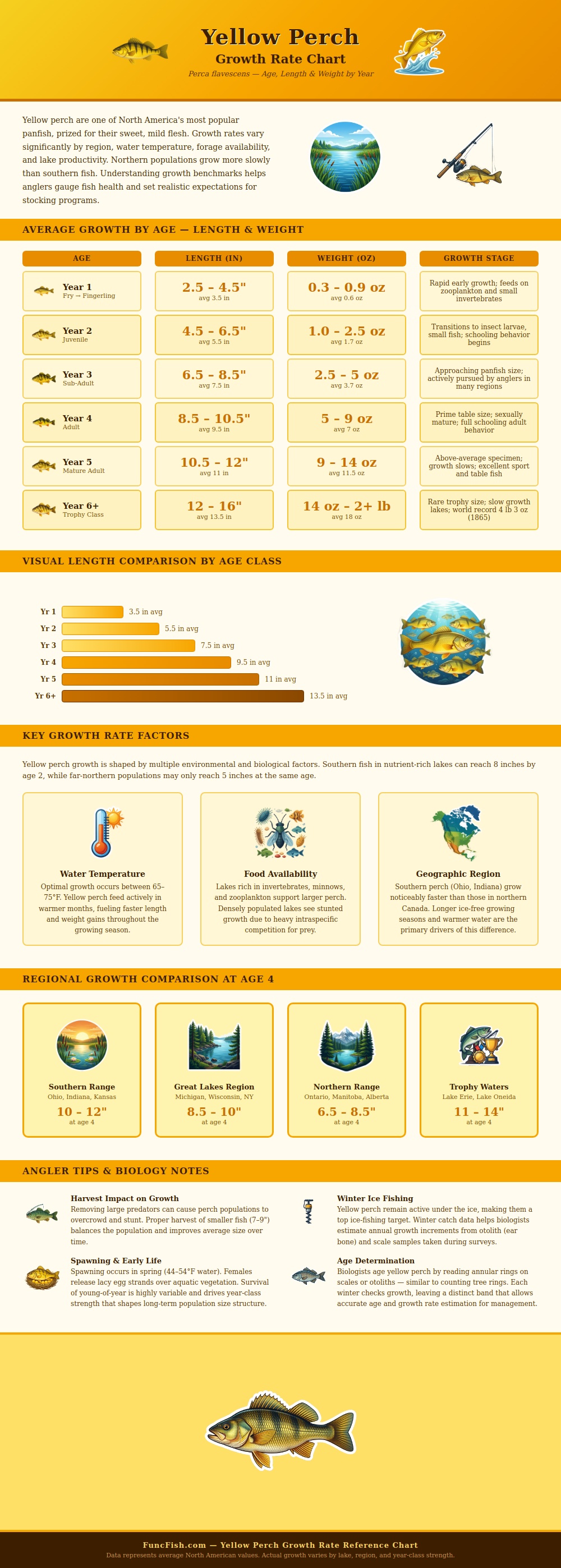
As you can see from chart above, growth compounds: weight and length increase over time, meaning the jump between year one and year two is huge in relative terms. A fish that reaches five inches by age two is well on its way to becoming a trophy someday. One who remains stuck at three inches never catches up. We hear people say “oh, that’s just an old perch,” but it is almost always the case that it’s a perch that got a great start and continued getting good food.
By year three or four though, they becomes less inclined to eat plankton and instead turn to insect and small baitfish prey, both of which take more energy to catch. Abundant forage lakes will grow bigger, longer perch, and warmer water also help them grow. They’re cold-water tolerant species, but prefer to feed heavily when temps hits the mid-sixties Fahrenheit.
The growing season is typically shorter in the north (Manitoba) which results southern perch in Ohio or Indiana hitting prime table size quicker then their northern cousins. In the north, ice can cover the lake for months at a time putting a halt to all biological activity. This costs northern perch a good chunk of potential growth time versus those in warmer waters.
Too much density is the silent killer of growth rates, meaning that when a lake produces thousands of young perch with no predator (like pike or bass) to cull the herd, the population explodes and the result is stunted. Thousands of fish competing for a limited amount of food means everybody eats a little and grows slow, nobody gets big. That’s what makes harvest regulations sometimes asks anglers to take smaller perch, as taking out the small fish decreases competition and leaves more resources for the remaining fish to thrive. It seems backwards to some, but it works and leads to larger fish over time in a balanced population.
To see how this works, biologists count scales and analyze the otoliths (the small ear bones in the fish). In these bones, they can see annual growth bands that are similar to the rings on a tree. Narrow bands reflect crowding and hard times; wider ones represent a good year. This information helps managers predict future harvest potential. They can explain why some lakes consistently yield nice ten inch perch while others hardly hit six, even though water temps may be identical. It has nothing to do with the thermometer read-out; it’s all about the predator/prey balance.
If you can find recent surveys and know the local regulations, a lake that was recently restocked or uses a slot limit is probably managing for size. Trophy waters tend to have similar characteristics, including clear water, ample aquatic vegetation for cover, and a good mix of baitfish. This means it is not just about catching fish but catching fish that has thrived.
So next time you have one in your hand, examine it. Is it dull and slim? Or vibrant and deep bodied? If so then you know how old the lake is. A skinny perch means there is something wrong with this picture. A fat perch shows a healthy ecosystem, one where food is plentiful and competition isn’t too fierce. But either way, it’s a biological readout of the very lake itself.
And that’s what makes panfishing such an endless interest, connecting the angler with the fish and the environment. It is not just for the catch, but for reading the lake based off its most common resident.