
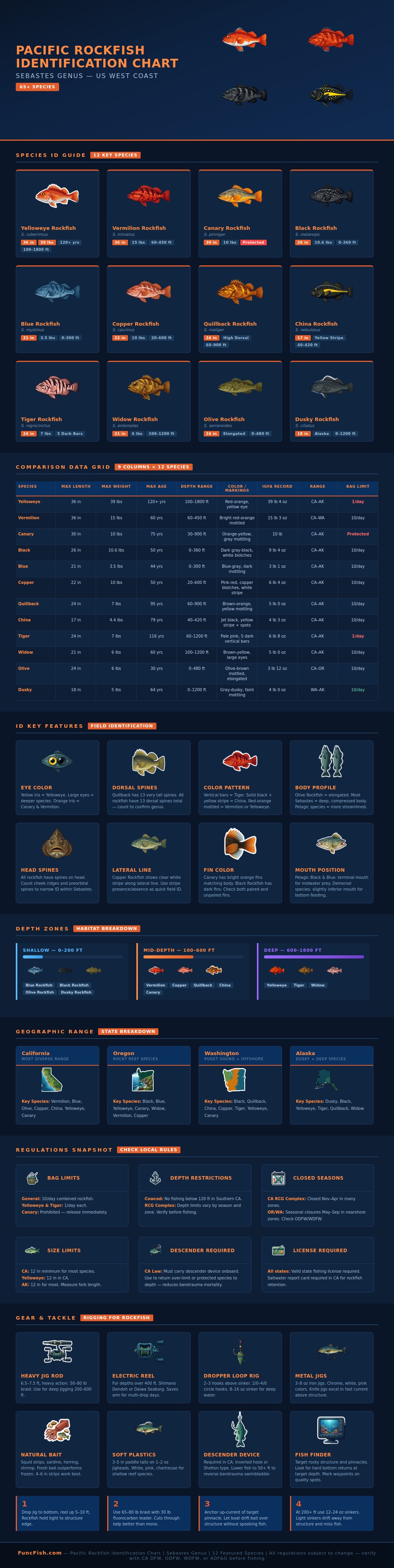
When you peer out the porthole and notice red swimming around in the darkness below, panic sets in, but the fish isnt what you thought; no Vermilion Rockfish here. Instead, you’ve reeled up a Canary Rockfish, which must be released at once if you’re fishing in California waters. Not only will you waste an hour of fishing time, but keeping such a fish might be illegal, too.
Sometimes, a feature smaller than a thumbnail is what distinguishes a keeper from a regulated catch. More than any piece of tackle you select during a trip, being able to decipher these fish prior to them breaking the surface are critical. That breakdown separate typical Pacific species based off how they look. It goes beyond just color, which is meaningless if you’re fishing dirty water or at night.
How to Identify Rockfish
A lot of guys assume Vermilion and Yelloweye rockfish is the same fish since they’re both a bright red-orange body color. But the chart calls out key differences (eyes and max age). Yelloweye have a literally yellow iris. And can live well over a century. This makes it a very highly protected species with hard limits per day. Because it lives that long, the ecosystem need time to replenish it, hence why the limit is only one per day. Understanding the biology behind it really clarifies the rules instead of seeing them as just some random bureaucratic rule.
Beyond knowing which fish to look for, it is just as important to know what depth they inhabit. Rockfish don’t exist at random throughout the water column. We included this information in infographic to help identify species. Depending on where you plan to fish shallow (near rock) or deep (below 400’), you’ll want to make sure your gear choices align with your target depth before you even leave the dock. Standard drop-shotting won’t get the job done quickly or efficient if you’re targeting fish in deeper depths. In those cases, heavy jig rods or even electric reels becomes essential equipment instead of optional upgrades.
For those who fish, having an idea of what they’ve caught helps with field identification, but anatomical markers is best used to confirm rather than just relying on their memory. One such marker is always the dorsal fin. Specifically, it’s the Quillback Rockfish’s exceptionally tall spines that makes it stand out, especially when identifying them from each other. Lateral line is another quick tell. In most cases where you see a distinct white stripe down the side, you’re looking at a Copper Rockfish, a prized species for its eating qualities that also has a limit. So, while you still want a pair of pliers in one hand, there’s no need to a field guide in the other; these little tidbits help sort the take in no time.
The check on the current state of fish stocks changes regularly and the rules change with it. Knowing what is happening with the fish is key but you also need to know where to find out about the regulations too. To safely catch and release deep-water species affected by barotrauma, several states now has a rule requiring a descender device onboard. Barotrauma occurs when swim bladders expands, causing fish to be fatally injured if they are brought up too fast. This means the protected tiger or Canary rockfish will live and you show respect for the resource. A little goes a long way in preserving the fishery for us all to enjoy livig going forward.
Always match tackle to the species profile you’re fishing for. Rockfish tucked into shallow kelp bed respond better to lighter soft plastic baits and lures. Heavy metal jigs are needed for the fast-flowing water around deep offshore pinnacles. Targeting bottom dwellers is best done with natural bait, fresh squid strips trump their frozen counterparts by a huge margin. The trick is to add just enough weight to hold your offering near the structure where the fish are feeding, yet still make your presentation look as natural as possible.
Knowing your rockfish makes the hunt tactical instead of guesswork. Instead of wondering if you should of shoot at an unclear shape in the water, you can target specific species based on their look, depth, and habitat. If you know which ones has high dorsal spines or yellow eyes prior to landing them on the net, it takes the randomness out of it and puts more knowledge into your fishing. And having that understanding make each outing an education, not a lottery ticket. At the end of the day, you return to shore with exactly what you intended to catch without any potential problems during future run-ins with law enforcement.