
You are pulling up a rockfish off of a deep reef structure. It’s a heavy-bodied fish with some orange coloration. You’ve got the fish; now what? What age is this fish? Not knowing the answer can lead to many bad conservation behaviors. Many folks believe there is a direct link between size and age. A large fish is simply an older version of small one.
This is not true for deep-water rockfish. They’re one of the oldest vertebrates on the planet. They live longer then turtles and trees. The rougheye rockfish is also longest lived verified species of fish, living for more than 200 years. So yeah, that means if you catch one you’ve caught someone who’s older than most people on Earth. Despite all that time, it can live a long life without growing much larger than a dinner plate.
Deep Sea Fish Live Very Long Lives
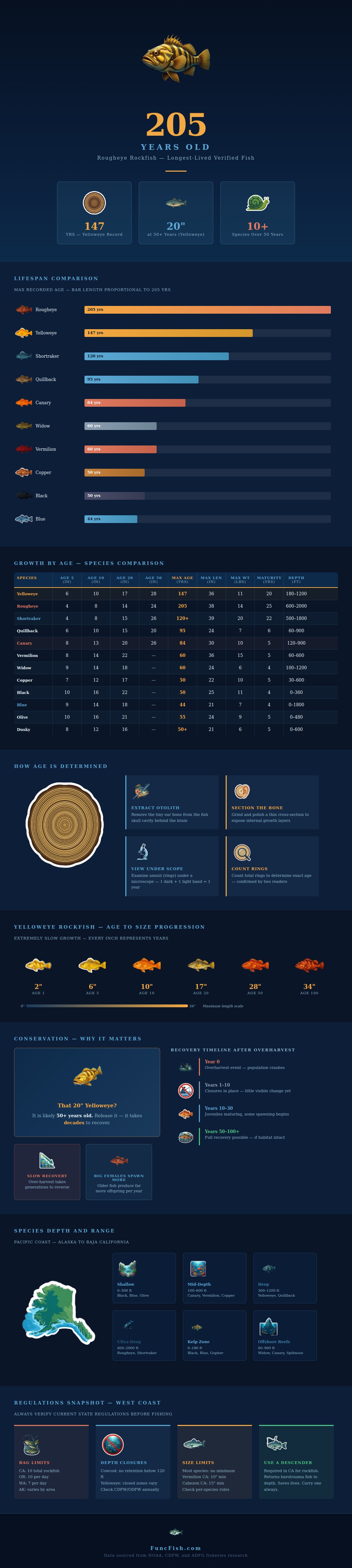
How? They grow slowly and mature late. At age five, a yelloweye rockfish is only six inches long. They are not sexually mature until age twenty. So by the time we finally get to meet them, they’ve been dodging bullets for decades. Here are those life cycles laid out in an infographic. You’ll see their otoliths (those little ear bones) with their rings that tell exactly how old each was.
So what does that do to your mind frame with a fish in the livewell? That twenty inch yelloweye isn’t a youngster, it’s probably over 50 years old. It made it through disease and other predators. It carries heavy ecological cost to remove it. Old females has a ton of larval output compared to their young counterparts. When you take it home you lost a reproductive powerhouse.
Many folks just don’t understand this aspect of sustainability. They get hung up on catch limits but they never think about generational replacement time. Overharvested fisheries require several decades of recovery time. The impact of closing fishing access doesn’t happen overnight. Juveniles aren’t yet spawning-ready, so there’s minimal difference within a decade. Recovery can take three-to-five decades for population stability. Today’s management choices impact the health of tomorrow’s fisheries.
A chart comparing species’ lifespan shows that shallow-water species (blue, black rockfish) have relatively brief lives compared to rougheyes and shortrakers. Habitat depth also dictates these factors. The fastest growing, shortest lived species occur in shallow water forests. The slowest growing species live in the deep ocean at around two thousand feet.
That translates into more pressure on various zones. The accessible shallow reefs recover quickly but they’re easy pickings too. Remote deep water seamounts hold old giants who can’t be replaced if fished hard. Descenders help get barotrauma victims back down to depth alive. In most places it’s not just good sense but required by law.
Take a little care with what you catch; let some large ones go so the population won’t dissapear. Keep it going, have fun.