
It’s happened to all of us at some point; you reel up a crab trap, and…your heart skips a beat. It’s too small, a juvenile or maybe just another mud crab. If you’ve ever checked a few pots off the end of a dock or spent any amount of time wading through estuary, you know what I’m talking about. This continues until you get a better look.
Then you see the wrong thing. Maybe it is the wrong size. Or worse, it might be the wrong sex. But this isn’t just about avoiding disappointment; it is about understanding how to identify crabs. Why? Because if you don’t, you risk taking home more then just dinner.
How to Identify Crabs Correctly
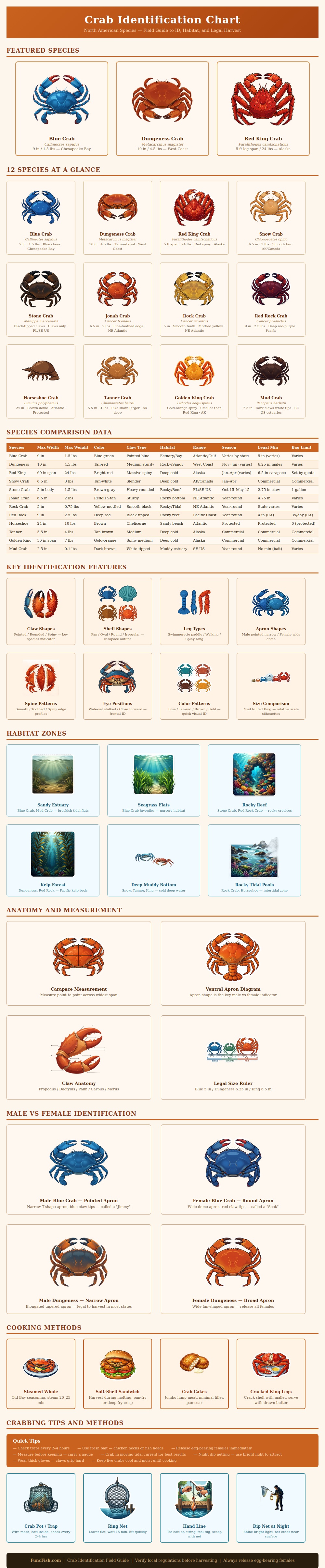
Most people think they can tell species apart by color alone, but that is a mistake. That couldn’t be further from the truth. Lighting, water quality and diet all change things. To properly identify a crab, you have to look at its structure. Twelve species is covered in the visual breakdown above, all of which are common North American species. That’s what it does, take away the guesswork created by lowlight conditions or murkiness.
We begin with the big three, the dreams every angler wants to make real. It is the red king crab. The Dungeness. And there is the blue crab. Side-by-side and you’re struck by just how different they are in size. Until you pick one up yourself, you don’t really know.
The blue crab can fit in the palm of your hand. The red king crab looks like it needs to be mounted in a moddern museum exhibit. Size matter when it comes to fishing tackle. What works for catching blues with smaller mesh traps won’t work for kings. Expecting the same numbers? No way.
The chart shows underlying reasons for their physical differences, habitat. Blues favor seagrass hidey holes inside brackish estuaries. Kings and snows wanders around in the chilly depths of mud-bottomed habitats. Where to look is half the battle. What’s on the bottom? For most harvesters, this is where mistake occurs.
The apron is what reveals all your crab’s reproductive secrets. In the graphic above, you can see how a male blue crab has a narrow, pointy T-shaped apron while a female’s is wide and round. Why does it matter? The females are the ones carrying eggs and the future of the species. Not only is it against the law to release females in most locations; it’s good conservation practice. Every female you retain means you’ve mined a resource that will not be able to replenish itself fast enough.
According to the guide, the Dungeness males likewise has a tapered apron with females having one that’s wider and fan-shaped. Knowing to turn a crab over to check for this shape prevents unintentional poaching (and a guilty conscience).
The fact that bait selection also factors into success is surprising. The best baits are fresh chicken necks or fish heads. In running water they leave behind realy good scent trails. Stale bait will give you a couple of bites. But it won’t attract those looking to actively feed, just those who like to scavenge.
Be sure to check your traps often. Left in there too long crabs will start eating one another. Within hours, what was a good catch becomes a pile of mush. And when you go to lift out a keeper, do so with heavy duty gloves on. Their pincers are made for crushing shellfish. They are not made to shake hands with humans.
Whether they are fried as soft shells or steamed in Old Bay, you’ll know why after cooking them. The difference between a well-identified catch and a careless one becomes clear in the flavor of conscience. You could of enjoyed your meal with a clear conscience knowing you did it right. “Catching crabs isn’t a numbers game; it’s all about finesse. There are no trophies in size, but being patient and paying attention pays off. Measure and double-check your catch, whether you are checking the pots before dawn or dipping them by headlamp at night. And don’t hesitate to let the losers go. The water won’t run out anytime soon. It’s full of life that awaits another person willing to make the effort to see it well enough to truly enjoy it. That’s where the reward lies.”