
Walk onto a beach on the Delaware Bay during an early June full moon high tide, and you may think sand itself is shifting under your feet. What’s happening? It’s not simply the pull of waves carrying away debris: tens of thousands of horseshoe crabs has come to spawn, making for one of biggest gatherings of crustaceans in the Western Hemisphere.
These look like some kind of armor-plated prehistoric beast. They are truly living fossils that have been around for approximately 450 million years, walking the ocean floor for most of that time. About 200 million years before dinosaurs, there were horseshoe crabs and they made it through each of the five great mass extinctions without ever having to update their genes. Their family line has proven impressively stable.
Why Horseshoe Crabs Are Important
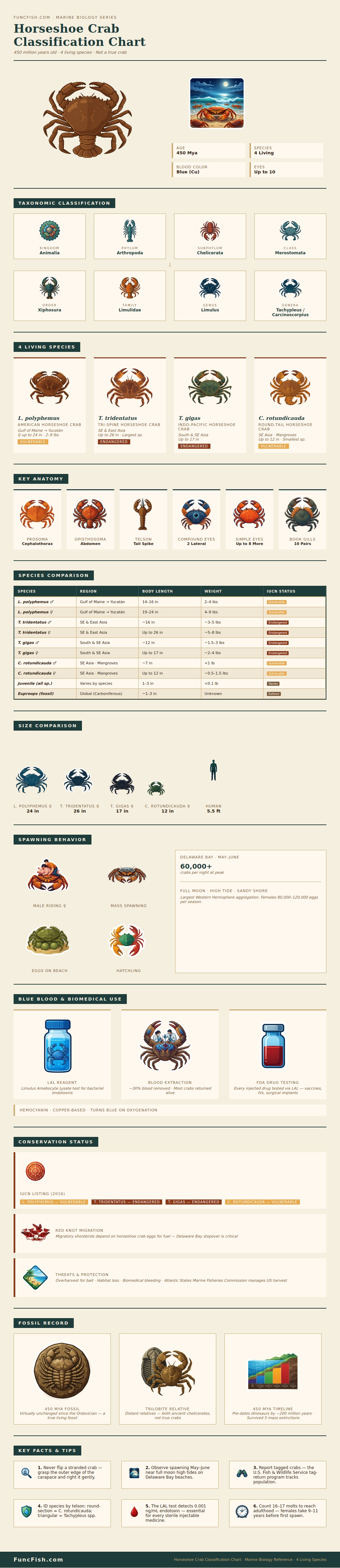
Yes, horseshoe crabs belong to animal kingdom and the phylum Arthropoda. But no, they’re not actualy crabs. Horseshoe crabs is called chelicerates. This means they are more closely related to scorpions and spiders different than the crab you ate at a seafood shack with lemon. That’s why they look so different compared to other shellfish.
So you’ll read about their opisthosoma or abdomen; and their cephalothorax, or prosoma. And then you’ll notice that tail. Which isn’t what stings you. When waves flip them upside down, that’s just what the tail do. It lets them flip right-side-up again.
The infographic explains each in detail, but there are now only four species alive today. Three inhabit Asian waters from India to Southeast Asia; the other (the American Horseshoe Crab) inhabit the Atlantic coast. At up to 26 inches across, Tri-spine is biggest, and the Round-tail is the smallest, frequently less than a pound in weight. The design is basicly the same for all four, as evolution tends to preserve what works. Males tend to be smaller than females who must bear the load of producing thousands of egg every year. On average a female will deposit between 80,000-120,000 eggs per trip to the beach but very few make it into adulthood.
But the blue blood of horseshoes crabs matter today too; it’s used as an essential component of moddern medicine, and pharmaceutical firms extract the stuff from living crabs to produce what’s known as a Limulus Amebocyte Lysate test, which is mandatory to ensure all surgical implants, IV medications and vaccines aren’t contaminated with bacterial endotoxins before being administered to patients.
The next time you get vaccinated, remember to thank a horseshoe crab (indirectly, since you’ll never meet each other). It’s one of the weirdest collaborations in history of science, linking old-school ocean life to sterile hospital supplies.
Today these animal are in danger. They face overharvesting for the biomedical industry, use as bait fish, and habitat loss. And if you see one washed up along the shore, don’t pick it up by the tail and flip it. Just lightly grab edge of the carapace and roll it back over, where hopefully it will crawl away into deeper waters.
It’s a little thing but an act of respect for an animal who has survived rising seas, meteorites and ice ages for almost half a billion years. Let’s make sure we help horseshoe crab survive. They have been here longer then humans. They earned their spot in this world, and now they should of had ours.