
If you’re not careful, a cracked open stone crab claw sounds like you just heard someone crash their car. It typicaly results in having a bunch of crab meat all over your napkin and no desire to eat anymore. Knowing what you’re about to do before picking up a mallet can be the difference between a delicious seafood feast and some unfortunate accidents like the one described here.
What’s different about eating a stone crab? This species is special because when only claws are harvested, the rest of the crab is left behind to grow new ones in the coming months and years. This means every claw you put into your mouth has already gone through another’s hands, so each is a rare treat and must be treated like one.
How to Choose and Eat Stone Crab Claws
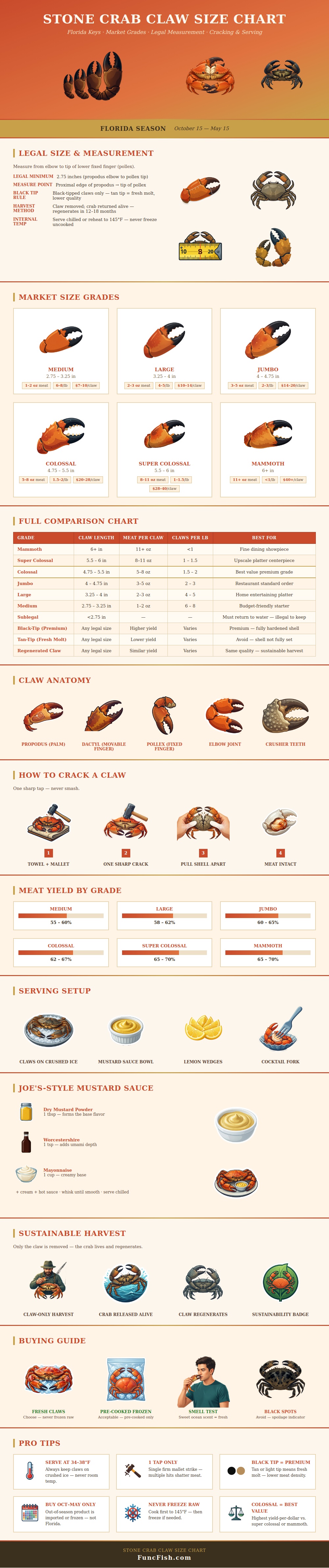
That’s why knowing the different sizes, from medium to colossal, matters. It help you understand what will get how much meat and how much that meat will cost. This is critical information whether you are shopping at fish counter or ordering off the menu.
If it sounds arbitrary, consider that size system has something to do with how much meat each one contains, and its shell thickness. What appears like a large claw in the box can be little more than an ounce or two once cracked open. That’s fine for budget shoppers, or those who plan to use claws as an appetizer portion. But it won’t impress a ravenous mob.
As you progress through the grades… Jumbos and colossals, the payoff gets bigger: more meat per claw, plus lower per-pound cost since processing costs is spread out across bigger sizes. Simple economics inside a tough shell.
Beyond that, many folks assume they should of buy the biggest sizes. In fact, the return on investment for “super-colossal” (or “mammoth”) claws are less than it is for “colossal.” As the infographic demonstrates, “colossal” is the sweet spot of lowest cost and highest yield:
But there’s another biological indicator that most casual eaters overlook. Notice the bottom, unmoving finger. The end of it will be colored like this: A black tip indicates that the claw has fully hardened since its last molt, meaning shell is dense and meat inside is firm and sweet. A lighter, tan color to the tip indicates that the crab just molted. Its shell isn’t quite hard yet. Meat hasn’t fully filled out, so yield won’t be as high. The texture may not be as pleasing either. It’s a tiny visual clue that helps guarantee quality.
Because when you see that darkness, that hardness, it tells you that this animal was mature enough to be pulled from the water. That’s biology, folks, and it’s why you don’t want to buy fresh claws outside of the Florida season (mid-October through mid-May). Anything else served to you at any other time of year is frozen pre-harvest, imported, or, frankley, not worth the gamble.
A well-chilled, locally caught claw is clearly bright with the taste of the ocean. The best way to handle preparing them is with restraint. Get yourself a thick towel, wrap the claw around it and give it a good, swift tap with the back of your chef’s knife or a mallet. More than one blow will destroy meat into unrecognizable shreds. Aim for a nice break along the natural joint line. Then, just peel the two halves of shell apart, and a whole chunk of creamy white goodness will be ready to be removed.
Serve over crushed ice to keep things cool. This keeps things chill, makes the flesh firmer, and retains that fresh-from-the-sea aroma. Add some kind of mustard-based sauce that complements the subtle sweetness of the crab without overpowering its flavor. And most importantly, be patient. Once you know the right method, the correct time of year, and have a grasp on the animal’s size, cracking open those shells won’t feel jarring at all, just satisfying.
Clean hands, a filled belly, what could be better?