Fish Eye Diameter To Length Calculator
Estimate fish standard, fork, or total length from measured eye diameter using species profile, growth stage, photo angle, measurement quality, and calibration confidence.
📌Field presets
⚙Eye-to-length inputs
Eye diameter estimate
Calculation breakdown
📊Eye profile data grid
Adult perch-like predator, side-view eye diameter to total length.
Stream trout and salmonids need clean side-on eye edges.
Small deep-bodied fish often carry larger relative eyes.
Small visible eye means small measurement errors matter more.
🧮Estimator comparison
Best when only the head is visible and the species group is known.
Often stronger in side photos, but needs the full head depth to be visible.
Useful when snout, tail, and a measuring board are all in the same plane.
Use the optional ratio field when you have species-specific local samples.
📋Reference tables
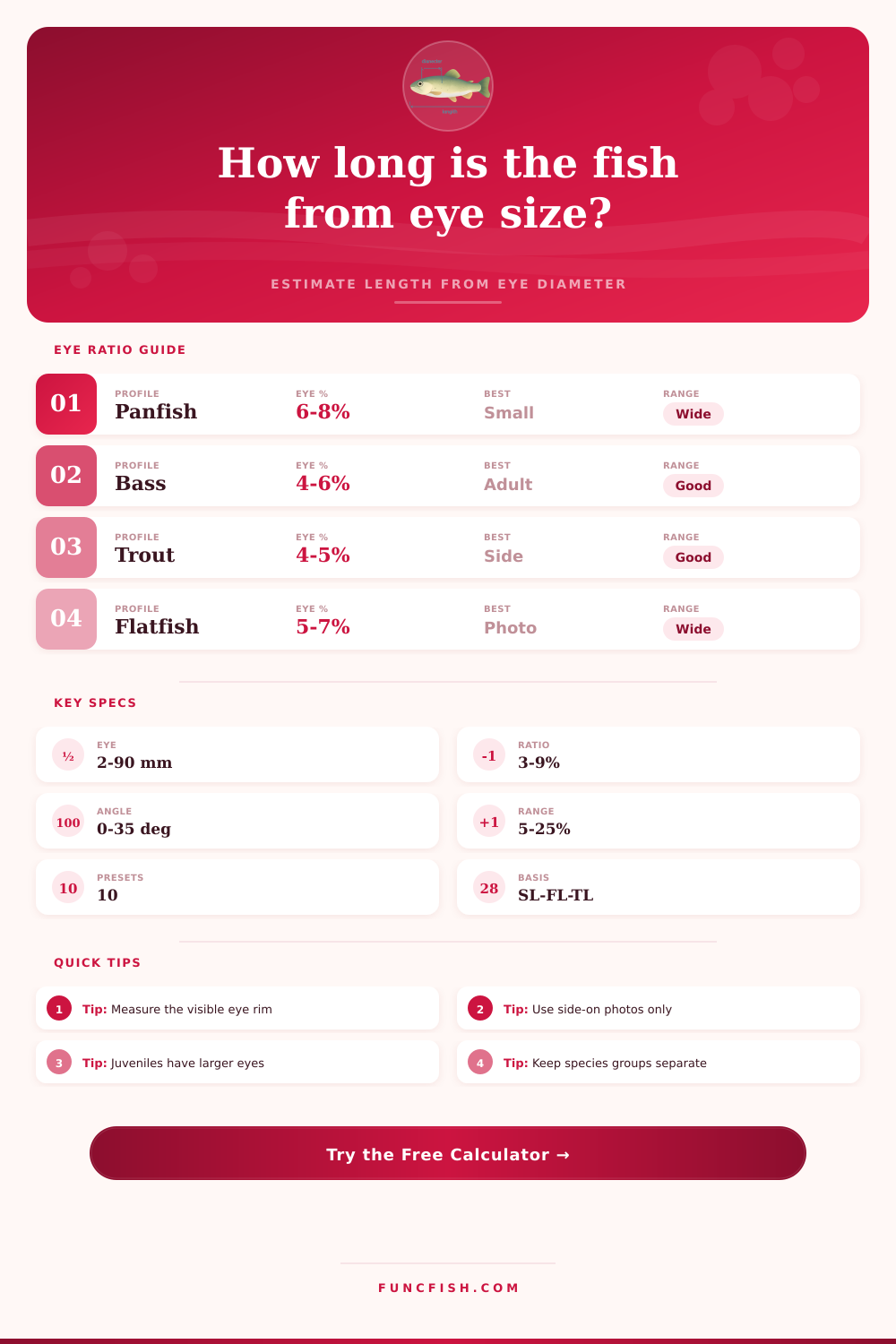
| Species profile | Reference eye ratio | Reference length | Allometry exponent | Best use |
|---|---|---|---|---|
| Bass or perch-like predator | 4.8% of TL | 16 in / 40.6 cm | 0.93 | Side photos of adult sport fish |
| Trout, char, or salmonid | 4.5% of TL | 14 in / 35.6 cm | 0.92 | Clear stream photos and specimens |
| Panfish or small sunfish | 6.6% of TL | 7 in / 17.8 cm | 0.90 | Small fish where eyes stay proportionally large |
| Walleye or zander | 5.2% of TL | 20 in / 50.8 cm | 0.91 | Large reflective eyes in low-light predators |
| Pike, muskie, or gar-like | 3.9% of TL | 30 in / 76.2 cm | 0.94 | Long bodies where full tail may be outside frame |
| Catfish or bullhead | 3.6% of TL | 24 in / 61.0 cm | 0.95 | Direct specimen checks; photos are often low contrast |
| Measurement situation | Typical range spread | Confidence effect | Use when | Watch item |
|---|---|---|---|---|
| Direct caliper or ruler | 5 to 8% | Strong positive | Specimen is available | Do not include glare halo |
| Known measuring board in image | 8 to 12% | Positive | Board and eye are in one plane | Camera angle still matters |
| Nearby object scale | 12 to 18% | Moderate | Object is close to the eye plane | Hands and lures may be closer to camera |
| Pixel estimate only | 18 to 25% | Low | No real-world scale exists | Result is relative, not definitive |
| Reported eye size from notes | 15 to 24% | Low | Old survey notes list eye diameter | Check whether diameter or orbit was recorded |
| Growth stage | Relative eye adjustment | Length effect | Typical field signal | Estimator note |
|---|---|---|---|---|
| Juvenile / young-of-year | +18% ratio | Shorter predicted length | Oversized eye and short snout | Do not use adult ratios directly |
| Subadult | +7% ratio | Slightly shorter prediction | Eye still large for body length | Good for yearling survey fish |
| Adult | Baseline ratio | Neutral | Species profile looks normal | Best default for angler photos |
| Large adult | -6% ratio | Longer predicted length | Head and eye look smaller relative to body | Useful for mature predators |
| Very large / old fish | -11% ratio | Longest prediction | Large head but small relative eye | Use wider range unless species-specific data exists |
| Length basis | Conversion used from TL | Works best for | Equivalent example | Note |
|---|---|---|---|---|
| Total length (TL) | 100% of total estimate | Angler and regulation-style records | 20.0 in TL stays 20.0 in | Tail tip is included |
| Fork length (FL) | 94% of total estimate | Fork-tailed fish and many surveys | 20.0 in TL becomes 18.8 in FL | Useful for salmonids and pelagic fish |
| Standard length (SL) | 82% of total estimate | Biology notes and specimen measurements | 20.0 in TL becomes 16.4 in SL | Tail fin excluded |
| Photo-visible length | 96% of total estimate | Partial tail or slight body curve | 20.0 in TL becomes 19.2 in visible length | Not a formal biological length |
💡Measurement tips
Well, there’s the fish and there’s the photo. The eyes jump right off of boat deck (or the water) but estimating how long the body realy is from just this one picture seems tough.
Enter morphometrics, or in this case more precisely, the ratio of eye diameter to total body length. It might seem strange to estimate the entire fish based off just a tiny portion, but nature has rules and it work. The fancy math is done for you by calculator above (just enter some simple numbers). That way you don’t have to worry about perspective distortions or species specific variations that mess with your estimates. Allometric principles are the core behind this.
How to Guess Fish Size From Photos
Allometry is the science of the relationship between various components within an organism’s body as they grow. In other words, as a fish grows bigger, its eyes tends to stay proportionally smaller. Their bodies elongate, but their eyes don’t necessarily change drasticly in size over time. So while an adult’s eye-to-body ratio is much smaller than a juvenile’s due to allometry, this happens because eyes don’t grow as fast as the rest of body as the fish ages. An adult steelhead’s eye size will be very different from a young-of-year fish.
And so the tool takes this into account by prompting you to identify if your target is a trophy sized adult, subadult or juvenile. Why? Because biologically speaking, the eyes don’t grow as fast as snouts and tails and so making that adjustment make a big difference in the underlying ratio.
There’s one more wrinkle here that many anglers don’t think about: camera angle. Tilting the camera ever so slightly can causes the eye to be oval instead of round, distorting its diameter measurement. Turning the fish ever so slightly toward the camera also will shrink the apparent eye size. This causes us to overestimate body length when we imagine it as being in perfect side profile. Knowing roughly what angle the camera was tilted at is therefore included in estimate since it increases the width of the confidence interval accordingly. You don’t have to get out a protractor. Just guessing roughly at whether the image is straight-on or tilted slightly off adds some reliability to the answer, recognizing the uncertainty of your perspective makes the tool work better.
Precision alone isn’t useful unless it is used with context. That context helps to tell difference between important information and random data. There is also a needed correction factor that comes from species presets as body shape changes wildly across families. Pike and catfish don’t have the same head proportion as bass and perch do. A pike has relatively small eyes compared to its total body length because of its long, slender shape, whereas a deep-bodied panfish like a bluegill have larger eyes relative to its length. There would of systematic error in whole categories of species if a generic average was used for all fish. These differences are reflected in the reference data built into the tool, anchoring estimates to known shape standards for each profile. Not magic, but a lot better then guessing.
The key here is to interpret what you’re seeing in terms of range, not just the middle number. Conditions under which measurements were made aren’t perfect, and the animals being measured aren’t perfect little widgets. Take this with a grain of salt. A narrow range indicates a high confidence result based on direct measure using a caliper on a specimen. A broad range indicates an estimate made by someone looking at a blurry action photo via pixels in Photoshop. The range communicates something important about the quality of your estimates. And if they’re not good enough to do anything with; if the range is too large to matter, then that’s not because the math isn’t working. That’s because you didn’t have good enough source material to estimate accuratley.
When you understand all of this, what was once a random photograph can be seen as an exercise where you consider some factors. First. What species is it? Second, In which life stage is it most likely? Next, How good is my view and how clear is my reference for scale? In the end, You use that information to combine your inputs into a probable length. Why? Instead of relying on intuition, you are applying a set of structured reasoning. The result might not be exact but the process itself is sound.
Now you aren’t just gazing at a beautiful picture. You’re actualy reading the biological information contained in the image. And that’s what sets a person who really knows the fish on the other end of the lens apart from a casual observer.