
Freshwater shrimps are cute. They’re also colorful and small. Get some and put them in your tank. Then, let nature take care off the cleaning. But soon, you realize that those juvenile shrimps you bought is gone or transformed into something else. This leads many beginner keeper to a dilemma common when keeping shrimps. How do you know how big an animal will grow if you don’t know adult size? How do you maintain a thriving population if you don’t? What’s needed to sustain them over time?
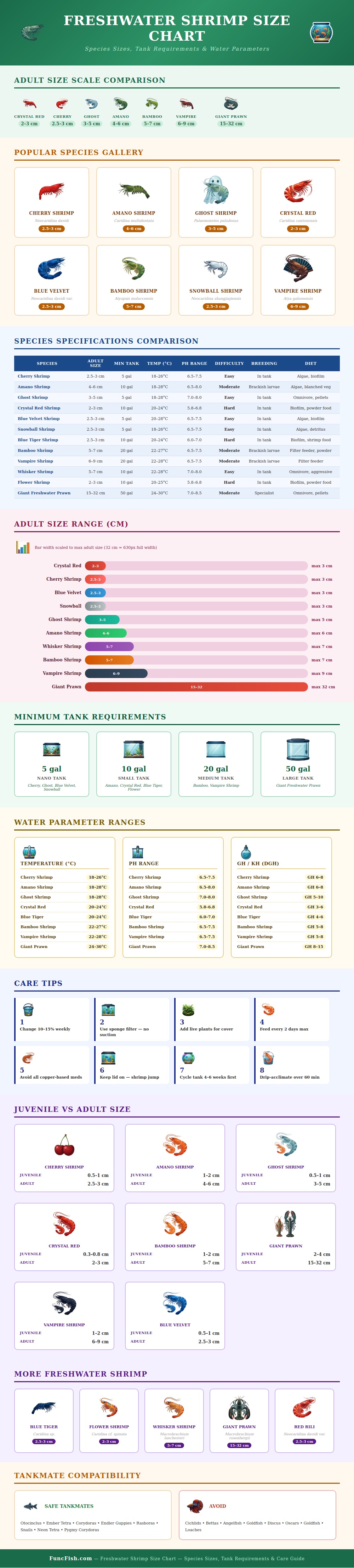
The following chart show the max size per species and what environmental factors to expect. A common misconception among novice keeper is that all shrimps are about the same size. That’s simply not true. Certain species will stay small enough to hide in substrate whereas others need ample room. Lots of shrimp species doesn’t fit in a five gallon bowl, so making that assumption will lead you down wrong path. For instance, the Amano can reach a length of six centimeters different than the Cherry which only gets to 2, 3 cm.
How Big Do Freshwater Shrimps Grow?
That’s quite a size difference, and it makes a big behavioral impact. Bigger shrimps produces more waste and are also more active. What might be fine for keeping Cherry shrimp could be too cramped for Amano shrimp. So it’s not just a question of space, but rather handling the bioload over time.
You can see from the visual comparison above (in the graphic) that the sizes varies a lot. When you compare smaller species of Caridina with larger ones like Vampire or Bamboo shrimp, it all starts to make sense. Why? Because you have to know what size your shrimps are so they’re not going to get eaten by tankmates. A big shrimp isn’t going to get away from a hungry tetra… but a tiny one just might. Knowing which other species is safe tankmate is key.
So how much space do you need? The infographic categorizes species by the minimum tank size required. This keeps you from overcrowding a nano tank. Larger species requires more room. They require more space to move around and feed without feeling stressed. When they feel stressed, they gets sick. When they get sick, they die. Proper planning would of avoided this cycle.
The other thing folks overlook is water chemistry. Each species evolved in an environment with specific types of water it expects to find. Some prefer acidic soft water, while others prefers neutral hard water. This chart breaks down the parameters of all varieties. If you mix a hard water shrimp with a soft water shrimp, both will suffer. Evolution adapted these animals to the waters they came from over millions of years. Fighting their biology by forcing them into something else is fighting a losing battle. On the other hand, if you can match the water conditions to what species needs, then the shrimp become strong.
When conditions are right the shrimp clean up algae and remove waste. People also often misunderstand there feeding. They get specialty pellets and think that’s it. What they don’t know is that shrimp are scavengers. Their diet consist mostly of decaying matter and biofilm. The guide recommends a proper feeding routine to match their naturaly behavior. Underfeeding will result in stunt growth; over-feeding will cause spikes in ammonia.
You’ll need to observe. How do you know if you’re underfeeding? If the pellets vanish rapidly. Too much food? If the pellets sink without being eaten. It’s a delicate dance that depends on your trust of the shrimp to look for food amongst the substrate and plants.
It’s more complicated if you’re starting with juveniles. By the time an adult specimen reaches maturity, a baby shrimp have grown quite large. Many common species has different juvenile and adult sizes listed in the infographic. Knowing this growth pattern helps plan for the long term regarding tank size requirements. What worked when they were smaller will not work as adults. Adults will grow out of small tanks fast. Prevent emergencies (like needing to rehome them) by doing the math now.
Understand that each shrimp species has its own individual needs To be successful with shrimp you need to understand that they are not all alike; they have different dietary, water chemistry, and tank size requirements depending on their species. Use the chart as a guide so you know what to expect, which will eventually help you decide whether or not to purchase a given species.
When you manage your expectations to match reality then your tank stabilizes. By providing the proper environment for each species, you will end up with a self-sustaining community of baby shrimp. It starts with knowing what kind of commitment you are making for each species.