
There’s rows of little shrimp inside clear bags at your local fish store. To a casual onlooker, it appear as if there are tiny red flecks swimming amongst some plants. To the *Neocaridina davidi* breeder, however, they represent something else entirely.
They could be wild type specimens with just a bit of pink to them or heavily colored Grade 7 Bloody Mary shrimp whose coloration rival that of polished rubies. Knowing the difference between these two ends of the spectrum isn’t merely for the sake of having unique colors. It’s because you’re aware of the effort required to produce it and what exactly you’re paying for.
How to Keep Healthy Colorful Shrimp
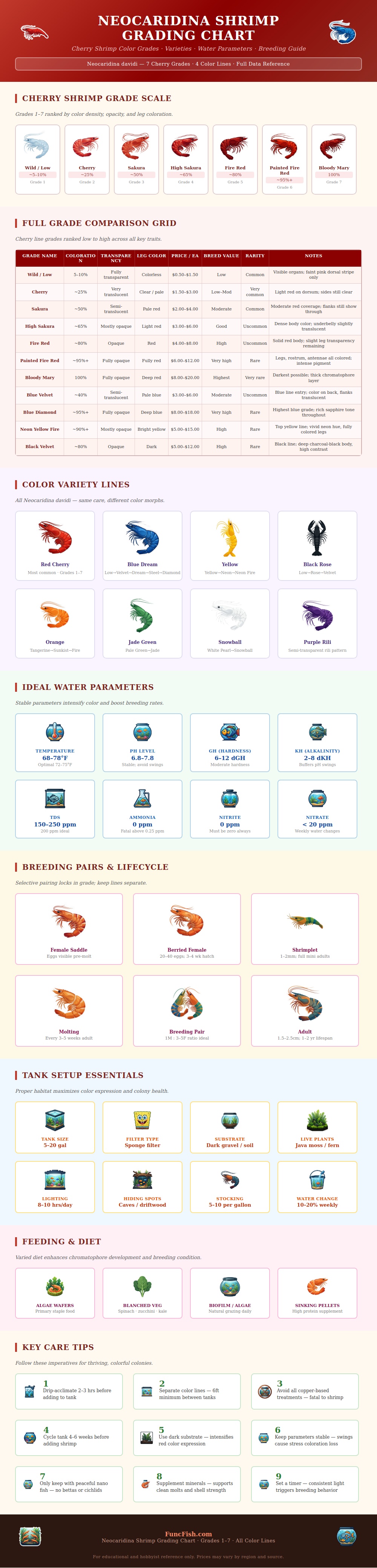
These differences breaks down in seven levels (grades) used by the hobbyist community. Each grade is determined by how transparent and dense the coloration is. If you’re a beginner, you’ll likely begin with lower grades; these are so transparent that you can see their internal organs through their shell. Higher grades feature thicker pigmentation, until eventually, the shrimp are completely opaque. This matter because higher grades are more expensive; it takes selective breeding to produce them. Breeders paired only the most intense individuals over time, and you’re paying for all those generations.
To make sure that you’re keeping these lines pure, you’ll want to have strict separation between them in your set up. For example, if you’ve got multiple colors in one tank, the colors will cross breed and ultimate dilute the specific trait(s) you spent money on. Generally speaking, color varieties should be kept at least six feet away from each other (or ideally in totally separate filtration systems). Otherwise, stray shrimps can migrate over to the other area.
While it might sound excessive, having even one escaped Fire Red can destroy a pure line of Blue Velvets within several months. That’s why some serious keepers use dark substrate and strive to maintain steady water parameters to promote the health of each isolated group.
The color of the shrimp you see is largely dependent on water quality. If your water is highly unstable (huge swings in temp) or very acidic, an otherwise perfect Grade 6 shrimp will look drab. It is better to be stable then to be precise every time. A little change everyday is less stressful than having one big swing once a week.
To help molting and shell formation, most keepers has luck with the pH range from 6.8, 7.8 with modest hardness. The biggest risk for shrimp is when it are molting as it is defenseless while its new shell hardens. Having proper minerals in the water ensures a clean molt without twisting or deforming the shell.
Another overlooked factor in color expression is feeding. Chromatophores (the pigment-producing cells that give them their colorful hues) develop when they’re fed a varied diet. Good staples include algae wafers, but toss some blanched veggies such as zucchini or spinach into the mix to ensure sufficient variety. Occasionally, some keepers will use high protein sinking pellets to increase breeding condition. You want your shrimps to be well-fed so they can reproduce but not overfed since rotting food will spike your tank’s ammonia and kill those sensitive crustaceans. Remember, shrimp graze naturaly in nature and you want to replicate this in captivity.
Breeding your *Neocaridina* is mostly about observation and patience (not doing much), in contrast than fancy guppies with their intentional selection of desirable traits. For *Neos*, it’s all about setting up the best conditions for nature to take its course among a limited population. Ideally you’d have 3-5 females to every male to increase mating chances while minimizing fighting. The female hold her brood beneath her tail for weeks and eventually releases tiny baby shrimps that resemble mini-adults. Conveniently they are able to feed right away, so water quality must be spot-on from Day One.
Going from a barely pigmented wildtype to a deep red Bloody Mary is not easy. This take years of care and selective pressure. To do so teaches you how to look for things most aquarists simply don’t notice. You can look for things like the behavior of the shrimp and the water chemistry (test kit). Color becomes not just an aesthetic preference but also a measure of health.
All of those little things done every day add up and end in something special when you finally have a tankful of colorful and healthy shrimp you’ve raised yourself. And it begins with knowing what you’re even dealing with when you lift that first bag of tiny little red animals.