Tow Capacity Checker Calculator
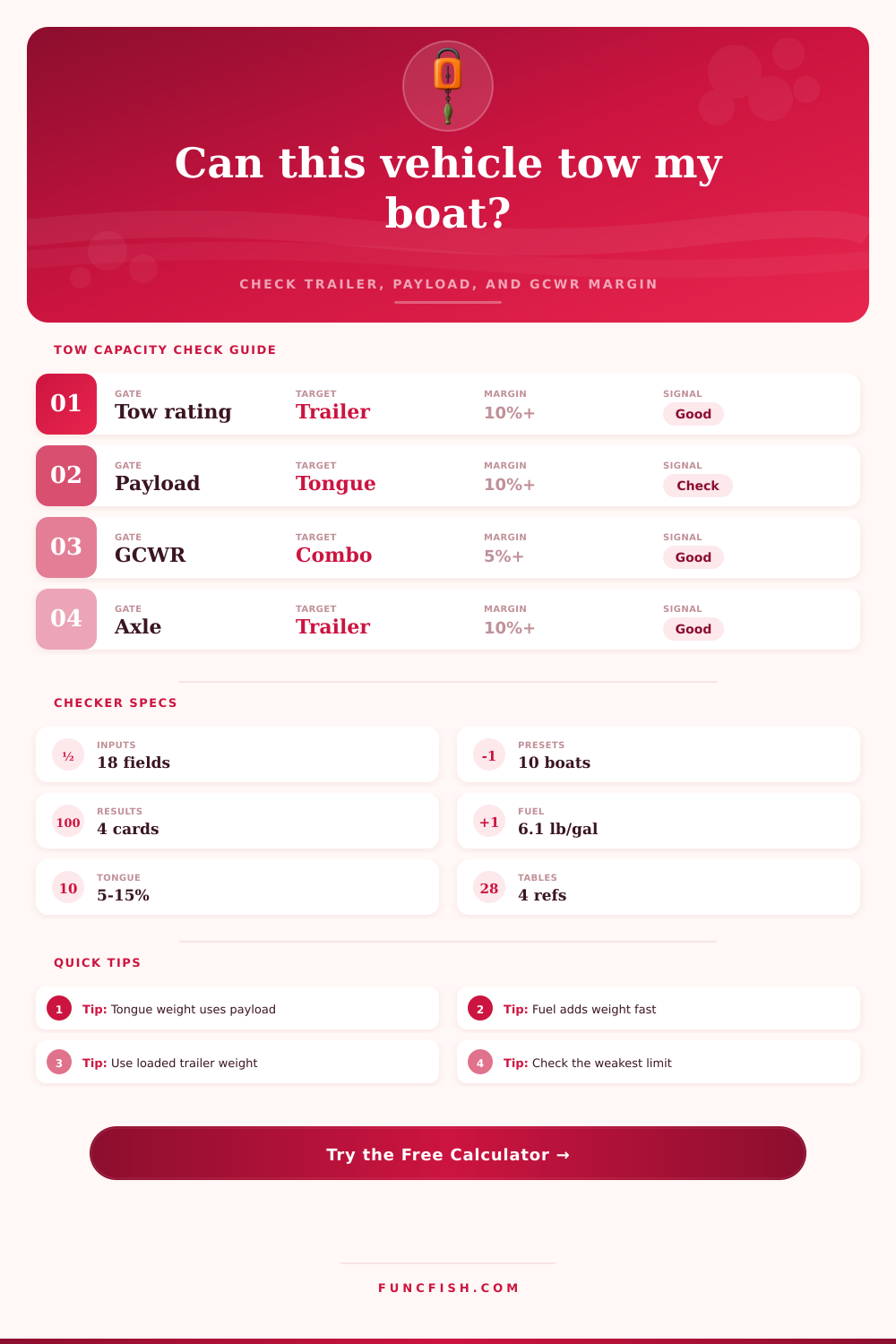
Check loaded boat and trailer weight against tow rating, GCWR, payload, tongue weight, receiver limit, trailer axle rating, brake requirement, and stability margin.
📌Boat and trailer presets
⚙Tow vehicle, boat, trailer, and load inputs
Tow capacity check results
Calculation breakdown
🧮Capacity snapshot
Loaded trailer divided by the tow rating entered.
Vehicle cargo plus tongue weight against payload.
Loaded trailer against axle, tire, or trailer GVWR limit.
Road, ramp, brake, and vehicle-class reserve target.
⚖Limit comparison grid
Loaded trailer versus the vehicle maximum trailer rating.
People, cargo, and tongue weight versus door sticker payload.
Tongue weight compared with receiver tongue rating.
Loaded trailer compared with trailer GVWR or axle/tire rating.
📚Tow capacity reference tables
| Boat trailer type | Typical loaded range | Common tongue band | Capacity note |
|---|---|---|---|
| Kayak or small skiff trailer | 300-1,200 lb / 136-544 kg | 7-12% | Payload is rarely the limiter unless vehicle cargo is high. |
| Aluminum fishing boat | 1,200-2,800 lb / 544-1,270 kg | 6-10% | Fuel, batteries, and trolling motor can add several hundred pounds. |
| Bass boat or deep V | 2,800-4,800 lb / 1,270-2,177 kg | 7-11% | Tongue weight and receiver rating often become close checks. |
| Pontoon or ski boat | 3,500-6,500 lb / 1,588-2,948 kg | 8-12% | GCWR and braking margin matter for longer highway trips. |
| Offshore center console | 6,000-12,000 lb / 2,722-5,443 kg | 9-15% | Requires careful scale checks, rated hitch hardware, and brake reserve. |
| Weight item | Imperial value | Metric value | Use in calculator |
|---|---|---|---|
| Gasoline | 6.1 lb/gal | 0.73 kg/L | Added to trailer load from fuel aboard. |
| Diesel | 7.1 lb/gal | 0.85 kg/L | Used for diesel or heavier fuel selections. |
| Fresh water | 8.34 lb/gal | 1.00 kg/L | Livewell, ballast, tanks, and carried water. |
| Lead-acid group 31 battery | 55-75 lb | 25-34 kg | Add in the gear field if not included in dry weight. |
| Cooler with ice and fish | 40-150 lb | 18-68 kg | Add as gear or vehicle cargo depending where it rides. |
| Capacity gate | What it protects | Checker formula | Good working margin |
|---|---|---|---|
| Maximum tow rating | Powertrain, cooling, structure, braking assumptions | Tow rating - loaded trailer | 10% or more after trip load |
| Payload rating | Vehicle springs, tires, axle, cabin cargo | Payload - cargo - tongue weight | 10% or more after people and cargo |
| GCWR | Total combined mass the vehicle is rated to move | GCWR - vehicle trip weight - loaded trailer | 5-10% depending terrain |
| Receiver tongue limit | Hitch receiver and drawbar load | Receiver limit - tongue weight | Stay within the stamped rating |
| Trailer axle or GVWR | Frame, axles, tires, coupler, suspension | Trailer rating - loaded trailer | 10% or more for road reserve |
| Road or ramp condition | Reserve add-on | Brake concern | Checker behavior |
|---|---|---|---|
| Flat local ramp | 0% | Low to moderate | Uses base reserve target. |
| Rolling highway | 3% | Heat and repeated stops | Adds a small reserve target. |
| Mountain grades | 8% | Long descents and cooling | Raises reserve and flags weak brake setups. |
| Steep or slippery ramp | 6% | Traction during launch and retrieval | Raises reserve and handling caution. |
| Hot weather and long grade | 10% | Cooling and brake fade | Uses the strongest reserve add-on. |
💡Two tow check tips
The family gets loaded up, the boat goes on the back of the truck, you buy the boat and you buy the truck…only to find out it rock down the highway. You didn’t get the numbers on towing.
Yes, your half-ton pickup says in the marketing brochure that it can absorbs seven thousand pounds…but that’s best case, meaning there are no people or cargo inside the cab, just a light load. Real life never seem to have ideal conditions like this.
How to Tow Safely
You’ll plug your load into the calculator above and let it do the math for you. You will no longer has to guess if you are within your towing limits or potentially causing mechanical issues.
People will typically look right at sticker and immediately hone in on largest number: the tow rating. That’s what most folks get wrong. Tow capacity is not just about how much weight you can put behind your engine. It is a balance of three other important limits, these limits are far more likely to cause problems.
The payload capacity. First up is payload capacity. Payload capacity refer to how much weight your rig can hold within its own body, including tongue weight pressing downward on the hitch, plus people in seats and any items being hauled in the back. Throw in a few angler, some tackle, coolers and a full tank of gas with the boat added on, and that payload space fills fast. Often, just the weight of the tongue alone will eat up 1/2 or more of your rated payload before ever turning the key. Going over this limit harm the strength of the vehicle’s suspension system.
Finally, there is the Gross Combined Weight Rating (GCWR). That’s the max amount of what can be pulled by the tow vehicle, including whatever gear or people are riding in/on the trailer. Why does it matter? Both the transmission and engine has a thermal rating. Dragging close to the max GCWR over the mountains will cause the driveline to be working hard, resulting in overheated failures long before you get where you’re going. So the tool factors that into equation as well. What’s your margin to that combined number? You need enough to give yourself some breathing room when you need to brake or go up and down hills.
Another aspect that is frequently overlooked until too late is weight of fuel. Water in your ballast tank(s) and/or livewell(s) is much heavier at more than eight pounds per gallon. Gasoline itself outweighs all others at more than six pounds per gallon. Twenty gallons of fuel added to the back of a bass boat equals more than one-hundred pounds to your trailer load. Not only does this change axle stress but also the tongue weight, the calculator includes these fluid weights in the total load. You’ll have a realistic picture of what’s going to sit on the scale instead of what the brochure says.
If a boat’s CG (center of gravity) sits behind the trailer’s axle hub, then it will feel light on the hitch while traveling faster, resulting in dangerous fishtailing. If it’s too heavy toward the front, steering becomes sluggish and the rear axle get strained. Typically this balance is achieved by moving tackle boxes, the motor or the battery forward or backward from the axle hub. To see what the tongue weights should of be on your particular type of boat, check out the chart/table on the page. It’s based off real data so you can compare and know whether you have your boat set up correctly.
Long descents and excessive heat can cause braking systems to lose effectiveness as well, particularly when heavily loaded. Surge brakes are common on smaller trailers, whereas electric systems offer better control and fail-safes for heavier rigs. The proper brake selection goes beyond a check-the-box requirement… It’s a safety measure against riding your brakes into oblivion.
In summary, respect the weak link. That’s what safe towing comes down to. Knowing your limitations keeps you off the side of the road and protects your equipment whether it be the vehicles frame strength, the receivers rated hitch weight, or the tire load capacity. Weigh your loaded rig before you leave; take a few minutes to do this. It will save you loads of grief later and is only a small inconvenience. Go with plenty of margin, drive smart and have fun on the water knowing you’re not trying to push things beyond your comfortabely level.