Total Onboard Electrical Load Calculator
Estimate daily amp hours, watt hours, reserve, runtime, charging balance, peak load, and voltage-drop context for fishing boats, kayaks, cruisers, and offshore electrical setups.
📌Onboard load presets
⚙Battery bank, loads, and charging inputs
Core DC loads
Cabin, lighting, and refrigeration
High draw, AC inverter, and charge sources
Electrical load plan
Calculation breakdown
🔋Battery and load summary
Used for breaker and cable drop context.
Daily amp hours divided by 24 hours.
Solar, alternator, and charger input.
Round-trip cable estimate at peak DC load.
📊Battery size comparison grid
Runtime using half of the entered rated amp-hour bank.
Runtime using the current battery bank and reserve settings.
Runtime if rated amp hours are doubled at the same voltage.
Share of daily electrical load replaced by daily charging.
📐Reference tables
| Load type | Typical draw | Runtime basis | Planning note |
|---|---|---|---|
| Chartplotter and sonar | 1.5-5 A DC | Full fishing day | Large screens and live sonar increase draw. |
| VHF, AIS, sensors | 0.5-3 A DC | Mostly continuous | Transmit power creates short peaks above standby. |
| Livewell or bait pump | 2-8 A DC | Timed or continuous | Cycling timers cut amp hours sharply. |
| LED navigation lights | 0.2-2 A DC | Dusk, night, fog | Incandescent lights can be several times higher. |
| Portable fridge | 2-6 A DC | Duty cycle | Hot weather raises duty percentage. |
| Small inverter load | 60-300 W AC | Use watt hours | Divide by voltage and inverter efficiency. |
| Battery chemistry | Conservative usable depth | Sag factor | Best planning use |
|---|---|---|---|
| Flooded lead-acid | 50% | Higher sag | Simple day boats with moderate discharge. |
| AGM deep-cycle | 62% | Moderate sag | Fishing electronics and mixed house loads. |
| Gel deep-cycle | 60% | Moderate sag | Steady house loads with careful charging. |
| LiFePO4 lithium | 90% | Low sag | High usable amp hours and repeated cycling. |
| Mixed or aging bank | 42% | High sag | Use conservative reserve until tested. |
| Charge source | Amp-hour formula | Efficiency used | Planning note |
|---|---|---|---|
| Solar panel | W x sun hr / V | 78% | Panel heat, angle, and controller loss reduce output. |
| Alternator or DC-DC | A x run hr | 88% | Charge current tapers as batteries fill. |
| Shore charger | A x charge hr | 92% | Good for restoring reserve after a fishing day. |
| Portable generator charger | A x charge hr | 90% | Use charger output current, not generator watts. |
| System type | Typical bank | Daily load band | Reserve target |
|---|---|---|---|
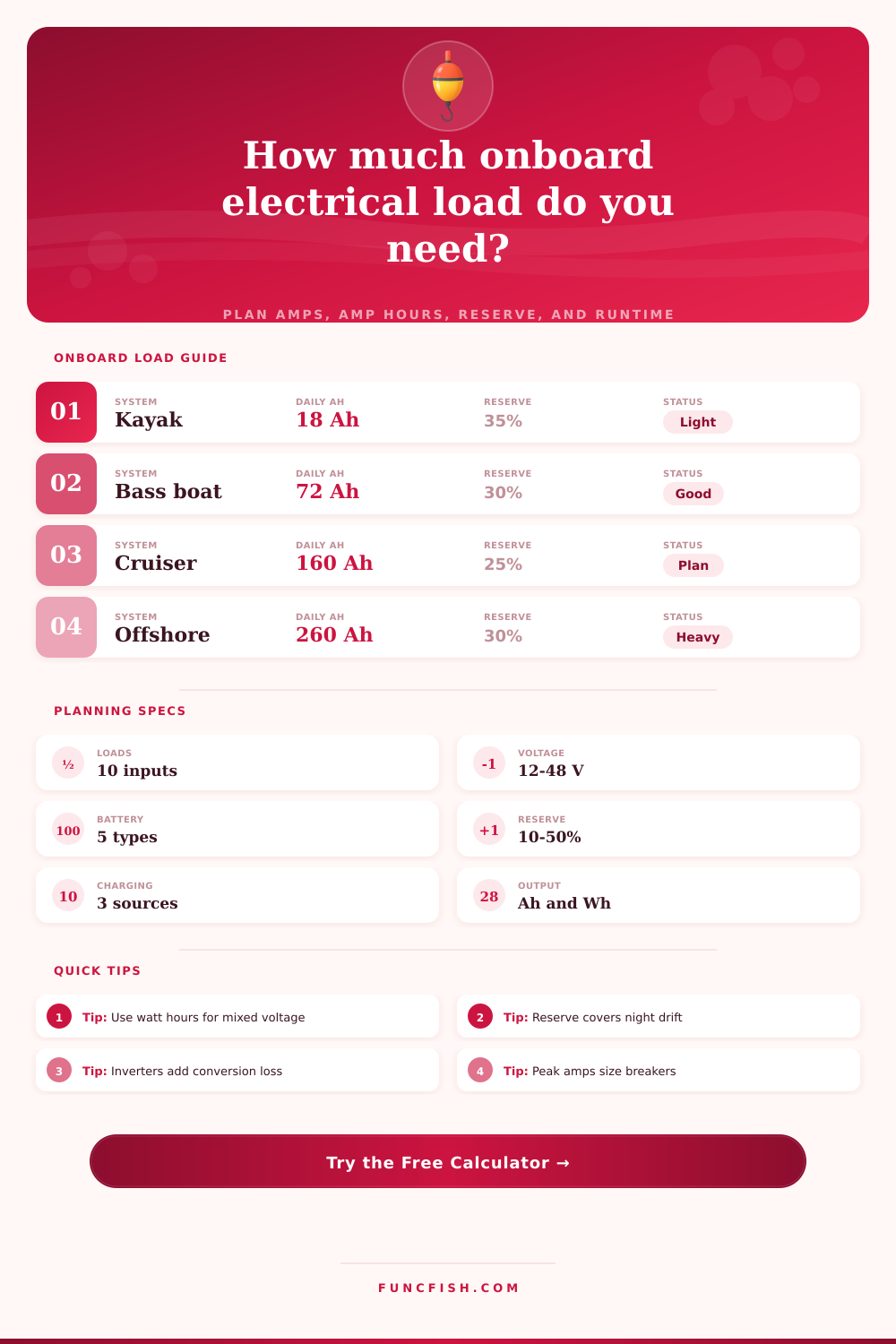
| Kayak electronics | 20-60 Ah at 12 V | 10-35 Ah | 30-40% |
| Bass boat house loads | 80-150 Ah at 12 V | 45-110 Ah | 25-35% |
| Inshore skiff | 100-200 Ah at 12 V | 60-140 Ah | 25-35% |
| Weekend cruiser | 200-500 Ah at 12 V | 120-300 Ah | 20-35% |
| Offshore electronics boat | 200-600 Ah at 12 or 24 V | 150-450 Ah | 30-40% |
💡Planning tips
The moment happens. You pull into the hot spot on the lake and the screen goes dark. A certain type of dread sets in as losing the information is more worse than catching the fish.
This isn’t due to forgetting to plug in your battery but rather underestimating the amount of juice your sonar pulls when you’re imaging three levels of water. Everything’s silent except for the electronics turning on, which seem to suck up power faster. Electrical planning revolves around understanding the gap between a device’s stated power requirements versus actual long-term usage.
How to Plan Your Boat’s Power
For example, many chartplotter may state a low standby draw. However, adding in continuous livewell pumping, VHF radio usage, and perhaps live sonar adds up to a significant drain on battery usage throughout the day. These seemingly little numbers realy begin to add up. With the calculator above, you don’t need to guess if you can take your boat out for the weekend with the battery bank you currently have.
Amp hours are not equal. Battery chemistry do change the situation. For example, maybe you’ve got two batteries rated equally yet one is lithium iron phosphate and the other is flooded lead acid. The lithium bank allows you to use ninety percent of its storage; the lead acid unit requires you to protect the cells by leaving half its capacity unused. Boaters often make mistake of ignoring the usable depth factor. They buy enough capacity on paper, but not enough in practice. Then they end up with a dead house battery when engine starter’s still charged.
According to the reference table, based off the type of vessel and its usage pattern, reserve targets changes accordingly. For instance, a person fishing from their kayak in calm waters will be near land with easy access for replacing dead batteries so a small reserve suffices. Conversely, an offshore charter boat rely on plenty of juice to run navigation equipment, communication systems, lights, fans and other amenities to keep customers happy, all while traveling far out to sea. That extra room isn’t dead space; it’s peace-of-mind insurance against any voltage sag that might dim your lights or reboot your computer at a bad time.
The battery’s not the only thing to consider; the wire gauge is equally important. A thin cable will limit the flow. You might have a big battery bank, but if you run power to it with undersized wire, you’ll create resistance and turn electrical energy into heat. The voltage loss may be imperceptible. Unless your electronics suddenly begin randomly rebooting on a run. Size your cables and breakers based on maximum load so that current flow efficiently from the source to the device without losing pressure along the way.
The power goes in, but people do not always think about charging sources until later. Solar seems like free energy, but its efficiency is limited by sun angle, controller and temperature. Alternators will charge well only when engine is running, which means you might drain more power trolling slowly then you replenish idling at the dock. Knowing the trade-offs will help determine if you need to have shore charging capability, or just deal with shorter runtimes between charges.
You should of known this earlier. Matching your expectations to reality… That’s what electrical planning is all about. You want the ability to keep the fish cold and the lights on, but you don’t want a system sitting half empty each season. Getting the load profile right will mean fewer problems at sunset and more time focusing on the water instead of worrying about the wiring.
The ice maker runs. The screen stays lit. And you return to the dock with power to spare.