Soft Plastic Pour Weight Calculator
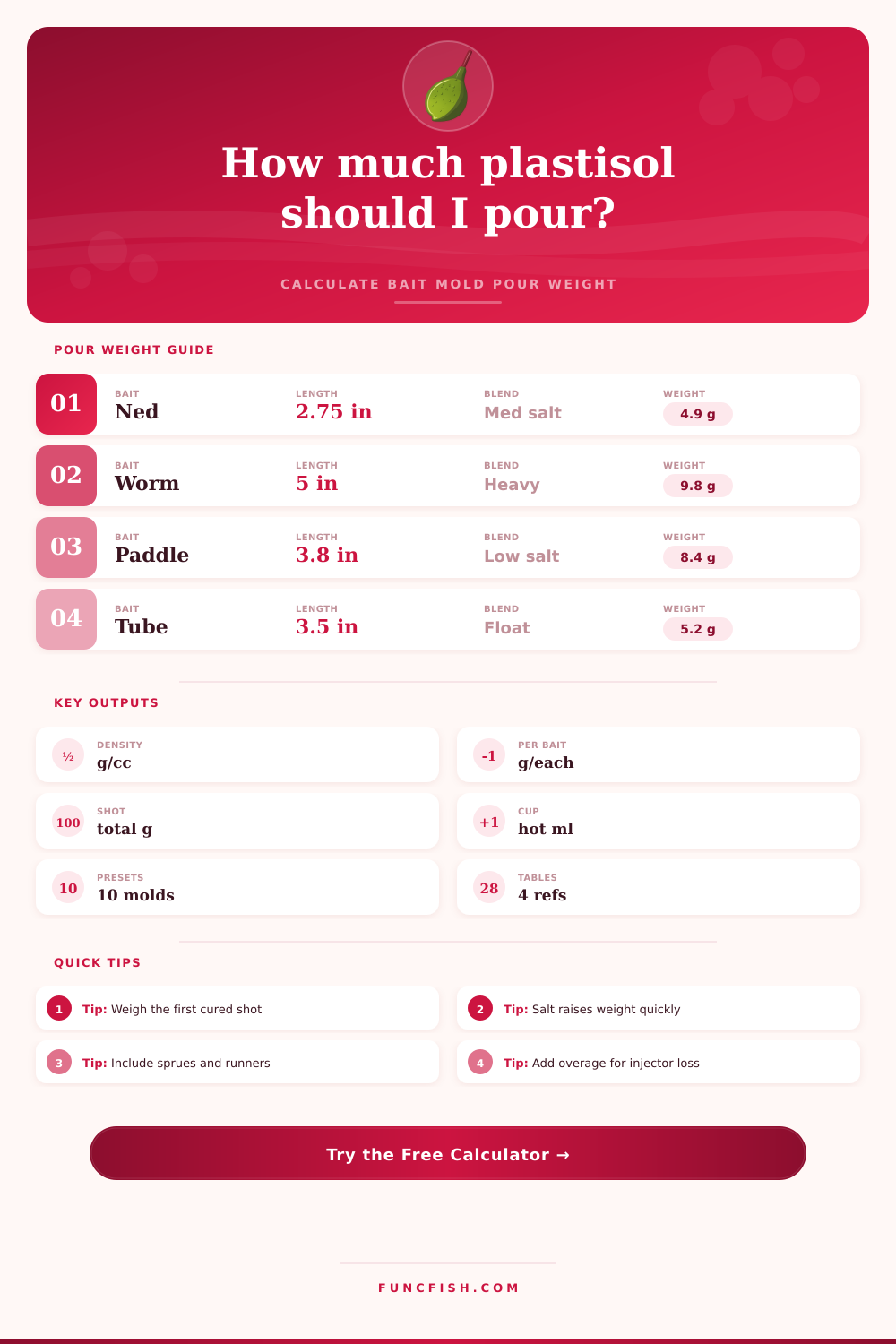
Estimate the exact hot cup target for hand-pouring or injecting soft plastic baits from cavity geometry, mold count, blend density, salt load, glitter, runner volume, reheats, and overage.
Mold presets
Pour inputs
Pour weight results
Calculation breakdown
Blend density grid
Microballoons lower mass and raise cup volume.
Soft worms, finesse minnows, small trailers.
Common bass worms and paddletails.
Sinking stick baits and wacky worms.
Pour method comparison
Open hand pour
Low runner waste, higher surface trim, best with extra cup holdback for steady streams.
Injector shot
Sprue and runner volume matters most, especially on multi-cavity aluminum molds.
Laminate plate
Split total weight by color after calculating the full cavity and runner requirement.
Core or tail shot
Use fill percentage to isolate a small section without changing the whole bait geometry.
Reference tables
| Bait style | Shape factor | Typical density | Pour note |
|---|---|---|---|
| Round stick worm | 0.785 cross-section | 1.18-1.38 g/cc | Salt load dominates the final per-bait weight. |
| Ribbed finesse worm | 0.62-0.72 average | 1.04-1.16 g/cc | Ribs reduce body volume even when max diameter looks large. |
| Paddletail swimbait | 0.70-0.82 oval | 1.03-1.14 g/cc | Tail section usually adds drag but little mass. |
| Tube bait | 0.45-0.58 hollow | 0.98-1.10 g/cc | Subtract hollow core by using the tube shape preset. |
| Craw or creature | 0.86 body factor | 1.06-1.20 g/cc | Appendages increase mold volume more than width suggests. |
| Blend type | Density used | Sink tendency | Adjustment cue |
|---|---|---|---|
| Floating microballoon | 0.82 g/cc | Floating to neutral | Expect large hot volume for the same scale weight. |
| Soft low salt | 1.04 g/cc | Slow sink | Use for small baits where action matters more than fall. |
| Standard medium salt | 1.12 g/cc | Controlled fall | Good baseline when measured bait weight is unknown. |
| Heavy salted stick | 1.32 g/cc | Fast sink | Raises total weight and lowers cup volume per ounce. |
| Saltwater tough blend | 1.10 g/cc | Moderate sink | Durability additive adds weight but not much cavity fill. |
| Mold setup | Runner allowance | Overage range | Best use |
|---|---|---|---|
| Single open mold | 0-2 ml | 5-8% | Small worms, grubs, hand-poured laminates. |
| Two-piece injector mold | 3-8 ml | 8-12% | Most bass baits with a short sprue. |
| Multi-cavity plate | 8-18 ml | 10-16% | Production shots and repeated color batches. |
| Long swimbait mold | 10-28 ml | 12-20% | Large cavities that need steady injector pressure. |
| Tail shot insert | 1-5 ml | 6-10% | Partial pours where fill percent controls volume. |
| Measured result | Likely cause | Math correction | Next test |
|---|---|---|---|
| Bait too light | Shape factor too low | Raise width, height, or fill by 3-6% | Weigh one cured bait without sprue. |
| Cup runs short | Runner not counted | Add runner volume to every shot | Weigh trimmed sprue pile after one shot. |
| Too much leftover | Overage too high | Lower holdback after mold warms up | Track leftover cup grams each reheat. |
| Laminate uneven | Wrong split by color | Divide cavity mass by color percentage | Start with equal hot volume, then tune by weight. |
| Sink rate changed | Salt or glitter shift | Update blend density instead of dimensions | Record density from water displacement. |
Pour weight tips
If you’ve attempted do-it-yourself soft plastics, you know exactly what I’m talking about. You measured the weight, melted down the mixture and poured it all into the cavity of nothing but your eyeballs could calculate. While some blame can fall on the mold, most often it’s not the issue. Weight does not equal volume. Add in something to help with visibility (glitter) or sink rate (salt), and it gets tricky. A cup isn’t a bucket.
Most angler make mistake of thinking that as long as it appears to fit the cavities, it should work. More plastic waste isn’t the only cost here. Time is wasted. Batches is ruined before curing.
Why You Need to Calculate Bait Weight
After you enter your blend density and mold dimensions into the calculator above, it will do all of the conversions and calculate coefficients for you, no guessing involved. But that’s just one part of knowing how to make process repeatable rather than leaving things to luck.
Let’s begin with shape factor. Does a hollow tube have the same volume profile as a ribbed finesse bait? What about a round worm? This tool factors that in using its math calculations dependent based off the body style you choose. It may seem insignificant, but a hollow body like a ribbed finesse bait eats up space without adding much mass. In contrast, a solid oval shaped swimbait contains a lot more material per inch of length. Failing to account for that will result in either an underfilled cavity or an overfilled hot cup. Your product is wasted and overfilling will lead to messy sprues. Read this article on how to pour plastics.
And then we have the blend density. That’s where folks gets tripped up here the most. Even though two pieces of bait of the same size; one molded using a heavy salted sinking mix and one made from a floating microballoon blend, will fit in the exact same place, the sinking mix will weigh much more. Dimension alone don’t dictate how much something will weigh. It’s the density that matters, and that’s why the calculator wants to know what kind of plastisol you’re going to use. If you add things like barium sulfate (sinking agents) or other ingredients to increase the weight, you’ll change mass but not volume. If you ignore this, your baits might float too high or sink too quickly no matter how good they look. The reference tables lays out these density variances very well. For example, they show that a super-heavy mix will act different than a medium-salt blend that’s considered “standard.” Take a moment to glance over those numbers before melting your first batch of baits.
Runners and sprues are the other quiet thieves. When molding plastics, there are channels that feed the material called runners into each cavity within the injection mold. A lot of material exist in those runners. So if you simply multiply the weight of the baits by number of cavities and forget about the runners, you’ll be running out of material in middle of the shot. For the hand pourer, it becomes a similar problem. You must pour extra to compensate for material holding back. You also has to account for material streaming off too fast, which can break the stream and cause an air bubble. There are areas in the calculator for Runner Volume as well as Pour Overage. Modify the percentage according to how complex your mold is so you have sufficient hot material to reach all corners but not too much leftover wasted material in the cup.
The other factor is temperature, though subtly. Plastisol actualy expands slightly more under heat than it do when cold. Again, the amount of expansion is slight but can be significant if you’re trying to achieve exact weights on tournament baits. The volume calculator accounts for temperature and calculates the hot cup volume accordingly. You still need to weigh your initial shot of cured plastic, but this will get you close enough that later runs will only need minor adjustments.
Don’t guess, measure: Your starting point can be found on the tool, but use some real world data after your initial pour to dial it in for you. Save money, avoid wasting plastic, and most importantly, stop hating making bait just because you hate doing all that math. There’s little talent separating a good batch of baits from a great batch. You should of know exactly how much you’ll want prior to turning on the heater.