Fly Sink Rate by Bead Weight Calculator
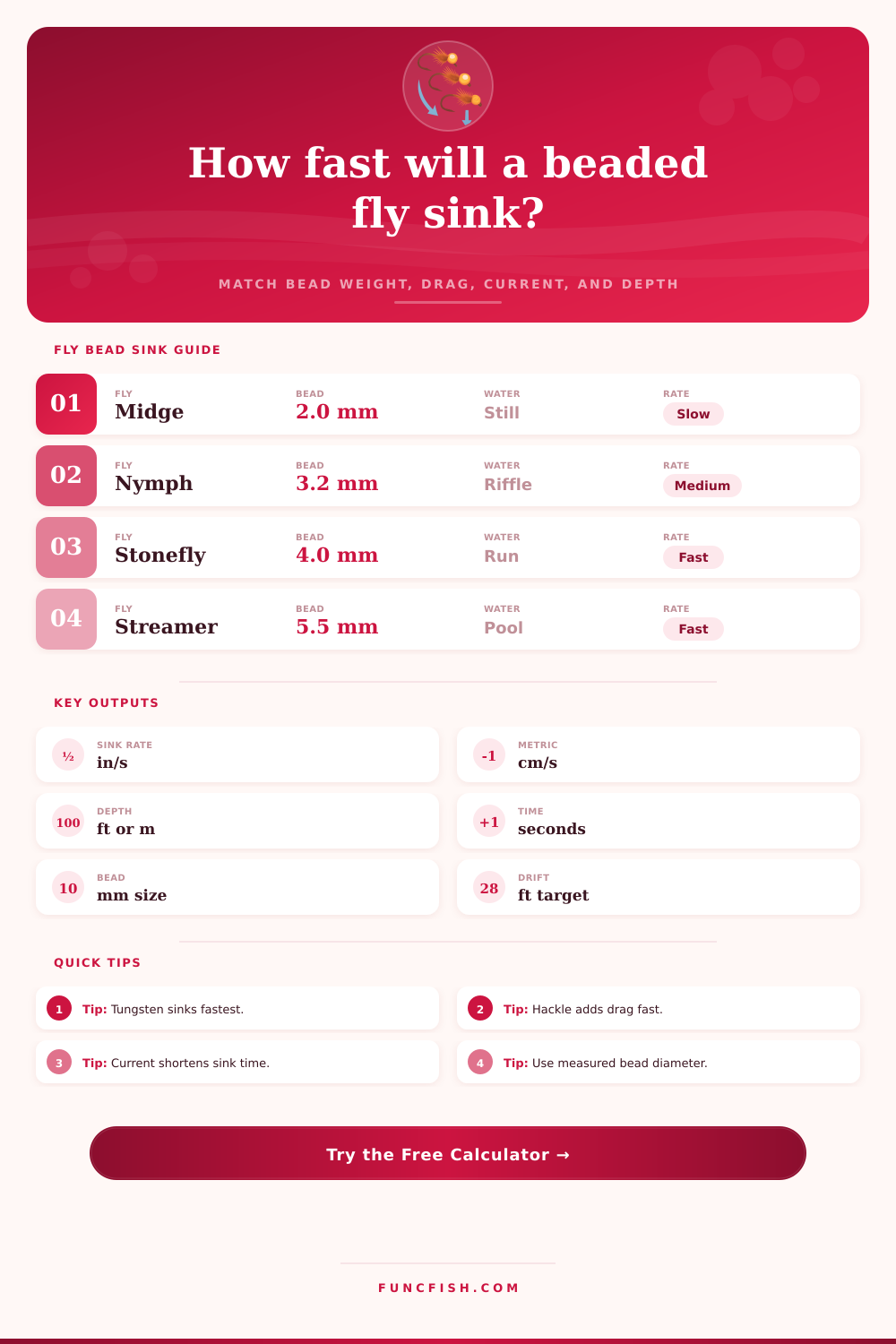
Estimate bead mass, effective fly density, sink rate, target-depth timing, drift reach, and alternate bead choices from bead material, bead diameter, fly drag, tippet drag, current, water type, and rig angle.
📌 Beaded fly presets
⚙ Fly, bead, water, and drift inputs
Bead sink estimate
Calculation breakdown
📊 Bead material data grid
Small bead, high submerged weight, fast depth gain.
Classic bead choice, roughly half tungsten mass.
Flash and color with modest sink contribution.
Underbody wire or wraps add dense ballast.
🔄 Live bead comparison grid
Same bead diameter, brass material, current fly drag.
Next common bead diameter in tungsten.
Two entered beads with the same material and shape.
Non-bead fly and hook mass only.
📘 Reference tables
| Bead size | Typical hook range | Tungsten mass guide | Common use |
|---|---|---|---|
| 1.5 to 2.0 mm | 20 to 24 | Very light | Midges, tiny emergers, shallow riffles |
| 2.3 to 2.8 mm | 16 to 20 | Light | Pheasant tails, zebra midges, soft hackles |
| 3.0 to 3.5 mm | 12 to 16 | Medium | Standard trout nymphs and jig flies |
| 3.8 to 4.6 mm | 8 to 12 | Heavy | Stoneflies, anchor flies, deeper pocket water |
| 5.0 to 6.4 mm | 2 to 8 | Extra heavy | Streamers, bass craws, saltwater patterns |
| Fly dressing | Typical Cd | Volume tendency | Sink behavior |
|---|---|---|---|
| Sparse midge or perdigon | 0.78 to 0.95 | Low water hold | Fast for bead size |
| General nymph | 1.00 to 1.18 | Moderate dubbing | Predictable drift sink |
| Soft hackle or wet fly | 1.20 to 1.45 | Fibers flare in current | Slower, more swing lift |
| Stonefly or craw | 1.35 to 1.70 | Bulky body and legs | Needs heavier bead to punch down |
| Streamer or leech | 1.25 to 1.65 | Long moving fibers | Sinks well on pause, lifts when stripped |
| Presentation | Useful angle | Current effect | Depth note |
|---|---|---|---|
| Euro nymph tight line | 0 to 20 degrees | Low surface drag | Best depth per bead weight |
| Indicator nymphing | 25 to 45 degrees | Leader belly adds drag | Lead distance matters more |
| Dry-dropper | 30 to 55 degrees | Dry fly limits dropper pull | Use thinner tippet and compact flies |
| Wet fly swing | 45 to 60 degrees | Cross-current lift | Sinks before tension, then planes upward |
| Stillwater count down | 0 to 15 degrees | Low current drift | Sink rate converts cleanly to count time |
| Water condition | Density input | Viscosity tendency | Calculator effect |
|---|---|---|---|
| Cold freshwater | High freshwater | More viscous | Slightly slower, more drag |
| Cool freshwater | Standard trout stream | Moderate | Baseline for most nymphing |
| Warm freshwater | Slightly lower | Less viscous | Slightly faster sink |
| Brackish water | Higher density | Moderate | More buoyancy, slightly slower |
| Saltwater | Highest listed | Moderate | Heavy flies may need extra bead mass |
💡 Calculation tips
A nymph won’t sink to the feeding lane on the noses of trout; it simply floats by. Frustration sets in for fly fishers. You have the right bead material and you’ve tied the pattern properly. Yet, it refuse to get to the desired depth because its buoyancy isn’t naturaly. Sink rate calculators is a handy tool that help bridge the gap between what you expect and what actualy happens.
More often than not, the problem are not due solely to tying skills. It’s about the complex blend of hydrodynamics, drag and density. After you input your current conditions and bead specs, the calculator do the math for you (no need to guess at coefficients). From there it convert theoretical physics into usable timing data that lets you know whether to expect your fly to touch down in time.
How to Make Your Nymph Sink Faster
What many anglers forget is that a bead’s not the only thing adding drag; heavy dubbing or bulky hackle will add drag big-time. And here’s why: Water resists your fly, fighting gravity and offsetting part of weight you spent on the bead. Low profile drag make a slim euro nymph sink fast, while a bushy stonefly imitation want more ballast to do the same thing.
To help with understanding how dressings work, the page’s reference table put fly types into expected drag coefficient ranges that correspond to their behavior in the real world. For example, the surface area of a soft hackle flare catch water flow, increasing lift and reducing sink rate. Knowing about this tradeoff lets you choose dressing style and bead size for your desired depth.
Need to increase speed of descent? Try substituting a classic pheasant tail for a heavier jig head variation. This reduces water retention while avoiding excess weight that spooks the fishs. Weight isn’t the only factor; the current add complications that a weight chart won’t show.
In a fast-running riffle, you need a quick-sinking fly because the current’s forward push will quickly carry your offering downstream, leaving it above bottom before it gets anywhere near them. That lack of synchrony lead many folks to miss strikes with heavy beads even when fishing fast water. Tapered leaders with tightline techniques reduces the drag on the tippet and improve timing by putting the line at a tighter angle. This transfers more energy directly into fly instead of picking up the slack in the leader.
Temperature and the weight of water Cold water is more dense and thick and contribute to the equation as well. The greater buoyancy of saltwater make for yet another variable, and requires even heavier beads or other more dense materials such as tungsten. What’s a good bead set-up on a cold spring creek may not be in a warm saltwater bay. Matching your bead selection to local conditions will keep it consistent.
It’s not about remembering numbers (weights), but rather knowing how variables interact. How does mass relate to drag? What is the current speed, and how much time do I have to balance them? When you get that, it makes making the correct fly choice intuitive and those misses dissapears, because your casts hit their mark and the drift holds position.
It’s all about sinking at the exact time and place the fish wait. That means thinking beyond weight, into time and space.