Euro Nymph Rig Weight Calculator
Estimate the tungsten bead mass, lead-free shot equivalent, and bottom-contact rating for euro nymphing from depth, current speed, drift length, tippet diameter, fly count, and water texture.
📌Euro nymph presets
⚙Rig and drift inputs
Euro nymph weight result
Formula breakdown
🧰Bead and shot reference grid
About 0.10 g / 1.5 grains. Light point flies for skinny lanes and low clear water.
About 0.15 g / 2.3 grains. Common shallow riffle bead for size 16 to 18 jigs.
About 0.20 g / 3.1 grains. Versatile anchor for two to four foot trout runs.
About 0.31 g / 4.8 grains. Strong point fly for pushy seams and short pocket drifts.
About 0.48 g / 7.4 grains. Heavy anchor when the fly must punch through fast surface flow.
About 0.06 g. Fine tune one light tick at a time without changing fly profile.
About 0.10 g. Useful when one bead size is close but not quite reaching.
About 0.18 g. A larger correction for deep slots, winter pools, and heavy seams.
🎣Gear and species comparison grid
7X to 6X, slim perdigons, 2.4 to 3.0 mm tungsten, soft bottom contact.
6X to 5X, dubbed jigs or quill bodies, two-fly team in moderate flow.
Long drifts, thin tippet, sparse flies, and lighter contact than pocket-water trout rigs.
5X to 4X, 3.5 to 4.0 mm tungsten, short-line control, frequent bottom ticks.
4X to 3X, compact heavy bugs, stronger rod angle control, deep lane contact.
4X to 2X, stonefly or jig streamer profile, larger hooks and pushy current lanes.
5X to 6X, slower drifts, modest bead mass, controlled hover near the substrate.
Rapid bead changes, slim profile point flies, and drag-managed leader angles.
📊Euro nymph reference tables
| Bead / Weight | Approx mass | Typical hook range | Best drift use |
|---|---|---|---|
| 2.0 mm tungsten | 0.06 g / 0.9 grains | 18-22 | Ultra-shallow flats and tiny droppers with minimal bottom contact. |
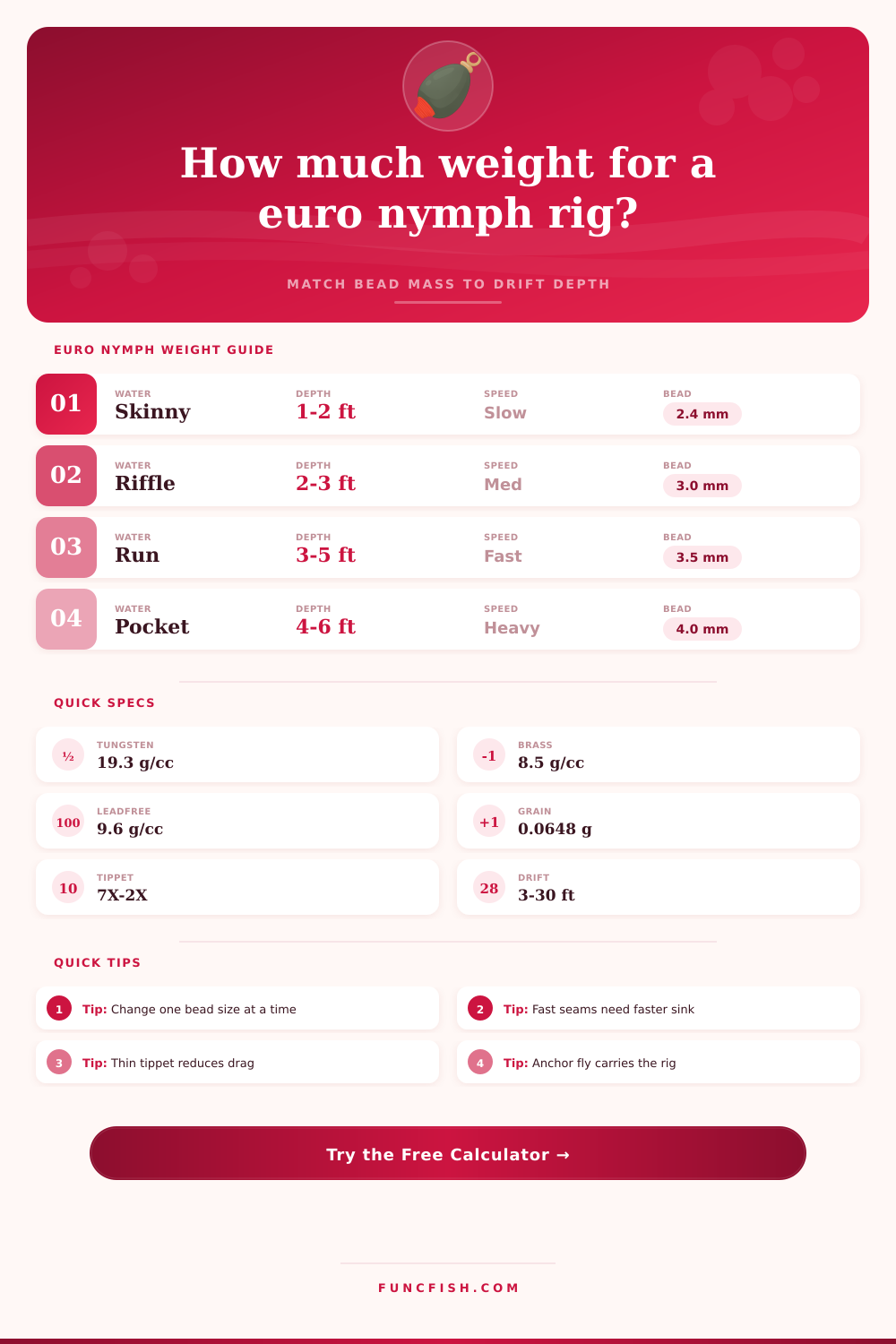
| 2.4 mm tungsten | 0.10 g / 1.5 grains | 16-20 | Clear low water, spring creeks, and soft tailouts with 6X or 7X. |
| 2.8 mm tungsten | 0.15 g / 2.3 grains | 14-18 | Shallow riffles where a slim fly needs to tick lightly. |
| 3.0 mm tungsten | 0.20 g / 3.1 grains | 12-18 | General trout euro nymphing in two to four feet of moving water. |
| 3.5 mm tungsten | 0.31 g / 4.8 grains | 10-16 | Pocket water, broken freestone runs, or short drifts through fast seams. |
| 4.0 mm tungsten | 0.48 g / 7.4 grains | 8-14 | Deep slots and heavy surface push where fast entry matters. |
| #6 lead-free shot | 0.10 g / 1.5 grains | Above point fly | Fine correction when a bead is close but the drift rides high. |
| #4 lead-free shot | 0.18 g / 2.8 grains | Above point fly | Noticeable correction for deep seams or bulky fly profiles. |
| Water lane | Depth and flow | Starting mass | Adjustment cue |
|---|---|---|---|
| Spring creek flat | 1-2.5 ft, 0.6-1.3 ft/s | 0.06-0.18 g | If sighter stalls without ticks, lighten before changing angle. |
| Tailwater glide | 2-4 ft, 1.0-2.0 ft/s | 0.15-0.35 g | Add small shot when the first third of drift never reaches depth. |
| Freestone riffle | 2-4 ft, 1.8-3.0 ft/s | 0.25-0.50 g | Use slimmer flies before adding large mass in turbulent water. |
| Pocket slot | 3-5 ft, 2.5-4.0 ft/s | 0.35-0.80 g | Short drift length requires a heavy anchor and direct leader entry. |
| Deep run | 4-7 ft, 1.5-3.0 ft/s | 0.35-0.75 g | Extend upstream entry if added mass starts hanging below the drift. |
| High water edge | 3-6 ft, 3.0-5.0 ft/s | 0.60-1.20 g | Use compact flies and stronger tippet to keep the rig stable. |
| Tippet class | Diameter | Drag impact | Practical use |
|---|---|---|---|
| 7X | 0.004 in / 0.10 mm | Very low | Tiny nymphs, clear flats, careful hook sets, soft rod angle. |
| 6X | 0.005 in / 0.13 mm | Low | Light euro rigs, small trout, and slow to moderate current. |
| 5X | 0.006 in / 0.15 mm | Moderate | Default trout range for two-nymph rigs and mixed pocket water. |
| 4X | 0.007 in / 0.18 mm | Moderate-high | Larger fish, heavier hooks, and rougher substrate where abrasion matters. |
| 3X | 0.008 in / 0.20 mm | High | Stoneflies, smallmouth, barbel edges, or stained pushy lanes. |
| 2X | 0.009 in / 0.23 mm | Very high | Heavy bugs and strong fish; expect to add mass or slim the fly. |
| Fly profile | Drag factor | Mass response | Rigging note |
|---|---|---|---|
| Slim perdigon / jig nymph | 0.90 | Needs less mass | Best for fast sink and precise bottom contact. |
| Quill body nymph | 0.97 | Slightly efficient | Good compromise for clear water and moderate flow. |
| Hare's ear / dubbed body | 1.08 | Needs a little more | Dubbing slows descent and can hang in microcurrents. |
| Stonefly or mop profile | 1.25 | Needs much more | Use as anchor only when the lane can support the larger silhouette. |
| Soft hackle dropper | 1.18 | Often rides high | Let a heavier point fly carry it down without over-shotting. |
| Squirmy or worm pattern | 1.22 | Needs more control | Material movement adds drag; shorten tags in fast water. |
💡Rig weight tips
You make a cast to a fast seam, watching as your sighter line dissapears, not even grazing bottom. You can see ’em holding in place with the current; they’re right there, but your fly won’t go down. Instead it rests on top, far above the head of trout.
That’s when physics meets intuition. For most folks, the reaction is to add more weight to the tippet. Enough to turn their line into a pearl necklace, creating drag and ruining the drift.
How to Choose the Right Weight for Your Fly
Instead, understand that weight doesn’t necessarily equal mass. It is also how mass interacts with water speed, depth, and the gentle resistance of your leader. You don’t have to wonder if a 3.0 millimeter tungsten bead is enough, or if you should of go straight to the heavy side of things. The calculator above do the work for you; just input your water conditions.
It only requires information about variables that weigh far more heavly into the equation than the bead itself. It wants to know the depth at which the fish are holding and speed of surface water. Why? Your leader gets pushed downstream faster as water moves over it. This causes drag and keeps fly higher off bottom then it would be in still water. So the tool takes all of this into account and adjust the needed sink rate according to the speed you input. If you neglect current speed variable, you’ll always overweight your rig in slow pools and under weight it in riffles.
The other variable that alters everything are your tippet diameter. Just like a parachute drags in the air, thicker line also creates drag in the water. So even with same size bead mass, a 5X tippet will sink significantly slower then a 7X. To account for that, the calculator looks at which diameter of tippet you choose and adjust the target weight of the rig upwards based off that. It is a small detail, but it makes a difference.
When fishing big trout and using heavy leader, you don’t want fewer beads. You want more. And the tool will tell you precisely how many more pounds of mass you’ll need to compensate for that drag coefficient and get your fly down into the zone without being stuck on the surface film.
The other trickier variable here is fly profile. For example, a thin Perdigon nymph will cut through the water with little resistance and dive fast even on modest weight. Conversely, a stonefly imitator or a really fat bulked up hare’s ear pattern will have a lot of water resistance simply because of their size and shape. The calculator accounts for this, too, by having a body profile question so you can avoid adding extra shot if a denser fly would do the job.
And this is where a lot of folks get hung up. They continue to add split shot to their big bulky fly that won’t sink. But they fail to realize it’s not the weight of the fly that is the issue but rather its silhouette. Going to a slimmer pattern will solve your problem better then going heavier.
All of that boils down into the output, bottom contact rating. That’s how it tells you if you’re going to barely touch bottom or dredge along the substrate. This is important because you’ll want a light bottom contact for a light nymph dropper drifting across top of the rocks in clear water. This matters when the fish are really picky and want to see that fly float naturaly just off the bottom. Or you may want something heavier so that you can still bring your fly up and keep it in the strike zone in muddy, fast-moving water where there’s a lot of current but not enough to hold a fly up.
And the page has a reference grid where it shows which bead size is appropriate to common fishing conditions and helps you envision what a 4.0 millimeter anchor would feel like versus a 2.4 millimeter one.
In the end, the whole point of euro nymphing is control. You’re attempting to put a small morsel of bait right in front of a fish’s face, just out of reach, not up above them. It is not below them either. By converting those many variables into a straightforward bead size/split shot recommendation, the calculator take the guessing game out of the equation.
But remember, there’s no substitute for your eyes. Spend the initial third of your drift watching. If the sighter line continues forward without slowing or twitching, don’t worry what the numbers tell you. You need more weight on your rig. And adjust only one variable at a time; start with bead size and save the split shot until last. Keep your leader steep so gravity does most of the work and minimize drag.
And when that first tick of rod tip lets you know the fly has reached bottom, then you know; you have ’em dialed in. That connection makes all this calculation worthwhil.