Transducer Angle Offset Calculator
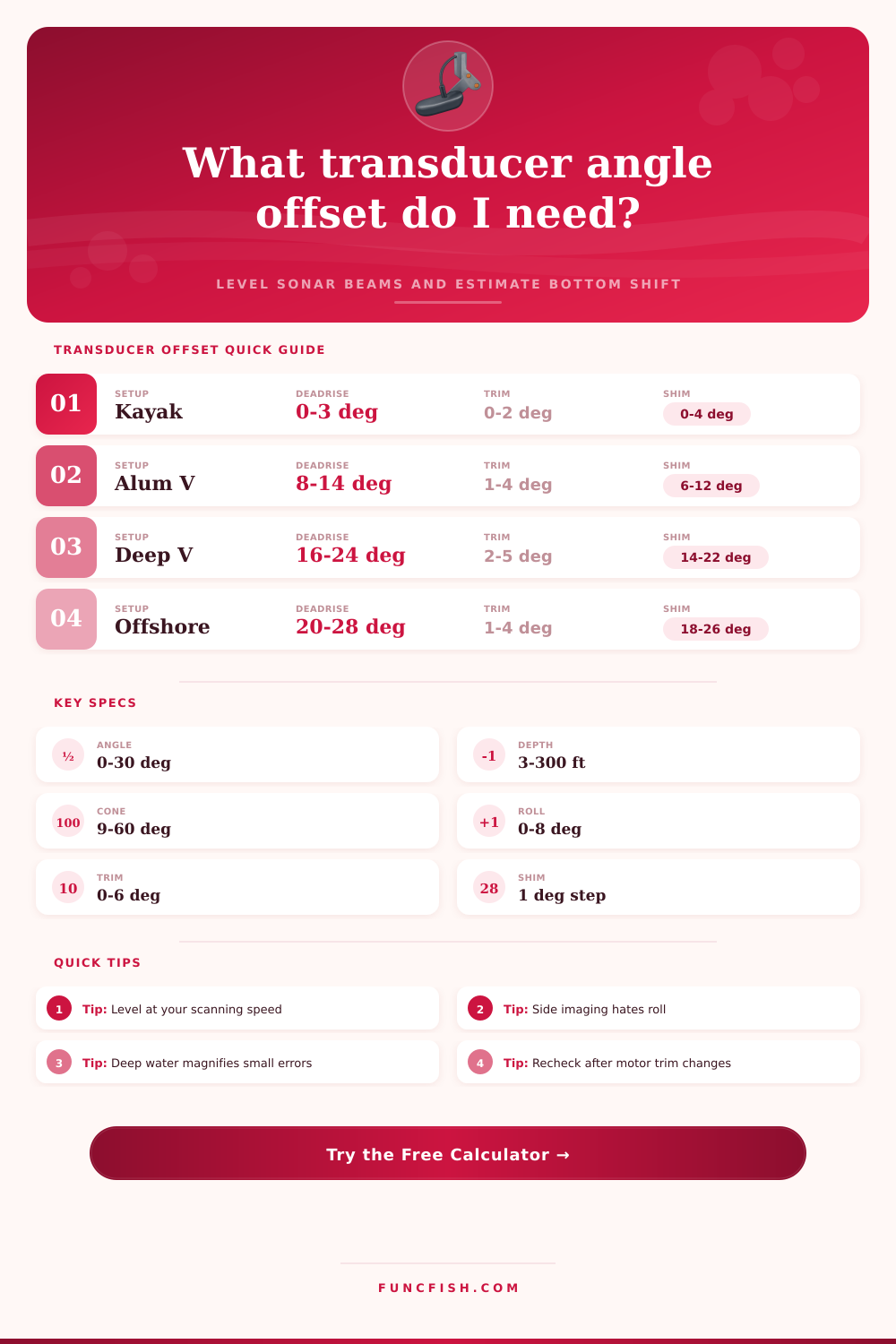
Estimate the wedge, shim, and sonar-footprint offset needed to keep a fish finder transducer beam vertical when hull deadrise, running trim, side roll, and target depth are working against it.
📍Transducer mounting presets
⚙Mounting geometry inputs
Offset and beam alignment results
Formula breakdown
📊Transducer beam reference grid
Tight bottom lock for deep water, ledges, and offshore marks where small tilt errors move the return a long way.
Common fish finder cone for mixed freshwater work, balancing target separation and enough coverage for trolling passes.
Sharper vertical picture of brush, shell, grass, and rock; alignment matters because the slice is thin fore and aft.
Wide scanning fan that quickly shows roll, deadrise, or bracket lean as one side brighter than the other.
Forward-facing beams need a level reference so casts land where the screen says the target is sitting.
Forgiving for depth reading in shallow water but less precise when marking fish tight to edges or small cover.
Thru-hull elements are sold by built-in tilt; choose the tilt closest to local deadrise for a vertical beam.
A useful real-world alignment goal for many transom mounts after boat load, motor trim, and bracket flex are included.
🎣Gear and species comparison grid
Bass on docks
Side imaging or down imaging, 8-18 ft, low trim, strict roll control for clean shadows beside posts and brush.
Walleye on breaks
2D CHIRP plus down imaging, 20-45 ft, moderate deadrise, trim-compensated wedge for contour trolling.
Crappie brush piles
Wide 2D or down imaging, 8-25 ft, slow speed, level bracket to keep small cover centered under the boat.
Redfish flats
Side imaging in 3-10 ft, shallow running attitude, small errors show as uneven bottom brightness on long scans.
Salmon trolling
Narrow or dual CHIRP, 60-180 ft, deep-V hulls need accurate deadrise correction to keep bait schools aligned.
Offshore reef fish
Narrow CHIRP or tilted thru-hull, 100-300 ft, tiny angle errors can shift marks many feet across bottom.
Catfish channels
Wide 2D and side imaging, 15-55 ft, bracket should be level at idle and at slow graphing speeds.
Kayak structure scans
Side imaging arm, 4-20 ft, seat lean and gear load matter more than hull deadrise on many small craft.
📐Shim angle and beam offset tables
| Mount type | Typical offset source | Best measuring reference | Practical shim step |
|---|---|---|---|
| Transom bracket | Deadrise plus motor trim | Pad beside transducer at graphing speed | 1° to 2° wedge |
| Jack plate mount | Setback turbulence and plate angle | Plate face plus hull running attitude | 1° wedge and bracket slots |
| Kayak rail arm | Seat lean and gear balance | Waterline with angler seated | Adjustable arm angle |
| Pontoon log bracket | Bracket twist and loaded list | Deck level versus waterline | Thin side shim |
| Thru-hull pocket | Hull deadrise at bore | Local hull plane, not catalog deadrise | Tilted element selection |
| Trolling motor | Motor barrel rotation | Shaft vertical and barrel level | Clamp rotation marks |
| Residual angle | Shift at 20 ft | Shift at 50 ft | Shift at 120 ft |
|---|---|---|---|
| 1° | 0.3 ft | 0.9 ft | 2.1 ft |
| 2° | 0.7 ft | 1.7 ft | 4.2 ft |
| 3° | 1.0 ft | 2.6 ft | 6.3 ft |
| 5° | 1.7 ft | 4.4 ft | 10.5 ft |
| 8° | 2.8 ft | 7.0 ft | 16.9 ft |
| 12° | 4.3 ft | 10.6 ft | 25.5 ft |
| Beam family | Beam angle used | Strong use case | Alignment sensitivity |
|---|---|---|---|
| Narrow CHIRP | 9° | Deep offshore, salmon, lake trout | Very high |
| Dual CHIRP | 16° | Walleye, catfish, mixed freshwater | High |
| Down imaging | 35° | Brush, rock, weeds, bridge pilings | Medium high |
| Side imaging | 50° | Docks, flats, ledges, long searches | Very high for roll |
| Live sonar | 20° | Forward casting to visible targets | High |
| Wide 2D | 60° | Shallow depth and general fish marks | Moderate |
| Fishing setup | Depth band | Speed to level for | Preferred tolerance |
|---|---|---|---|
| Bass side imaging | 5-25 ft | 3-6 mph graphing pass | Strict, 1.5° |
| Walleye contour troll | 18-50 ft | 1.2-2.5 mph trolling | Normal, 3° |
| Crappie brush search | 8-30 ft | Idle or electric motor | Normal, 3° |
| Offshore bottom lock | 90-300 ft | Cruise or slow search | Strict, 1.5° |
| Kayak scan | 3-20 ft | Paddle drift or pedal speed | Normal, 3° |
| Catfish channel edge | 15-60 ft | Idle graphing pass | Forgiving, 5° |
🚩Mounting calculation tips
Measure where the transducer actually sits. Published hull deadrise is often taken near the transom centerline, while a starboard-side bracket may sit on a flatter or steeper patch.
Level for the speed you use to read fish. A boat that is perfect on the trailer can be several degrees different at idle, trolling speed, or side-imaging graphing speed.
So now it’s on, you mount the transducer. Turn on the sonar. You stare at a screen that says you are sitting on forty feet of water when your depth sounder clearly shows thirty. There’s a ledge with a fish over it. Except there isnt a ledge. Bottom structure appear smeared rather than clear. Bad geometry typicaly. Not bad gear.
Beam landing is determined by transducer angle. Running trim and hull deadrise will tilt beam, tilt throws casting position off several feet before you drop bait. Enter your boat shape and its relative position in the water into calculator and it does the math for you. You won’t have to guess whether that list is real or an optical illusion.
Why Sonar Angles Matter
There are three main angles to consider. The first is the inherent V of the hull where the transducer mounts, which is called deadrise. On some offshore boats the V will be twenty degrees here (deep V). Flat bottom bass boats has virtually zero deadrise. Next you have trim, changing whenever you apply power. Depending on how they are set up, most engine will lift the bow or push it down. This changes the base line angle. Third, the boat may roll, typicaly because of weight distribution or a current pushing one side higher than the other. Current pushes the transducer down on one side, especially with side imaging transducers. There are broad bands to port and starboard. Hull lean causes one side of the beam to be leaning into a narrower fan different than the other. That side looks taller and lets in more light. The other side drops off sharply. It paints a deceptive portrait of the underwater terrain.”
What good is proper input without understanding what the tool spits out? Knowing how far to shim the transducer (how much wedge to put beneath the transducer pad) comes from the suggested shim angle. It offsets hull angles and returns the beam vertical. But the other number that does some serious damage when not considered are the bottom beam offset number. This is how far off to one side the sonar cone actualy impacts the bottom compared to where you thought it was impacting. A couple degrees at shallow depth may mean a few inches difference in where the cone hits. Pull that down to a hundred feet underwater and now your fish marks is a few feet away from reality. Because the screen deceived you on where they were relative to boat, you may end up casting past the school of bait.
The other thing to pay attention to are footprint width. Wide 2D footprints has poor target separation on targets in deep water but they do cover more ground. So if you’re off on your angling, it doesn’t matter as much. You’ll still hit the spot on bottom that you wanted to scan. Narrow CHIRP beams separate targets incredibly well in deep water, but they miss an entire swath of bottom. Because the beam is so narrow you may not be even looking down on the bottom where you want to be. When you want to hit that particular rock pile, they arent great at locating exactly what’s there to drop a bait onto.
The chart on page illustrates this nicely. It details sensitivity based off both depth and beam type. This gives insight into why folks who chase offshore salmon care about being perfect on their beam angle. Guys on a pontoon idling around for crappie often don’t give a second thought to a few degrees of tilt, and they won’t lose much.
So how do we measure it? We mostly measure it by measuring the angle that really matters. Typically when manufacturers cite the hull deadrise they’re referencing a point near the centerline of the transom. Where do you mount a transducer? You probably would of not mounted it in the middle of the back of your boat. So on the starboard side for example, the local hull angle may be steeper or flatter than what’s listed on the spec sheet. It should also be measured at normal scan speed (when you’re out running) not when sitting tied to the dock. Under power, the boat sit differently. The wake raises the stern, and the current pushes the bow over. Weight also shifts, and all of this change the effective transducer face angle.
Shim selection is considered a do-it-once deal when folks set up their trailers. But it’s more like a changing part of getting ready to go boating. You might load it down with some gear and roll the boat out a little bit. You might change your motor trim to get on plane easier in windy conditions. All these thing will cause it to move out of alignment. Five minutes before a long offshore run or a big tournament, check that shim angle again. Save yourself hours of head scratching on the water.
Get that beam vertical and a hazy guess becomes a clear map. It is a small thing but it matters when you are looking for fish in open water.