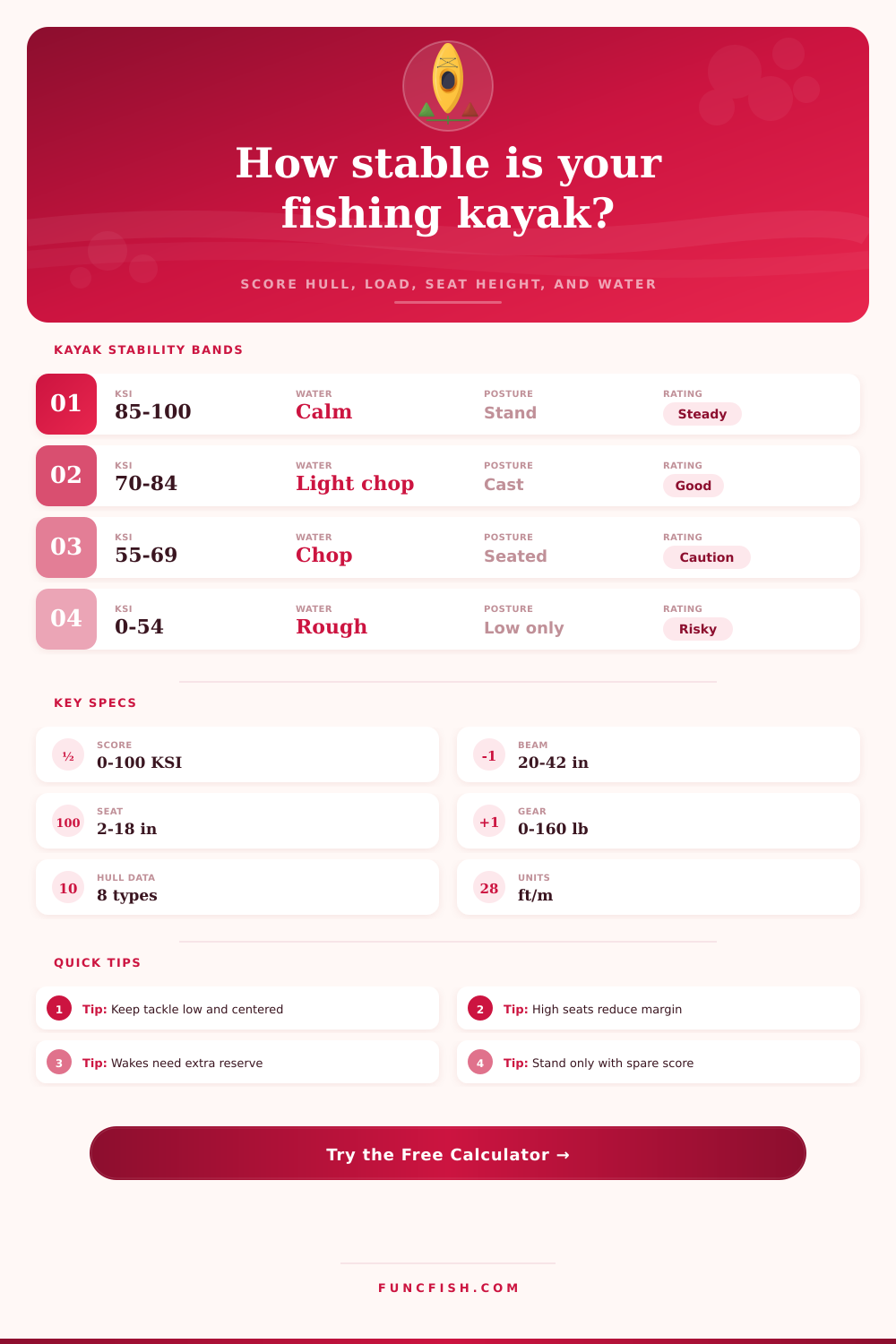
Kayak Stability Index Calculator
Estimate fishing kayak steadiness from hull dimensions, load, seat height, water state, and angling posture, then compare the score with common kayak fishing scenarios.
📌Kayak fishing presets
⚙Stability inputs
Kayak stability results
Formula breakdown
📊Hull stability data grid
High primary stability for casting, rigging, and light standing in calm water.
Stable platform with extra load from drive, battery, rudder, and tackle storage.
Efficient paddle hull with less initial steadiness but better edging response.
Large footprint and capacity, but windage and high cargo stacks still matter.
Each inch above the waterline raises the center of gravity and lowers margin.
Many fishing kayaks feel best before the carried load nears rated capacity.
A practical fishing margin for reaching, landing fish, and handling paddle strokes.
A strong score for short standing casts after accounting for water and load.
🎣Gear and species comparison grid
Medium tackle, crate, and seated casting usually suit 32-36 in fishing hulls.
Pedal kayaks and wide SOT hulls handle sight casting plus stakeout poles well.
Lower gear load and seated posture keep narrower touring hulls usable.
Heavy lures, figure-eights, and standing pushes favor wide, high-capacity hulls.
Anchor pulls and fish surges need spare reserve and centered battery or bait load.
Current seams reward secondary stability and quick recovery more than width alone.
Standing line management needs a low deck, wide beam, and calm-water discipline.
Wake, bait tank weight, and surf timing make load reserve especially important.
📚Reference tables
| Index band | Practical meaning | Fishing posture | Water note |
|---|---|---|---|
| 88-100 | Very stable after load and water adjustments | Brief standing casts, careful fish handling, seated work | Still reduce exposure in wake, current, or cold water |
| 75-87 | Strong seated platform with some standing potential | Seated casting, high seat, short stand in calm water | Good reserve for light chop if load stays centered |
| 62-74 | Workable fishing stability with active attention | Seated casting, trolling, drift fishing, low reach | Avoid abrupt side pulls and heavy deck clutter |
| 48-61 | Guarded margin; stability depends on technique | Low seated posture only for most anglers | Chop, wakes, and high seats can push it below comfort |
| 0-47 | Low practical fishing margin for the selected setup | Reduce load, lower seat, or choose calmer use | Not a good match for standing or side-load work |
| Hull style | Typical fishing beam | Stability character | Best matching use |
|---|---|---|---|
| Wide fishing sit-on-top | 33-38 in / 84-97 cm | High primary stability, moderate speed | Bass, redfish, catfish, rigging-heavy trips |
| Pedal-drive fishing kayak | 34-37 in / 86-94 cm | Stable platform with added drive-system load | Hands-free casting, trolling, marsh and lake work |
| Touring sit-inside kayak | 24-30 in / 61-76 cm | Lower primary, better glide and edging | Light tackle, trolling, protected lake trout |
| Inflatable fishing kayak | 34-40 in / 86-102 cm | Wide footprint, softer secondary response | Portable lake and slow river fishing |
| Hybrid canoe-kayak | 32-38 in / 81-97 cm | Open deck, high cargo sensitivity | Fly gear, coolers, shallow-water sight fishing |
| Adjustment | Multiplier range | Why it changes KSI | Setup response |
|---|---|---|---|
| Water state | 0.68-1.00 | Wakes, surf, current seams, and cold clothing reduce usable reaction time | Lower the seat, trim bow-stern load, and stay seated sooner |
| Fishing posture | 0.62-1.00 | Standing and side reaches raise leverage against the hull | Face the work, keep shoulders inside the rails, and brace before pulling |
| Seat height | 0.62-1.03 | Higher center of gravity shortens the practical heel angle | Drop to low-seat mode when chop or wake builds |
| Load ratio | 0.55-1.05 | Overloaded kayaks sit deeper and react slower to side force | Move heavy items below deck level and keep reserve above 25% |
| Fishing load item | Typical added load | Stability concern | Best placement |
|---|---|---|---|
| Crate with tackle trays | 12-28 lb / 5-13 kg | High rear cargo raises roll leverage | Low in tankwell and strapped tight |
| Battery and electronics | 4-18 lb / 2-8 kg | Dense load can list the kayak if off-center | On centerline near the seat or under deck |
| Anchor, chain, and line | 5-20 lb / 2-9 kg | Side pulls are more important than weight alone | Centered until deployed through trolley or bow line |
| Cooler or bait tank | 15-60 lb / 7-27 kg | Water slosh and height reduce recovery margin | Low, full-width support, close to center |
| Kept fish or tournament bag | 5-45 lb / 2-20 kg | Late-trip weight may exceed the original trim | Split weight evenly and recalculate reserve |
💡Stability calculation tips
If you’ve been fishing many lakes you’ve probably witnessed it: some poor soul purchases an “all bells and whistles” boat with a wide hull and big seat. They think they’ll be just fine because the width makes it stable, you step into the boat to cast, lean out just a tad too much and end up wearing your breakfast. Most of the time it isn’t the kayaks’ fault but instead physics of leverage is against you.
Use the calculator above to factor in your posture, load distribution, and hull dimension. It will reveal your true margin of error before you end up getting wet.
How to Stay Stable in Your Kayak
It’s simple to look at the width and focus only on beam. A thirty-six inch hull feels like a raft compared to a twenty-eight inch touring boat. The feeling of being stable are there and it holds true for sitting still. When you’re standing up and tipping then the boat doesn’t right itself…that’s secondary stability. Wide, flat-bottomed hulls don’t have as much good secondary response when you sit down and tip. You hit an angle and they just keep going over instead of correcting, people mistake that for lack of primary stability.
The center of gravity depend on load placement. Load placement changes everything because it moves your center of gravity. An anchor kit or battery in the back tankwell can feel like a convenient way to go, but think about it: That’s a long lever arm that multiplies any change in weight. This factor consider all your gear and how much of the boat is left with reserve capacity before you’re sitting too low in the water.
With more kayak depth, there’s not as much of the side to push against those sideways forces generated by paddling strokes and wind. Keeping heavier items low and in the middle are key. It is the difference between staying upright and taking a cold shower.
Most people don’t think about how important seat height is. It is easy to see why having a raised seat allow better access to your bait, but it also positions your center of gravity higher above the water line. Every inch that seat rises lowers your effective heel margin. In other words you are trading stability for comfort. That equation gets costly fast when you intend to stand.
A confidence metric based off results tells you whether or not your rig can use that additional force comfortabley without losing composure. Anything under seventy typically isn’t worth trying in an upright position if there’s any hint of a breeze or chop on the water.
There are other factors that no single number can account for: Water conditions. Pond water with glass on it reacts very differently than windy or boat traffic created choppy water. Rougher water require more reserve just because the waves impact you at odd angles and can’t be predicted. When? When does that wake come crashing into you from the side? That makes your window of stability smaller. The way that anchor tug feels manageable in calm water become terrifying in a current seam.
The other variable is skill-level. And while skill level doesn’t alter the physics involved, an experienced angler will know when he can absorbs and fight certain angles that would swamp a novice in mere seconds. To allow for this, the tool factor into the margin of usability based on your perceived balance skill. It expects you to err, and everybody does. But we want those errors to be forgiving… Not catastrophic.
A big boat isn’t always stable. The stability in a kayak isn’t just the hull. How do you reduce risk? Make smart decisions with that information. Before heading out off the dock, make sure you are loaded properly. Maintain your center of gravity low. Understand what the water conditions can be like and respect them. Listen to the numbers if they tell you to be cautious. Let the hull do its work.