Canoe Load Capacity Calculator
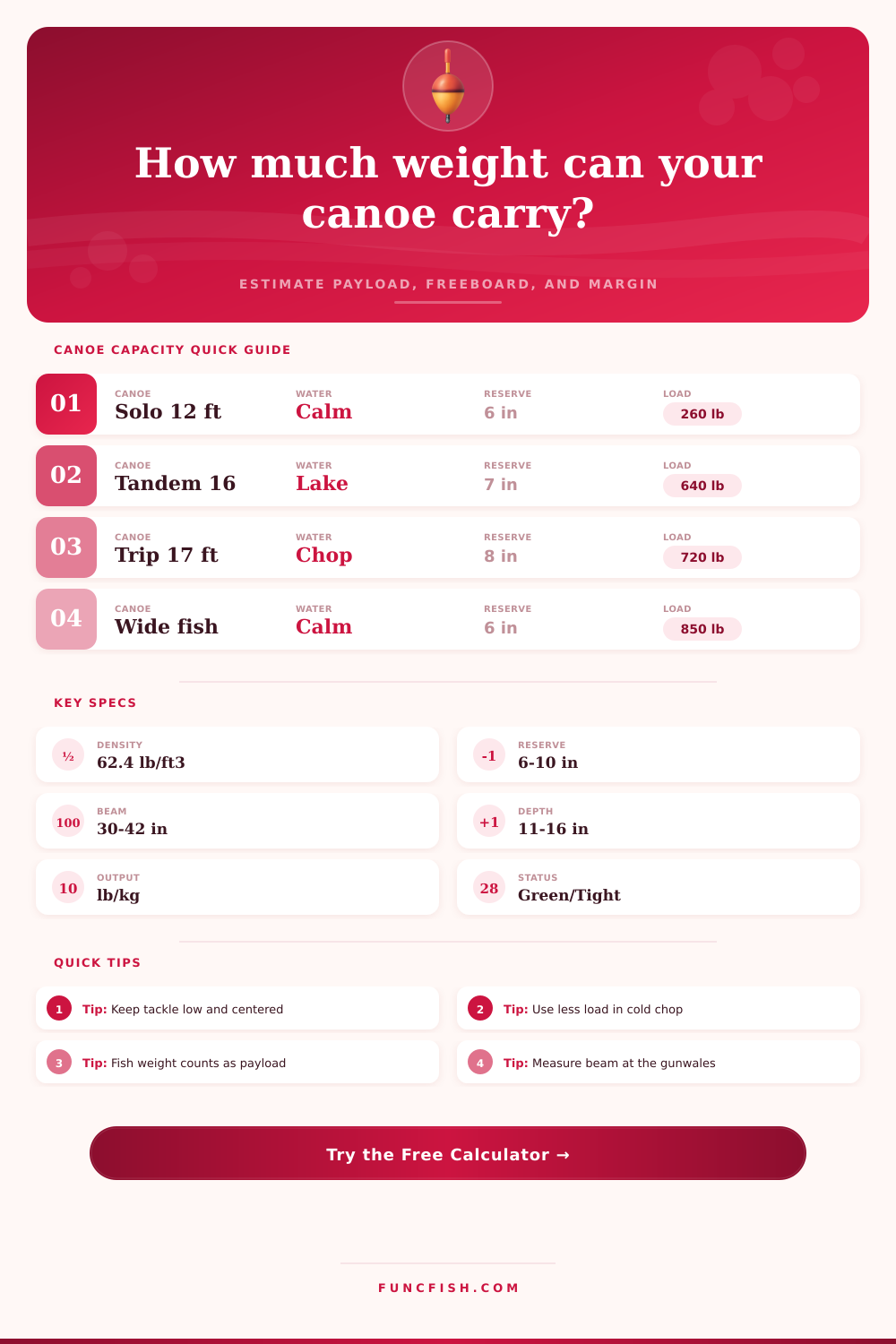
Estimate a fishing canoe load limit from hull dimensions, reserve freeboard, hull shape, water exposure, and current paddler plus gear weight.
📌Fishing canoe presets
⚙Capacity inputs
Canoe load result
Formula breakdown
🛶Canoe capacity data grid
Each displaced cubic foot supports this much total canoe plus load weight.
Fishing loads are safer when several inches of side remain above water.
Narrow round hulls displace less at shallow draft than broad fishing hulls.
Wind, chop, cold water, and wakes reduce practical usable payload.
🎣Gear and species comparison grid
Two rods, small tackle bag, anchor, net, soft cooler, and a moderate livewell substitute.
Light fly or spinning gear, wading layers, compact dry bag, and minimal retained fish weight.
Jig boxes, sonar battery, anchor kit, rain gear, food pack, and chilled catch allowance.
Large bait cooler, rod holders, lantern, heavy anchor, landing net, and extra water.
📊Reference tables
| Hull profile | Block coefficient | Typical fishing use | Capacity behavior |
|---|---|---|---|
| Solo touring canoe | 0.37 | Solo bass, trout, panfish, and fly fishing | Efficient hull, but narrow beam needs strict centered loading. |
| Tandem recreational canoe | 0.43 | Two-person lake fishing and mixed tackle | Good general capacity when the load is spread between seats. |
| Kevlar tripping canoe | 0.39 | Portage trips, walleye camps, remote lakes | Light hull helps payload, but rounded sections dislike high gear stacks. |
| Wide flatwater fishing canoe | 0.49 | Stillwater bass, panfish, and electronics | Broad beam gives strong initial stability and higher usable draft. |
| Square-stern fishing canoe | 0.50 | Small motor or battery-assisted fishing | High capacity, but stern weight should be trimmed forward. |
| Inflatable fishing canoe | 0.52 | Calm coves, reservoirs, and easy launches | Large tubes increase volume while windage reduces rough-water margin. |
| Water condition | Reserve added | Payload factor | Fishing interpretation |
|---|---|---|---|
| Calm pond or protected cove | 0 in (0 cm) | 92% | Highest practical load, still leave room for casting movement. |
| Light ripple on a lake | 1 in (2.5 cm) | 86% | Good everyday setting for two anglers and normal tackle. |
| Steady chop or boat wake | 2 in (5 cm) | 78% | Load should be reduced before crossing exposed water. |
| Moving river or riffle approaches | 1.5 in (4 cm) | 80% | Reserve is needed for eddy turns, shallow impacts, and current seams. |
| Cold water with heavy clothing | 2.5 in (6 cm) | 74% | Conservative load for bulky clothing and limited recovery margin. |
| Open water with crosswind | 3 in (8 cm) | 68% | Wind and waves make trim errors more important than raw buoyancy. |
| Fishing load item | Typical weight | Metric equivalent | Capacity note |
|---|---|---|---|
| Anchor, rope, and small chain | 10-22 lb | 4.5-10 kg | Store near the center unless anchoring from a fixed bow line. |
| Lead-acid trolling battery | 45-65 lb | 20-29 kg | A stern battery can overload trim before total payload is exceeded. |
| Lithium sonar battery and unit | 4-12 lb | 2-5 kg | Small enough to matter mainly in ultralight solo canoes. |
| Soft cooler with ice and drinks | 18-45 lb | 8-20 kg | Weight grows during a full fishing day and should be counted early. |
| Wet rain gear and dry bags | 8-28 lb | 4-13 kg | Waterlogged items raise load and can shift suddenly. |
| Kept fish on ice | 5-40 lb | 2-18 kg | Catch weight is new payload added after launch. |
| Estimated loaded freeboard | Status | Load action | Best use |
|---|---|---|---|
| 10 in or more (25 cm+) | Comfortable | Normal fishing movement still needs centered gear. | Calm lakes, broad coves, and short protected crossings. |
| 7-10 in (18-25 cm) | Usable | Keep anchors and coolers low; avoid sudden standing shifts. | Most two-person fishing days in settled weather. |
| 5-7 in (13-18 cm) | Tight | Remove gear or choose calmer water before launching. | Short sheltered moves only, with conservative paddling. |
| Under 5 in (under 13 cm) | Too low | Reduce load; the canoe is vulnerable to wakes and trim errors. | Not recommended for fishing use. |
💡Capacity tips
So there it sits; everything that will be required for a complete day on the lake has been loaded into your boat of choice. The tackle boxes is prepped, the rods are in the holder and you have even tossed some additional ice into cooler for the fish. Now you stand on the boat ramp with a canoe bottomed out, and that’s when things get real. Theory versus physics.
How much weight can this hull handle? Misjudging capacity may change confidence to caution. If you feed in your measurements, the calculator will do the rest. No more guesswork on all those pesky hydrostatic numbers. The calculator defines what safe working load is vs. Total displacement capacity.
How Much Weight Can Your Boat Hold?
This is important because unlike a steel ship that doesn’t sink but rather just lists, a canoe becomes unsteady. Then finally the waves roll into boat and you lose freeboard. That’s when things get dicey out on the water.
The capacity rating on the manufacturer’s plate is the max weight they give you to play with. People look at that number like it’s carved in stone. Plates always assume perfect conditions where all weights is evenly spread and the water is calm. That’s never what happens out there. Out here we have lots of gear crammed into one corner, choppy wakes from other boats and blowing winds.
That tool will reduce your safe payload based off those factors. Trim might be uneven. The water is rougher. Is there a cross wind? It’ll knock your max down big time. It isn’t trying to make you crazy. It just knows that as conditions get worse, stability fades quickly while buoyancy does not.
This is where the hull shape matters even more. If you are trying to figure out what amount of weight your boat will hold before taking on water, there’s a difference between a long thin solo canoe used for trips versus a wider flatwater fishing canoe. The narrower solo tourer has a smaller block coefficient. In other words, it takes up less volume in the water at low draft which results in higher initial stability but less margin for tipping over if you try to pack too much gear onboard. On the flip side, a flatter wide flatwater fishing canoe will displace more water at lower drafts. It also provides more initial stability because you can stack more gear without feeling like you’re going to tip over. However, a narrow rounded bottom tripping canoe made from a light material such as kevlar leaves little room for error.
The calculator takes these factors into account including specific displacement coefficients for each hull type. For example, it understands that a flat hull will displace more water than a round hull when loaded to capacity.
Another key consideration that many people fail to account for until they have trouble controlling their boat is trim. Sure, it may be nice having a cooler full of ice and/or a heavy battery in the stern so you can get at it with a trolling motor, but that will lift the bow up higher than the stern and make the boat harder to steer. You can tell the tool whether you are loaded center or more on one side or the other. If you are bow heavy, this will dig the nose down into waves and can cause swamping. This happens even though the gross weight is below capacity. It’s always best to keep things low and centered up no matter what the numbers indicate.
Keep in mind that fish are part of your payload as well. It seems like common sense, but it’s so easy to get a good bite early and forget about 20 pounds of catfish or five pounds of walleyes. Before long, you’re loaded down. Launch light with no margin for error, return with a deck full of fish, and you might just be bringing your boat in.
This is where the remaining load margin number on the calculator comes into play. You’ll know at a glance how much additional weight you can add while still operating within your comfort zone. Ten inches or better freeboard will allow you to move around without fear of water splashing over. Five inches or less is definitely a warning sign to lighten the load before even launching.
The calculations assume the density of water as well, but fresh water is fairly consistent at 62.4 pounds per cubic foot. You will get a bit more lift in salt water, which is more dense, but most of us fish from canoes on river or lake systems where that premium doesn’t apply. Another wrinkle is that cold water makes it riskier. Your clothing becomes heavy when wet, which slows down your recovery time if you go overboard. To offset that loss of mobility, the tool increases the required reserve freeboard for colder water conditions.
The bottom line: The idea is to be in control and not take on water. Wanting to fish well means having enough room but not so much as to strain the hull. Knowing how to adjust according to hull shape, trim and water conditions gives you a clear idea of what you can put in a canoe safely on a particular day. Using those numbers to create real-life safety margins will help you catch more fish instead of scooping out water. Stick to the center, heed the freeboard and let the math work for you before launching.