
They’re jewel-like critters suspended in a sea of moss… An aquatic forest floor. They appears to glow. Who can resist? It’s an aesthetic desire born of good taste and perfectly understandable.
But fast forward 48 hours after placing them into your tank and you’ll notice their brilliant color starting to dull. Their pace has slowed. Soon, you awake to discover a transparent shell abandoned on substrate. It is heartbreaking. If you’re like me and treat them as pets instead of decorations it hurts.
How to Keep Shrimp Healthy and Happy
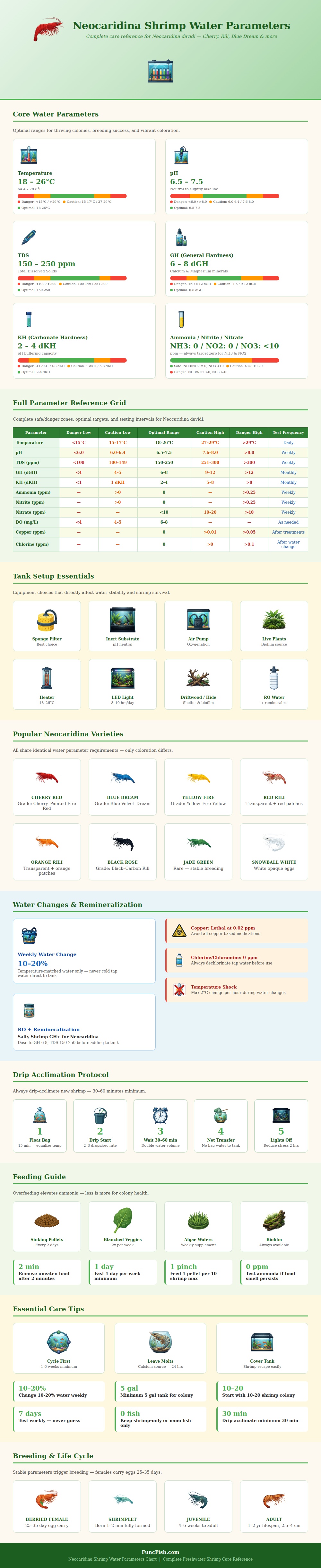
And it isn’t usually due to illness or aggression in the classic sense. It’s nearly always an issue with water chemistry that appears just dandy to naked eye but burns like hell under their gill covers. Though extremely hardy, Neocaridina species is also extremely sensitive to minuscule chemical composition of their surroundings. Getting it right isn’t so much science as it is habit. Below is a breakdown of those factors (see chart) that not only sustain life but allow these colonies to thrive.
The most glaring factor are temperature. And yet it’s also the most misinterpreted. People believe if they want tropical fish, they turn up heater. Wrong. The shrimp don’t like heat at all. Instead, they want cool, crisp water, similar than that found in shallow streams where they naturaly live throughout Southeast Asia. Anything less than 26 degrees Celsius will stimulate breeding and prevent stress. Push it above that number and metabolism increase, oxygen content decreases and the shrimp becomes lethargic. It is a simple give-and-take that could of save lives.
What’s important is not specific value on the test strip but rather how stable pH is. Any sudden shift (even by half a point) can shock colony into hiding and cause mass molting failure. That’s why the infographic shows a safe zone that leans toward being slightly more alkaline or neutral. This provides just enough buffering capacity for small swings without shocking the colony. Moderately high carbonate hardness mean the water isn’t some volatile chemistry experiment waiting to happen every time you change the water or feed fish. It is just enough to buffer out any slight fluctuation. It won’t be something you’ll see, until it’s gone… then your pH will drop like a rock, taking your shrimps with it.
Most newbie mistakes centers around mineral content. Most tap water don’t have enough magnesium and calcium ions for molting. Inadequate minerals cause exoskeleton softness, which in turn results in physical harm or infection to shrimp. To help keep things simple, the chart recommend maintaining GH in a relatively tight range that helps structural integrity but not too high as to become hard. Remineralizing filtered (or purified) water instead of using variable municipal supply provides an additional level of control over everything else.
There should be no toxic compound present. We have zero tolerance. There should never be detectable levels of ammonia or nitrites. They kills quickly…seconds, not days. While nitrates aren’t as immediately hazardous, they can still cause problems when allowed to build up over weeks. Prevention is always better than treatment so water changes are the easiest way to prevent this buildup. It is not very glamorous but it is necessary for health of colony.
Here’s where feeding discipline comes into play as well. Too much food leads to more waste, which causes a spike in ammonia. Cleaner water and fewer feedings lead to healthier shrimp. Such consistency leads to breeding success. As soon as females find themselves in the right ranges (i.e., optimal ranges found in reference grid), egg-carrying becomes commonplace.
These are not fast breeders; it takes time for the females to incubate their broods for three-plus weeks. The offspring hatch out full grown miniature versions of adult. They’re mature enough to graze on biofilm and driftwood immediately. With an abundance of live plants and places to hide, they settles down in the tank. They also find sanctuary. That’s all it takes to transform a regular tank into a self-sufficient environment.
The bottom line is this. Caring for Neocaridina shrimp comes down to restraint. They don’t require fancy equipment or pricy supplements. All they want is clean water, consistency, and basic knowledge of their requirements. Maintaining their health requires the same level of care that makes your tank look good. If you have some neon red juveniles skittering around in moss, you’ll know effort was worthwhile. Every drop of water tested is well-worth it because those little gems are precious.