
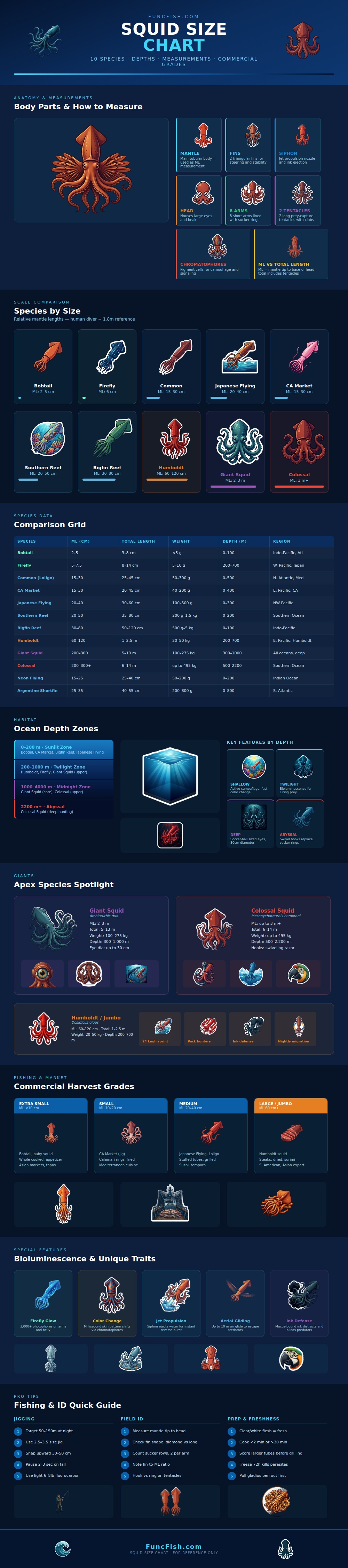
Squid are likely something you think of as one of two things: Either movie-monster kaiju or bite-size foodie appetizers. In truth, it’s a bit of both… And that’s where it gets complex quick, because size matter not only in terms of mass, but also diet, habitat, and swimming.
So when you peruse the chart above, take note of the spectrum, everything from leviathan mantle-bulges the length of your forearm, nearly matching small car, all the way down to the pocket-size bobtails. No wonder there are so many methods of cooking them. A two-centimeter squid will cook up in mere seconds; a sixty-centimeter mantle will require low and slow braising. Get it wrong, and texture will be like eating rubber band.
How Squid Size Changes Their Life and Taste
Most people assume squid are measured by their total length, how far it is from the tip of the longest tentacle to the tail. That’s what most folks think: drag out the measuring tape and do that. No, that’s not what the industry does. Why? Because mantles don’t change size, so that’s what we use. This is the edible center (that muscley tube) and main body (the “mantle”). Tentacles are all over the place in terms of length and stretching; they’re not good comparisons.
In the infographic, you’ll see where total length ends and mantle length begins, which is how a small squid can be quite long-armed. Nothing wrong with that, just a structural preference.
Light vs. Depth But why? The California market squid is a shallow water hunter. It needs to change color quickly to fool predators like sharks and to attract mating partner. It is also constantly out in the open where predator hide and sunlight shows everything.
On the other hand, deep-dwelling creatures deal with a different issue (in the twilight zone), light fades, so bioluminescence takes over. The glow of the firefly squid isn’t merely decorative; it attracts food while communicating in darkness. Down even deeper in the depths, the giant and colossal squids has evolved enormous eyes; the size of soccer balls, that allow them to detect the slightest silhouette against the light from above. Adaptation follows pressure, quite literal.
Commercial fishing reflects these biological realities. When people catch smaller fish, they’re used for fried calamari rings or other quick-cook appetizer; in order to keep tenderness, they require very short cooking time at high heat. When larger fish (e.g., Humboldt) is caught, they can be turned into surimi, dried products, and sometimes even steaks. The chart shows this clearly: culinary use depends on market size. Don’t purchase a giant frozen squid tube and attempt to sear it for half a minute, what’s going to happen? Break down that connective tissue first with care, either by scoring or longer cooking time, then throw it on the grill.
Beyond size alone, there are details that help distinguish species in the field. Examine the fins: Are they long or diamond-shaped? The shape of the fins points to a certain kind of water movement. Count the sucker rings on the arms. Most common species have two rows. Pay attention to length of the fins relative to the length of the mantle. This ratio shows you how the creature moves about in the water.
Some squid are designed for jet propulsion. Bursts of speed forward or backward, and others can launch themselves upward as much as ten meters above the water to escape predators. It’s an airborne escape that happens less often than you might think, but it is a true survival tactic.
It must be fresh. The fresher the better. White, clear flesh indicates a well-handled squid. Any cloudiness or browning means it is old and breaking down with bacteria. To kill parasites (which may be lurking in wild-caught squid) you can freeze it for three days but even then, better safe than sorry. Be sure to extract the gladius (the clear plastic-looking thing within the mantle), a very tough piece of connective tissue best not to bite on.
What makes a squid so interesting? It is a bit of both; it is part basic seafood and part advanced marine biology. They’re also survivors and they tell us something about how they live in the water, and where they get big enough to start calling themselves fish instead of invertebrates. So whether you catch them yourself or purchase them from the market, knowing how they’re made will make you more appreciative of what you’re consuming.
The next time you have a squid on your dinner plate, consider this. It is more than just food; it is a feat of engineering designed to stalk, hide, and survive in some of the world’s harshest waters. That’s the message. Every squid, from a tiny bobtail to the giant deep-sea squid, shows that elegant efficiency.