
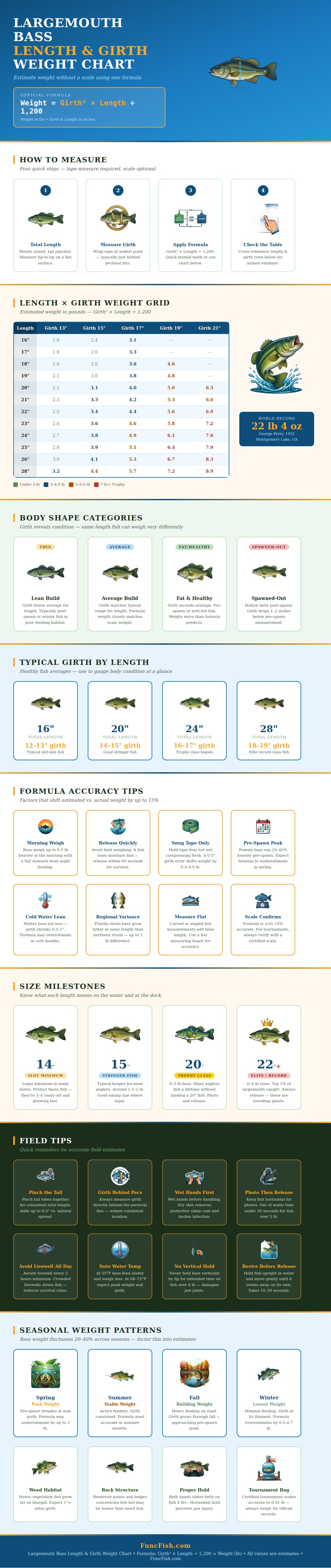
There’s something about getting a big bite that hooks itself in the water. Your line gets pulled tight, your heart starts pumping faster and suddenly every muscle in your arm want to quit. You battle the fish and land them. Then comes time to weigh her. Most guys keep their scales in the truck but man those things get lost and they’re a pain in the butt. Heck you might not even have one on hand anymore.
So being able to judge size by feel and look is something to become good at. This takes what would be a guess and makes it more of an educated guess. You like the fish but don’t need a number right away. It’s based off a very basic mathematical formula between girth and length.
How to Guess Fish Weight Without Scales
First, you take a measuring tape and measure your fish from the closed mouth to the tip of the tail. Next, you place a tape around the widest part of the fish. That part is typically right behind the pectoral fins. As the above infographic explains it, it’s easy to understand and should be done precisly. Even a slight mistake in one of the two measurements (length and girth) will throw your guess off.
For example, you may have pinched the tail wrong or maybe compressed the flesh too tight when taking the girth. If so, your overall guess will be way off base. So pay attention and do it correctly. It’s precis work.
With those two digits, the formula come into play. Square the girth, then multiply it by the length. Finally divide by 1,200. And there’s the poundage. It may sound like some complicated math to do but once you get it all laid out on paper or figured in your mind, it happens so fast.
So what does a twenty-inch bass weighing three pounds look like? That’s a healthy keeper for most fishermen, but keep in mind the conditions makes a huge difference in this calculation. The condition of fish can vary greatly different than habitat and time of year. An early spring pre-spawner has big egg loads which will increase her weight significantly, but won’t necessarily grow her length much at all.
The chart reflects typical averages, but mother nature likes to throw us curves where she’s either lean or fat. The second consideration is seasonal timing. A fish in the boat feels different seasonally. The winter fish tends to be thin and sluggish. Their girth has been reduced, so your formula may overstate its weight.
Females in the spring (particularly prior to spawn) have the potential to weigh 20-40% heavier than calculated; internals add mass. Summer is the most predictable time for weight because the fish are steady from feeding activity. Autumn is another spike, as they fill out with bluegill and shad reserves for the winter. Understanding biology enables you to tweak the mental model so the numbers align with what the fish feel like in your hands.
The other thing that affects accuracy beyond what many think is how you handle the fish. To maintain the fish’s slime coat, always wet your hands when handling a fish. It will protect it from disease and infection. Always hold the bass horizontal so as not to stress the jaw structure or organs in the fish. On bigger fish, don’t hold them vertically because this can stress their skull.
Lastly, keep the fish out of the water as short as possible (preferably less than 30 seconds on trophy sized fish). Why? This is for conservation reasons, but also because the rigidity and calmness of the fish will allow you to get an accurate and quick measurement before releasing it. The floppier the fish, the worse your data and lower the chance of survival.
The trophy aspect also matters. When we think of a trophy fish, it’s usually more than fourteen inches. Because they’re juvenile and growing like gangbusters, that’s considered a keeper for many areas. The real trophy category kicks in at twenty inches. That’s years of life and learning how to survive. The twenty-plus inch mark is the rarest of all sizes.
Those fish are among the top one percent of the largemouth population. They’ve lived through multiple anglers, weather events and predators. They’ve earned our respect, and they should of been immediately released. You get to measure yourself against nature and see how large your catch is. Capturing their dimensions gives you a sense of place in the ecosystem without keeping them from breeding.
But there’s something about estimating weight that ties you closer to the fish that a digital readout will never do. It teaches you about body shape, how heavy it feels, and the season. It makes you see a living creature, not just a number on a screen. It helps you observe the body shape, feel the density, and understand the season.
The next time you catch a bass, skip the scale the first time. Measure it out and figure it out. How close can you get? How good is your instinct? It makes the catch seem so much more earned. And that feels like an entirely different thing.