
Smallmouth bass living on a rocky bottom tend to be fished differently; they fight much harder and live longer then largemouth bass. So when you hook one, you might think it is heavier or lighter in net than what you’d expect given its size. Typically this has everything to do with seasonal factors, habitat quality and length. Understanding how length relate to weight will help you better understand the water you’re fishing and set realistic expectations for your catches.
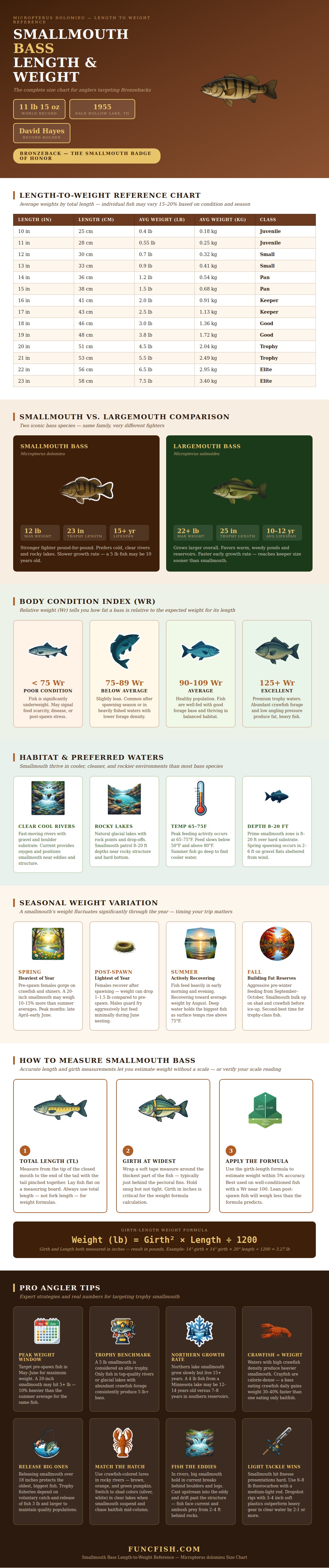
If you’re wondering how big a ten-to-twenty-three-inch smallie should of be, we’ve got that covered in chart above. It will show you the average weight for every inch from 10 to 23. So now you has some sort of guideline for what a healthy fish would weigh at that time. For instance, a fifteen-inch smallmouth averages about a pound and a half, which is often size people consider either releasing or keeping. Then as they becomes even longer, the weight doesn’t increase steadily but much faster. Just two extra inches can puts multiple pounds on the fish if the water will support it.
How Length Affects Smallmouth Bass Weight
Smallies have more cylindrical shaped body compared to largemouths, so they can retains more mass with each additional inch of length. That’s why a five-pound smallmouth feel heavier and larger than a five-pound largemouth. It is not necessarily due to volume but more so density.
The weight of smallmouth will vary greatly throughout the year depending on both feeding habits and the spawning cycle. Pre-spawn female smallmouths tend to be some of the heaviest of entire year. They gorge themselves on shiners and crawfish to build up energy stores in preparation for spawn. In fact a 20 inch bass may weigh 10 to 15 percent heavier in late spring (May and June) than it would in middle of the hot summer months. These fish are typically in poorest shape immediately following the spawn, recovering from their nesting duties. They won’t eat much, especially the males who protects their fry, and their condition will decline considerably. Early fall and early spring are prime times if you’re seeking fat trophies with energy levels cranked and plenty of forage available.
The second thing I noticed was how habitat play a huge role in how big a smallmouth can get. Smallies like cool, clear water, so they love glacial lakes where rocks abound and fast-moving rivers with gravel substrates. This environment tends to support a lot of energy-rich foods like crayfish. Feeding on craws every day makes a bass pack on pounds far quicker then one subsisting only on baitfish. And the numbers bear out: Lakes with prolific craw populations yield bigger smallies, in fact, those four pounders up north can be a dozen or more years old. Part of the allure is that snail-slow growth spurt. It leaves the fish plenty of time to grow up to possess solid bone structure and strong bodies.
If you want to check this for yourself, simply learn to accurately measure your catches. Using a standard formula, you can calculate estimated weight based off total length and girth (at its widest point). As long as you’re measuring correctly and taking the fishs condition into consideration, it’ll work. For example, a fish in good shape during the post-spawn will weigh more than the formula calculates, that’s where looking at the fish comes into play. Just because it fits on the ruler doesn’t mean much. Look at how thick the belly is instead.
Fishing for smallmouth bass is all about honoring their spunkiness and long lives. Letting go of big ones allows us to preserve quality populations and give other anglers the chance to enjoy the excitement of battling them in years ahead. Pay attention to structure and water temps. Downsize your tackle to match the light presentations these picky fish require. Before long, you’ll have more than you bargained for hanging from the end of your line. It’s worth the wait, as the payoff is sweet.