
When you get that bite you’ve been looking for, feel weight of your line tighten. Then the fish pulls down and forward into three feet of hydrilla before you’re able to set hook. The fish bit like a freight train. He saw bait perfectly, and your presentation was spot on. But then what?
You had the wrong weight for the cover. Maybe it was too heavy so he could pull down into the mat or maybe it’s too light so the bait doesn’t have a naturaly fall in the clear water. That one variable can be what decides whether you just lose the fish or drag him out of his comfort zone.
How to Choose the Right Weight for Fishing
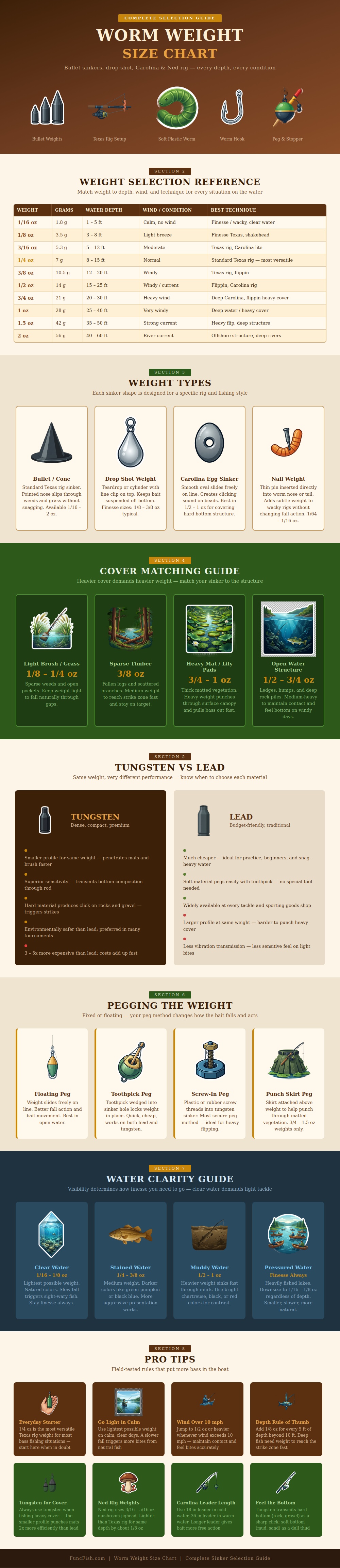
You’ll notice on the chart (above) that the wind conditions and corresponding depth is directly related to sinker size. So how do we make a smart choice about our tackle boxes? When the water is clean and calm, go light because you’re triggering some sight fish with natural fall. As the structure increases or the wind picks up, increase the sizes in increments while still keeping bottom contact. This isn’t necessarily about hitting the bottom but more about feeling what happens once you do.
Tungsten gets its higher cost because it transmits vibration better. Lead works just fine if you’re new and need to learn the ropes or if you want something cheap for open water. However, tungsten’s density mean it does a much better job at sending those vibrations back to your hand. A vague bump becomes a distinct click that let you know you’ve felt either soft mud or hard rock. With your rod tip, you can begin painting a picture of what the bottom look like. Basically, you can tell where they’re positioned without having seen the fish.
Not only is it harder and less likely to deform upon contact with an object but it also keeps your rig dependable throughout entire day. But even there most anglers fail to consider their options when selecting how to hold all of this together. For example, a floating peg will cause bait to drop freely with an inviting wobble. In open water this is beautiful. Natural motion attract predators.
If however, you’re punching thick lily pads or flipping heavy timber, you’ll want something fixed. Toothpicks and screw-in pegs keeps that weight glued to the hook. This lets you muscle the bait over obstacles where a snag would of otherwise strip the rest of your presentation. It turns a delicate finesse approach into a heavy-duty extraction tool.
The second part of the decision matrix has to do with water clarity. Fish becomes much more visual and wary in clear water. So they pick apart anything that looks or feels unnatural. Downsizing is not optional here, it’s a must if you want to draw bites. Conversely, you can afford to go big and bold when the water becomes heavily stained with either algae or silting. Because fish are feeding more by feel than by sight, they won’t be so discerning about detail. Instead, you’ll be able to use silhouette and vibration.
This is what most folks do wrong. Taking a one-size-fits-all approach by picking up one weight size in each scenario is typical for most beginner fisherman. Quarter ounce bullet sinkers work reasonably well… until they don’t. That quarter ounce sinker won’t cut it once the wind picks up. The versatility chart shows why it’s important to have options. A light breeze might call for an eighth ounce to keep sensitivity high. But when the wind picks up, now you’re looking at half an ounce or better just to get bait where it needs to go and keep it there.
Adapting your gear to the environment respect the fish you’re pursuing. The point is, presenting this worm as if it’s an easy meal to eat is what ultimately matters to the bass. It doesn’t matter if you’re punching heavy cover with tungsten weights or fishing finesse in clear water with a lightweight rig. The weight is simply there to deliver the package everything else is secondary if done properly. You are no longer struggling against the elements but instead working with them. As such, each cast isn’t a shot in the dark hope, it’s a planned opportunity.