
Unlike snook and red drum, which is aggressive predators, sheepshead are human-like toothed steady browsers. They can bites a barnacle of a piling and leave no ripple on your tip. Once you get there rhythm, they’re fun to catch. Approach them as you would any other saltwater species, however, and it’s infuriating.
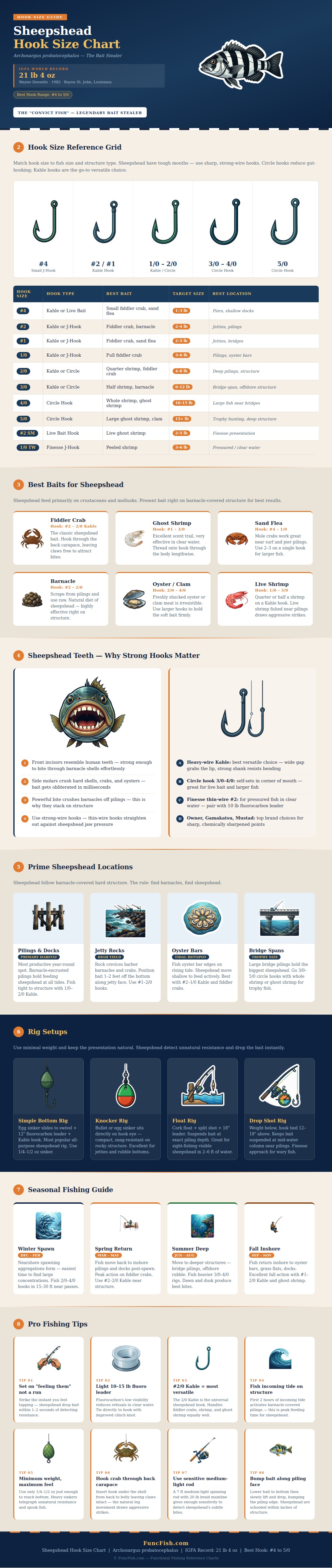
When fishing for these crustacean munchers, key is knowing that hook size matter more then rod power. Ever dropped bait to the pilings and felt a gentle tug followed by nothing but empty line? That’s what sheepshead experience is all about in its purest form. Here is a chart that maps out your targets and hook range to help you get the right hook range on your hooks for the targets (see above). So you don’t have to guess when heat is on.
Choosing the Right Hooks and Bait for Sheepshead
The most popular hook for starting is somewhere around a 1/0 or #2 Kahle. They’re strong and subtle enough to give you a good chance at hooking up, but still small enough that they don’t throw the fish off. That’s a good hook for handling both ghost shrimp and fiddler crab alike. But if you’re around some more pressured, smaller fish like maybe around some shallow docks, then going down a size or two to something like a 4/0 or even a 1 hook can mean the difference between getting bit or not.
On the other end of the spectrum, if you’re targeting trophies beneath big bridge spans, you want to go up to something like a 3/0 or even a 4/0 circle hook. This way, you’ll have the ability to hook and land these big sheepsheads while keeping them away from any structure.
You can’t compromise on strong wire construction. The side teeth of sheepshead is like molars, specifically made to crush hard shell prey. They don’t need much time to bend or snap your thin-wire hook. For a solid hookup and resistance against their crushing jaw power, I likes a heavy-wire Kahle with its wider gap that firmly grabs onto the lip. On live bait rigging, circle hooks work well too as they have a tendency to set themselves in the corner of the mouth. That means fewer gut-hooked fish and an easier release if you decide not to keep them. The visual guide highlights how the sizes move from smaller J-hooks for tricking fish to bigger circle hooks when you’re really hammering them around heavy structure.
How to present your bait How you present the bait depends on where you throw it. Oyster beds and barnacle-covered hard structure are where these fish like to hang out, and they are creatures of habit. There’s no need for fancy presentations. Just a plain old bottom rig with a sliding egg sinker will get ’em to pick up the bait and not feel naturaly resistant. Too heavy and they’ll feel the tension and drop the bait right away. Most of it is just a mind game. You want the presentation to be as natural looking as possible. Think of it more like the bait simply falling down from overhead versus being pulled along by some guy. This is the gear used.
When and where you fish is also extremely important. The incoming tide starts their feeding as it forces food into the structure area. Early mornings and evenings, particularly in the hot summer months, offer some of your best opportunities. They also cluster closer to shore for spawning in winter making them slightly more spooky but generally easier to find. Here a fluorocarbon leader can come into play as its almost undetectable in clean water.
So in conclusion, sheepshead fishing isn’t necessarily a battle of the beasts so much as it is an exercise in detecting the slight tickle along your line. When you feel something tap at your bait, set the hook immediately. Stick with bait that resembles what they eat. Use smaller hooks like a #4 or size 1 if you’re around shallow docks, but match your hook size to the situation. Remember their smarts and their tendencies and you’ll do better than just brute force could of accomplish. Stay sharp with your hooks. Keep your presentation careful. And don’t forget that patience goes a long way, especially when you aren’t expecting it.