
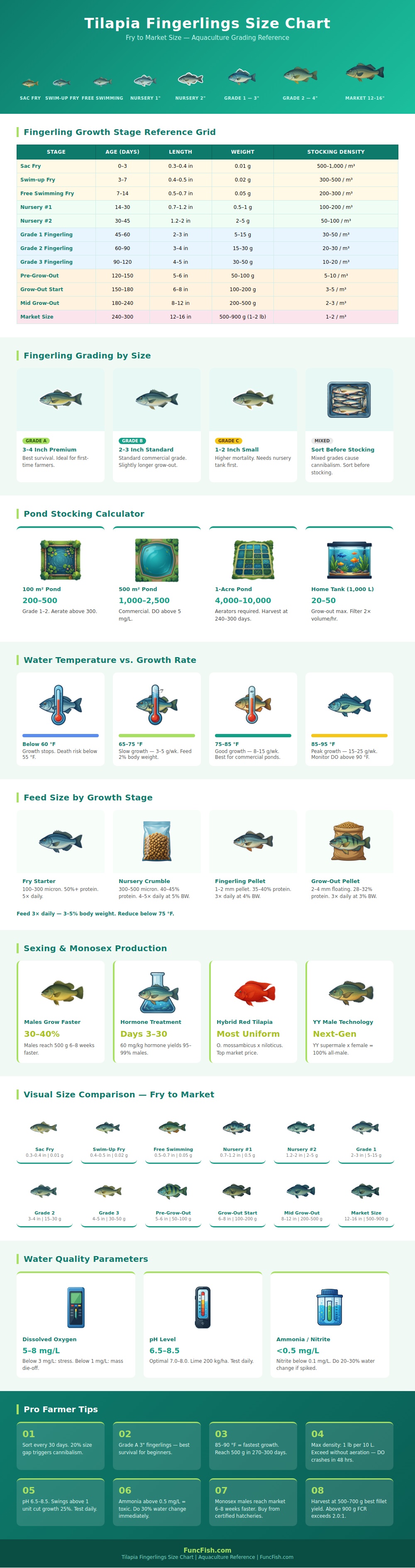
Tilapia fingerlings are the same size fishs in a bucket, but they has different outcomes in your pond. They will either stall or thrive. Why? It’s usually about knowing where those fish is in their life cycle before they enter your pond. This chart maps out age/stocking density versus specific growth stage so you don’t treat all small fish as the same commodity. Knowing exactly how many millimeters isn’t as important as knowing the stage, which tells you what the fish need to survive transition from hatchery to your system.
Swim-up fry rely solely on their yolk, while sac fry begin to hunt but remain very vulnerable; both need high quality starter feed and heavy protection from predators. To stock them, you would of a dedicated nursery set up with strict control of water quality. Once the fish move into free swimming phase, dynamics change again, the fish are actively feeding and size variation become extremely important. Because fish are small enough, a big difference in length mean one will eat another for protein. This results in cannibalism. Grading is non negotiable at this point.
How to Raise Healthy Tilapia
As the fish grow, density must also decline based off rapid increases in their space and oxygen needs. Ten thousand fry can be crowded in a tank. If you do that with fingerlings, it causes stress and stunts growth.
This leads many novices into their first mistake: They buy the lowest-grade available… Reasoning they save money at the front end. But you get what you pay for. Grade C fingerlings are tiny and not developed enough to survive in open pond conditions as well as more developed ones. This means they need more nursery time, which mean longer exposure to risk, until they are ready.
Grade A fingerlings are usualy three to four inches in length. This means they skip the most risky weeks of development and have a higher survival rate, which lead to a quicker payout. So you pay more at the start for them, but you get less exposure to risk and more of a yield on your dollar over time. Capital vs. Yield. Based off the data, if you’re new to farming, you might want to pay for the bigger, badder ones. They’ll be an insurance policy against losing half your inventory during the acclimation process to something like disease or other shock.
This timeline is very temperature dependent. Tilapia are tropical fish and will mostly shut down below sixty degrees fahrenheit. So, if you live in a cooler climate, you’re at the mercy of a biological clock that stops ticking when the heat shuts off. Between seventy-five and eighty-five degrees is considered optimal for quick commercial growth; the metabolism runs high enough to convert feed into muscle efficiently. You may achieve maximum growth rates at higher temperatures (i.e., ninety degrees), but you’ll need to pay close attention to dissolved oxygen as warm water hold less air.
Finding this balance creates consistency. Just as important as the other water quality parameters is such things as ammonia and pH. Any ammonia spike over one-half a milligram per liter is toxic, requiring immediate partial water changes to prevent mass die-offs. A pH swing greater than one unit within 24 hours will also cause extra stress for fish, reducing their growth rate by a quarter and their appetite to match. The only way to catch these invisible threats before they turn into visible disasters is with daily testing, it’s good practice, but more importantly the only way to do it. Monitor your system and feed according to actual conditions, not guesswork.
Data also aids with harvest time. To get the best feed conversion, you want your fish to be between five hundred and seven hundred grams. This provides the best fillet to feed ratio. If you push them past nine hundred grams, the benefits start to decrease as their feed conversion worsens as they age and becomes larger. They feed more pellets without gaining as much new meat. Your aim is to find that sweet spot between big enough for a nice fillet and not so big you’ve wasted energy on excess inefficient growth.
When you look at these phases it’s no longer guesswork, it’s aquaculture management. Temperature control, proper grading, rigid water quality, and knowing when to harvest become part of the system. You hope for the best less and control what you can observe more. Why would you put seed in the ground if you didn’t check the soil ph? Don’t put fish in a tank until you know their size and life stage. The map above shows you the path; day-to-day management handles the steps that will make it successful.