
We are moving away from trebles. Scientific studies have proven that moving from trebles to singles lead to about a 30-percent reduction in fish deaths, and this has become common practice throughout much of the country.
Why? Because it’s required, in certain states and all across Europe, there is laws dictating this change. Why do they do this? Because if you look at your old-style hook, you’ll notice it have three sets of barb. When an animal gets caught with a hook like this and released, those barbs greatly increase their chances of being severely injured. If a bass gets caught in the back of the mouth, say, with one of these hooks, there is a higher chance of deep hooking which increase stress and mortality.
Why Use Single Hooks Instead of Treble Hooks
But, if it only gets a single hook… And it live after release, it goes back into the water and can breed again. Treble hooks are complicated. And complication tends to mean trouble on the fish end. You now have three entry points into their mouth, increasing the likelihood that they will be hooked deeply instead of in the jaws where it’s easy to unhook. Deeper hooks takes longer to get out and every second out of water add stress to the fish’s body. Single hooks only give you one point of entry and if you position them correctly (usually at the corner of the mouth), they’re easier to unhook cleanly.
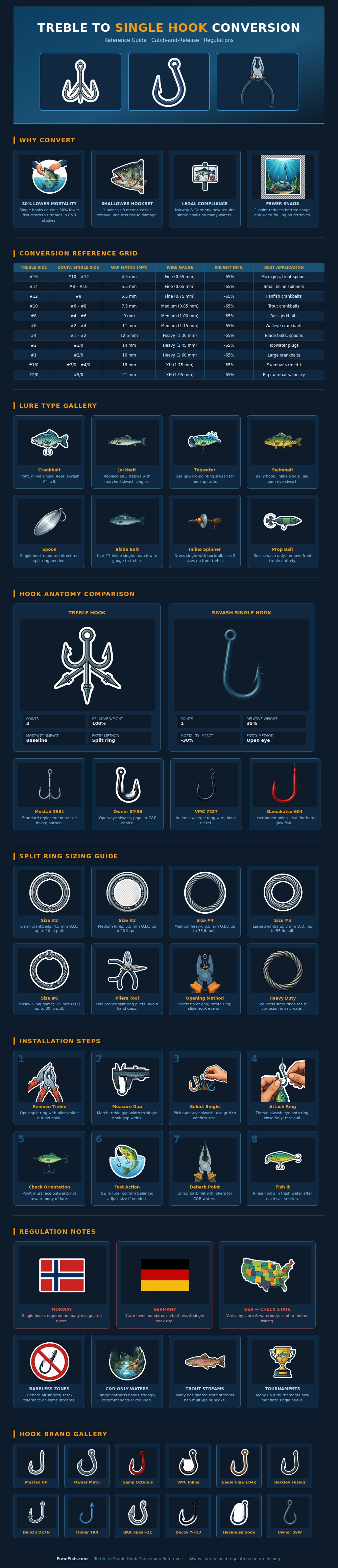
The following table outlines how to select a proper single hook size based off your original treble gap width to maintain good hookup ratio while getting the conservation benefits. The concern I hear from many guys about going single is they believe you’ll get a lot more misses on fish, but it’s really not as much of an issue after getting used to how they go back together. When swapping out a treble for a single, you typically want to go up two sizes. So if you’ve been using size eight trebles on a jerkbait for instance, then you’d probably be looking at size four or six single hooks. That gives you the wider opening necessary to stick a fish on a single hook versus three treble hooks. It removes some of the guessing so you can stock your tackle box comfortabley without having to do trial and error. It’s not like you’re taking away three hooks, you’re simply readjusting them to make ’em precise.
This changeover also comes at least partly due to regulatory efforts. Some countries, like Germany and Norway, has instituted mandatory single hook regulations on several bodies of water to safeguard sensitive fish species. And even without such prohibitions, state regulations and event sanctioning bodies is increasingly favoring barbless singles. As such, it’s wiser to get up-to-speed now rather than playing catch-up later when new regulations drop.
As the infograph explains, every artificial bait will work well with the right hookset. Each one, from swimbaits to inline spinners and beyond, has a specific use. And the installation isn’t as bad as one would think with the right tools. And there’s no getting around the fact that split rings are a must here. Then proper pliers for installing the hook will help prevent the annoying gaps. These gaps can happen if you try to stretch them apart with your fingers. It’s also important, according to the install, to make sure you match the size of the split ring to how strong of a lure you need it to hold up to. But do not make it much bigger than necessary so the connection doesn’t add any more bulk than necessary.
After installation it’s best to take the lure out and see how it swims in a tub or bucket. Taking two hooks off affect the balance just a little bit, and you may have to adjust a hair or two. However, it makes all the difference for a more naturaly presentation. At its core though, this conversion is all about respecting the resource we hope to enjoy. It changes the encounter from a chaotic mess into a controlled interaction that leaves both sides alive, and mostly intact.
Most anglers also like having fewer snags in cover and on structure over the course of a day’s fishing. Less tackle loss means more time on the water and less frustration. Follow the conversion principles above, and you’ll continue catching fish at the same level but your fish’s survival chances will skyrocket each time you do. A little tinkering in your box of tackle will bring big rewards for the environment.
You should of still get the picture. Still get the fight. But now it’s a happy ending when you let ‘em go because they’re still alive.