
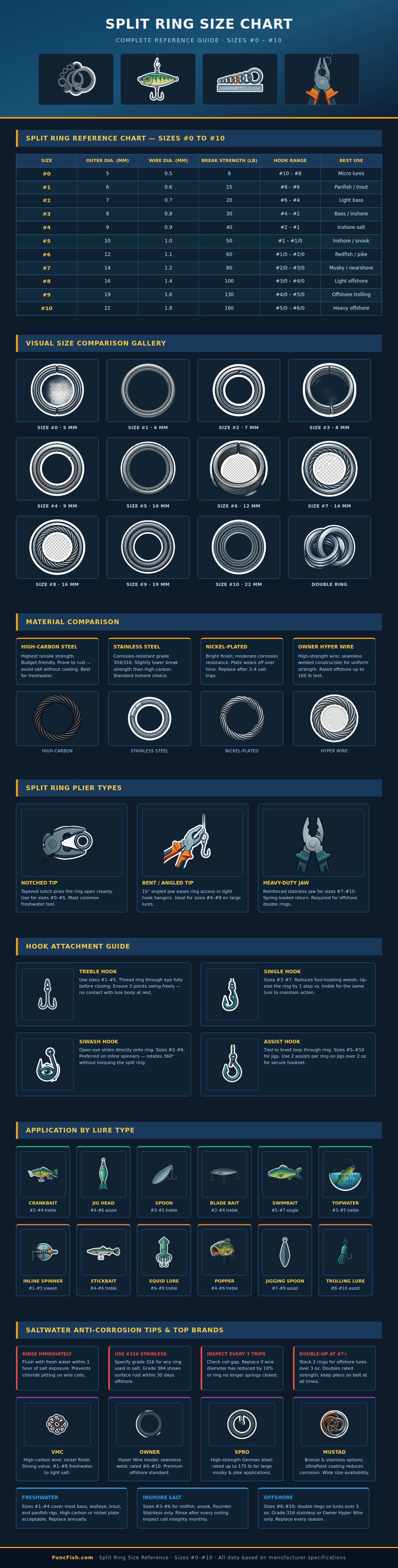
The split ring act as pivot point for rigging your bait, allowing it to swim freely while remaining strong enough to hold up during a fish fight. It can become frustrating when choosing a ring that is too big or too small, because the hook attaches directly to the body of your lure. Too small and it inhibits its action and too big and it gets snagged on anything in front of it in the water. Choosing the wrong sized rings mean you’re not going to be effective until it leaves your hand.
Here’s the chart of size-to-strength: as you move from micro to heavy offshore rings, their outer diameter and thickness grow proportionally. While you don’t have to remember each millimeter, you should know that bigger means stronger. For instance, a 0-sized ring is tiny, perfect for small lures balanced for tiny panfish food. Each ring size get thicker, able to take more weight.
How to Choose the Right Split Ring
Try to pair that with the appropriate line class, not necessarily the size of your lure. When you put a big ring on light line it’s now a weak link where the hardware join the line, rather than down the length of your line.
The second most critical factor to consider is almost as much the material from which the hook is made then the size number on the package. For freshwater bass fishing, you can get away with using high carbon steel since it’s inexpensive and has a lot of tensile strength. Rust is not as big a deal. But if you’re fishing in salt water, uncoated carbon steel will rapidly become corroded and brittle after just a couple of trips.
The go-to option for saltwater fishing is stainless steel because it doesn’t pit or corrode against chlorides. Nickel plated hooks appear to be less expensive at first glance. However, they will lose their nickel coating after a few days of salt water, and the exposed steel will begin to rust.
Split rings must be opened carefuly and with specialized tools. Needle-nose pliers won’t provide enough force on larger rings and will bend the wire out of shape and make it impossible to close. Split ring pliers feature notched tips that grab the ring’s edges cleanly. Trout rings is small and forgiving. However, offshore trolling and musky rigs calls for beefier rings that are best held in reinforced pliers jaws.
Generic pliers force a big ring open causing the wire to kink, reducing break strength to half. The proper tool keeps connections from coming apart mid-fight.
Ring size depends on the hook Small rings work well for trebles on crankbaits to align the hook properly with the lure body. Big rings can cause drag as a treble hook will swing out of position. Swimbaits single hooks does well with a little bigger ring to minimize weed hang ups. Double rings on heavy jigheads offer a backup in the event one fails under a sudden pull. This minimizes risk where it counts.
Before pulling away from the dock make sure you inspect each one so you don’t lose any. The metal may be strong but if there’s a gap in the coil that doesn’t snap closed tight it’ll open up when they pull on it. All of your equipment should of rinsed off with fresh water immediately following a day on the water using saltwater to avoid developing any rust on the surfaces. That alone keeps your tackle going much longer.
Paying attention to this helps your bait swim straight and keeps fish hooked on the line more easyly. When you get these things correct it can turn into a more succesful outing.